
Group Travel Frequently Asked Questions

These are frequently asked questions about the Camino de Santiago. This blog post addresses common inquiries regarding preparation for the walk and specific questions for those traveling with us. I have broken it down into four categories: Phones and Wifi, Money and Financial Concerns, Preparations and Daily Concerns, and Social Media. If you have a question not addressed in this blog, please reach out so we can add the question/answer.

Phones and Wi-Fi

  1. Will my phone work?
    1. The easy answer is yes! However, you need to decide what you do for coverage. Because of the cost, we don’t use our regular cell phone plan when we travel to Europe. Instead, we order a European SIM card from Orange right before we leave and activate it when we arrive in Spain. This is the link to their holiday plan. It’s an eSIM, so you can complete this online. Your phone has to be unlocked. Reach out to us if you have questions.
  2. Will there be cell service?
    1. Yes! You will be walking in populated areas with lots of cell coverage.
  3. Will there be wi-fi?
    1. Almost every bar, restaurant, and lodging will have wi-fi. I cannot guarantee it will be fast, but you will have phone access when needed.

Money and Financial Concerns

  1. How much should I budget for lunch and snacks?
    1. This depends greatly on how much you eat and if you are a drinker. Cocktails are a lot more expensive than wine. Water usually comes in a bottle unless you specifically ask for tap water (agua del grifo), but I cannot guarantee that will always work. If you budget 25-30€ daily, that should be plenty (unless you are a cocktail drinker, those can be 5-8€ each). Don’t forget money for souvenirs.
  2. How much cash should I have with me?
    1. You should always keep a small amount of cash, but not too much in case something happens and you lose your wallet. We recommend no more than €100 on hand time.
  3. Will there be ATMs along the way?
    1. You will find ATMs everywhere along the way, but those can have hefty fees if you don’t know what you are doing. Use a bank card that doesn’t have international fees or ATM fees. For cash, we use our Charles Schwab checking account debit card. Schwab does not charge ATM or international fees; they also reimburse you for any ATM fees the other bank charges.
    2. We strongly advise against using currency exchange locations! Although they are visible, they are expensive, and there are much better alternatives for accessing cash.
  4. Beyond the fee, what other expenses should I expect?
    1. The only expenses you should incur are meals throughout the day (second breakfast, lunch, snacks, cocktails), pharmacy needs, and souvenirs.
    2. Tips and gratuities from our group members are appreciated by our tour guides, drivers, and cooking class instructors..
  5. What happens if I can’t go on the trip?
    1. The $500 deposit is non-refundable. We will work on the rest with you. If your travel insurance is active when that decision is made, that is a great way to ensure we are still paid. At a minimum, we expect you to cover any expenses we will be out (museum tickets, etc).

Preparations, Daily Concerns, and Itineraries

  1. What is the schedule going to be like?
    1. We will start our day at about 7 a.m. Your walking will be done between 1-3 p.m. Then it’s time for washing clothes, grabbing a nap, and some self-reflection. We will have dinner at about 7 p.m. as a group. We will not only enjoy a meal but also reflect together. Lights out is about 10 p.m. so we can start again the next day.
  2. What if I have dietary restrictions?
    1. Please let us know ASAP so we can ensure you have breakfasts and dinners that meet your dietary needs. Please understand that a typical breakfast is coffee and a pastry.
  3. Should I have a guidebook with me?
    1. If you get lost, you should have a phone app with GPX tracks to help you find your way. Some people also like a guidebook. Here is an example of one we like to carry with us. Also, note that Google Maps will help you get back on a main road but not necessarily the trail.
  4. Do I need to know the local language?
    1. It’s helpful to have a basic understanding of the language. This will help you greet people properly and order food when you are hungry. Listening to podcasts like Coffee Break or working through lessons on Duolingo are very helpful.
  5. Will there be pharmacies?
    1. You will walk through multiple villages throughout the day, and pharmacies are everywhere. They will have everything you need, just like you would find in a CVS or Walgreens. 
  6. Will there be access to water on the trail? 
    1. Yes! There will be many places to grab water from fountains along the trail. It will be unfiltered water from a fountain. However, the fountains are used by locals and pilgrims alike, and we have not had any issues with them.
  7. Will we all walk together?
    1. Yes and no, that depends on the group. We will let the group decide what they are most comfortable with for the daily walks. We will not leave anyone alone unless they want to walk alone. We may start our day together and spread out throughout the day. Don’t stress – we are there to support you!

Social Media

  1. I want to be off-grid while on the trip; is that possible?
    1. Yes! Tell your friends to follow Cruisin’ with the Colemans on Facebook or Instagram. We will post photos and videos throughout the day on Facebook and Instagram. Additionally, we will be posting daily vlogs on YouTube during the trip. Your friends and family will have a lot to watch without bothering you! 
  2. How do I get the photos you took?
    1. We will share a drive with you containing photos and videos that you can download. They are yours forever! 

I hope this blog answers your questions. However, if it does not, please reach out. Leave a comment below so we can add your question to this post.

Thanks, Michelle & Brian

Preparing for a Hiking Vacation

When we think about vacations, we often imagine relaxation, sightseeing, and indulgence. However, when planning a hiking vacation, it’s essential to shift that mindset to one of preparation and training. Just as we wouldn’t head to an amusement park without some knowledge of the attractions, we shouldn’t embark on a hiking adventure without getting our bodies and minds ready for the journey ahead.

It’s amusing that no one “trains” for a vacation, even when they are headed to places like Disney World, where they’ll walk 6 to 10 miles a day, or Rome, Italy, where they may walk even further in a single day. We just don’t consider training for a traditional vacation. You know, because it’s a vacation; the place you go to relax and unwind.

But if we are planning a hiking vacation, we need to train. We must consider the gear we carry, what clothing to wear, and how to manage ourselves if a problem arises. When hiking, you might find yourself in the middle of nowhere. Do you have a plan? Do you have basic first aid knowledge? There are many considerations. I’m not addressing all of that today (maybe another day). Today, I’m focusing on training to be physically and emotionally prepared.

Understand the Terrain
First, get to know the trails you plan to hike. Research the elevation, terrain type, and estimated distance. Understanding what to expect will help you customize your training regimen. For example, hiking in the Rocky Mountains requires different training than trekking through the Appalachian foothills. A hiking trail like the Camino de Santiago is entirely different. On most routes of the Camino, there are villages every 3-4 miles, which provide a break, a snack, and a distraction that you won’t find on other trails.

“I love hiking, but I don’t love every minute of every hike.”

Building Physical Endurance
Any long-distance trek will challenge your physical abilities, and that shouldn’t scare you; it should excite you to push your limits. We often say, “I love hiking, but I don’t love every minute of every hike.” So why do we still love it even when we don’t enjoy every moment? Because during tough challenges on difficult days, things can be overwhelming; however, when you overcome something you once thought was impossible, the sense of achievement is incredibly rewarding.

  1. Start Walking. The best way to prepare for hiking is to start walking regularly. If you’re not already doing so, aim for at least 30 minutes of walking three to five times a week. Gradually increase the duration and intensity of your walks, aiming for longer distances over time. Set a manageable plan, one that feels attainable for you. This is not about being the fastest or best walker; it’s about improving what you can do today.
  2. Incorporate Hills. Explore local trails or spots with inclines. Walking uphill helps develop the leg strength and endurance necessary for hiking. Take your time on the hills; this isn’t a race. You’re only competing against yourself. If you don’t have hills where you live, then walk on a treadmill and slowly increase the incline.
  3. Cross-training. To boost overall fitness, consider exploring other forms of exercise. Activities such as cycling, swimming, or even strength training can improve your cardiovascular endurance and muscle strength, which are essential for navigating rugged trails. Yoga is excellent for enhancing flexibility, which your muscles will appreciate when they feel tired and tight after a long day of walking. We have a local yoga studio that offers a punch card for drop-ins, so you don’t need a membership.
  4. Practice with Gear. Don’t forget to train with the actual gear you plan to take on your trip. Get used to wearing your hiking boots or shoes, carrying your backpack, and using trekking poles. This way, you’ll break in your equipment and evaluate what adjustments might be necessary. Continue adding weight to your pack as you become comfortable, simulating the gear you’ll carry on your trip. Start with an empty pack, then add water, followed by a bit of clothing, and so on, until you have exactly what you will take on your trip. One thing we do to practice with our gear is add bags of rice to mimic gear and weight.

Mental Preparation
Hiking is not only a physical challenge but also a mental one. Some days, the trail can feel short and beautifully enjoyable, while other days may feel long and even tedious. To prepare yourself, set realistic expectations and establish mental goals for your hikes.

  1. Set Your Intention. Before I start walking, I like to set a daily intention: What do I want to think about today? What do I want to be thankful for today? What do I want to discuss with my partner or my higher power today? This intention helps me focus my mind when the day is long and gives my walk a greater purpose.
  2. Balance Your Mind. Include mindfulness or meditative practices in your training routine. Recognizing that hiking can sometimes be tough will help you stay calm and focused during challenging sections of the trail. While you’re on the trail, you’ll have plenty of time to lose yourself in your thoughts. Is that beneficial for you? Do you prefer music? Be ready for long periods of silence.
  3. Visualize Success. Spend time visualizing yourself completing your hike. Picture the stunning views, the sense of accomplishment at reaching the summit or the destination, and how to manage any physical challenges you might face. This practice can be a powerful motivator. 
  4. Learn Basic Navigation and Safety. Familiarize yourself with map reading and compass skills, or consider taking a wilderness first aid course. Being mentally prepared for emergencies boosts confidence and can make your hiking experience safer and more enjoyable.

Preparing for a hiking vacation is an investment in the great outdoors. It’s an investment in you—the health of your mind and body. By training both physically and mentally before you go, you’ll not only enhance your hiking experience but also ensure that you’re ready for any challenges that arise with confidence and resilience. Remember, it’s about enjoying the journey just as much as the destination. So lace up those hiking shoes, hit the trail right now, and let your adventure begin!

Have a question? Reach out to us! Make sure you subscribe to our newsletter so you know when new blog posts are published!

Do you like what you read today? Please give us a thumbs up, leave a comment, and share it with others!


What Do I Bring on Pilgrimage? Camino Packing List

It’s easy to overpack for a pilgrimage—believe me, I’ve learned from experience! On my first Camino, I carried way too much gear, and it was quite a burden, especially since I had to carry it all on my back. Fortunately, on our planned trips, you’ll have luggage service, so you won’t need to carry everything with you. Even with luggage service, this is not a trip of luxuries. We are on pilgrimage, so we are not carrying much “stuff” with us.

For the trips we lead on the Camino, each person is limited to one backpack or one small suitcase weighing no more than 15 kilograms or 33 pounds to manage the luggage for everyone. However, Brian and I take one suitcase (no more than 15 kilograms) between the two of us. We encourage everyone to pack light! Whether you have luggage service or not, having one backpack that weighs under 15 kilograms (the lighter, the better!) will help you, as it eases the burden of carrying your luggage day after day.

Our two backpacks from our 2019 Camino. This was everything we carried for 2 months in Europe

We believe in the principle of washing and wearing your clothes. What does this mean? It means you are either washing your clothes or wearing them. After hiking for the day, you should shower and wash your clothes. In the evening, you can wear hiking clothes for the next day. Any other clothes would be considered a luxury. You can have luxury items if you keep them in one backpack or suitcase under 15 kilograms (33 pounds). 

Ultimately, this is your trip. We will never tell you exactly what you “should” or “should not” take with you. This blog post offers suggestions and our perspective. Please feel free to use this information as you see fit.

This is our suggested packing list for any of our Camino trips.
Where there are differences between Brian and me, Michelle, we have identified them. These are just suggestions. You have to pack what you feel is best for you! Also, where we travel, you will be able to find what you need in local shops (band-aids, hiking poles, ibuprofen, etc)

  1. Toiletries: toothbrush, soap to wash clothes and body, shampoo, nail clippers, tweezers, comb, hair ties, etc. Some type of washcloth because they don’t use them as we do in the US. Here is the lightweight bag that I carry my toiletries.
  2. Sunscreen
  3. A bandana or something to wipe the sweat off your face. I use this towel as my sweat rag and my washcloth in the shower.
  4. Headlamp if you want to leave before sunrise to walk
  5. Clothesline: We use something like this, with safety pins to hold our clothes on the line
  6. A notebook or something like that for journaling
  7. Towel: When we take a group trip, the places we stay will provide towels. Some people like to have their own towels. This is Brian’s favorite towel, and this is my favorite towel. We carry a towel because sometimes we stay in places that don’t provide towels (outside of group experiences).
  8. European plug adaptor
  9. Portable backpack for evenings to get snacks or groceries or to take your laundry to the laundromat
  10. Sunglasses with UV protection
  11. Lightweight Sunglasses Case that clips on your pack.
  12. A hat: Here is what Brian likes to wear. I have worn my Nike hat but have no particular preferences.
  13. Merino wool lightweight socks are my favorite brand. I take two pairs, and I always have an extra pair in my daypack, so if my feet are sweating, I can change my socks. If your feet sweat a lot, I would suggest three pairs in case your socks don’t dry overnight.
  14. Some like sock liners to help prevent blisters. These are what I wear under my socks.
  15. Hiking shoes—this is quite a debatable conversation. Brian hikes in Chacos all day and wears Croc flip-flops in the evening. I hike in New Balance tennis shoes (a full size larger than my regular tennis shoes). I wear Chacos in the evenings and on shorter walking days. We have hiked for many years in other shoes, but this is what we have hiked in for more than three years. We can talk to you about all of the hiking shoe options, but it’s a decision you have to make.
  16. Some like a sun umbrella when they are hiking in the summer. This is our favorite brand because it’s super lightweight
  17. Lightweight underwear that fits well and has no lace that can rub and irritate the skin and will dry quickly—no cotton underwear! You just need two pairs—remember you are washing and wearing. These are the underwear that Brian wears, and this is the underwear I wear. We don’t buy expensive underwear; we just ensure it’s not cotton!
  18. Bras—ladies, that is up to you! Wear a sports bra during the day and a regular one at night; you decide. I can help if you need ideas. I hate sports bras. I have to pull them over my head because that is hard to do when you are hot and sweaty, so I love this sports bra.
  19. Lightweight jacket for cool evenings or early mornings. Remember, no cotton; this is the brand I prefer to wear.
  20. Rain jacket: You can make this your lightweight jacket if you want to save space. We love Marmot jackets
  21. T-shirts: Brian loves button-down shirts, and I prefer t-shirts. Either way, just make sure you are comfortable. Avoid wearing anything tight; you don’t want to feel self-conscious! Some people like tank tops. The problem with tank tops for hiking is (1) the rubbing from your daypack strap and your bare skin can become uncomfortable, and (2) many churches frown on those who don’t have their shoulders covered. You must have your shoulders covered in Italy to go into a church.
  22. Shawl: Some people like to have a nice shawl with them for cooler nights as a wrap or for churches.
  23. Pants: Brian likes zip-off pants (no more than two pairs). I like skorts and shorts
  24. Sleepwear: Brian sleeps in his underwear. I sleep in my evening dress or t-shirt and underwear. People on the Camino are not modest.
  25. Sleep liner: We travel on Camino in the summer; therefore, a light sleep liner is all we need when sheets are not provided. Sheets will be provided for our group travel experiences. Every albergue we have stayed at has blankets available. However, if you stay somewhere where sheets are not provided, this is our sleep liner.
  26. A swimsuit if you think you might be able to find a place with a swimming pool (on our trips, we always try to find a pool!)
  27. A swim cap. In Europe, people are required to wear a swim cap in most public pools (we have been required to purchase swim caps in some hotels but not all hotels). Brian loves this one because it’s comfortable. I love this one because it has room for all of my hair. It’s not waterproof, but it is comfortable, and that’s what I like about it.
  28. A fly swatter, you will thank me if it’s fly season!
  29. A sink stopper to wash your clothes in the sink. You would be shocked at how many people take or don’t provide a sink stopper.
  30. Some sort of stain remover pen. If you truly have a limited number of clothes, a stain-removing pen will be a blessing, so you don’t have to live with a stained item.
  31. Arnica Montana homeopathic medicine. Pills you put under your tongue that melt in your mouth. These pills help with muscle stiffness, cramping, bruising, and swelling. You can take these up to three times a day.
  32. Anti-chafing cream is a good thing to have if you have parts that rub. Haha!
  33. We always take a bit of Advil and muscle relaxers (non-drowsy script from the doctor).

In your daypack – If you are not carrying a backpack but rather a suitcase and daypacks, this is the daypack I use and the daypack Brian uses. You can carry something smaller, whatever you are most comfortable using. But ensure you have a way to cover your backpack if it rains. You should have the following at a minimum in your pack:

  1. Water bottles, a water bladder, or both. We both like carrying a water bladder to drink from while hiking. We also like a water bottle to make a drink with electrolytes or a flavored drink. Water bladders should only contain water to prevent mold or bacteria from forming.
  2. Water bladder cleaning tab. For a trip that is two weeks or less, you just need one tab to clean your bladder halfway through your trip
  3. Electrolytes. If you are feeling dehydrated, overheated, weak, or sluggish, drinking electrolytes will help. I love this brand of Salt Sticks for quick relief, and this brand for putting in my water bottle.
  4. Snacks. We find snacks in a local grocery store and only buy what we may want for the next day. This can be fruit, trail mix, chips, etc. Whatever makes you happy
  5. You should bring a few toiletries, such as tissues, toilet paper (yes, some places will have toilets without paper!), and maybe ibuprofen.
  6. You could also consider a small notebook if you like to journal with pen and paper or give your number to someone you meet along the way.
  7. Your cell phone charger, if you think you will need it during the day
  8. Your pilgrim shell should be attached to your daypack, as this identifies you as a pilgrim to other people
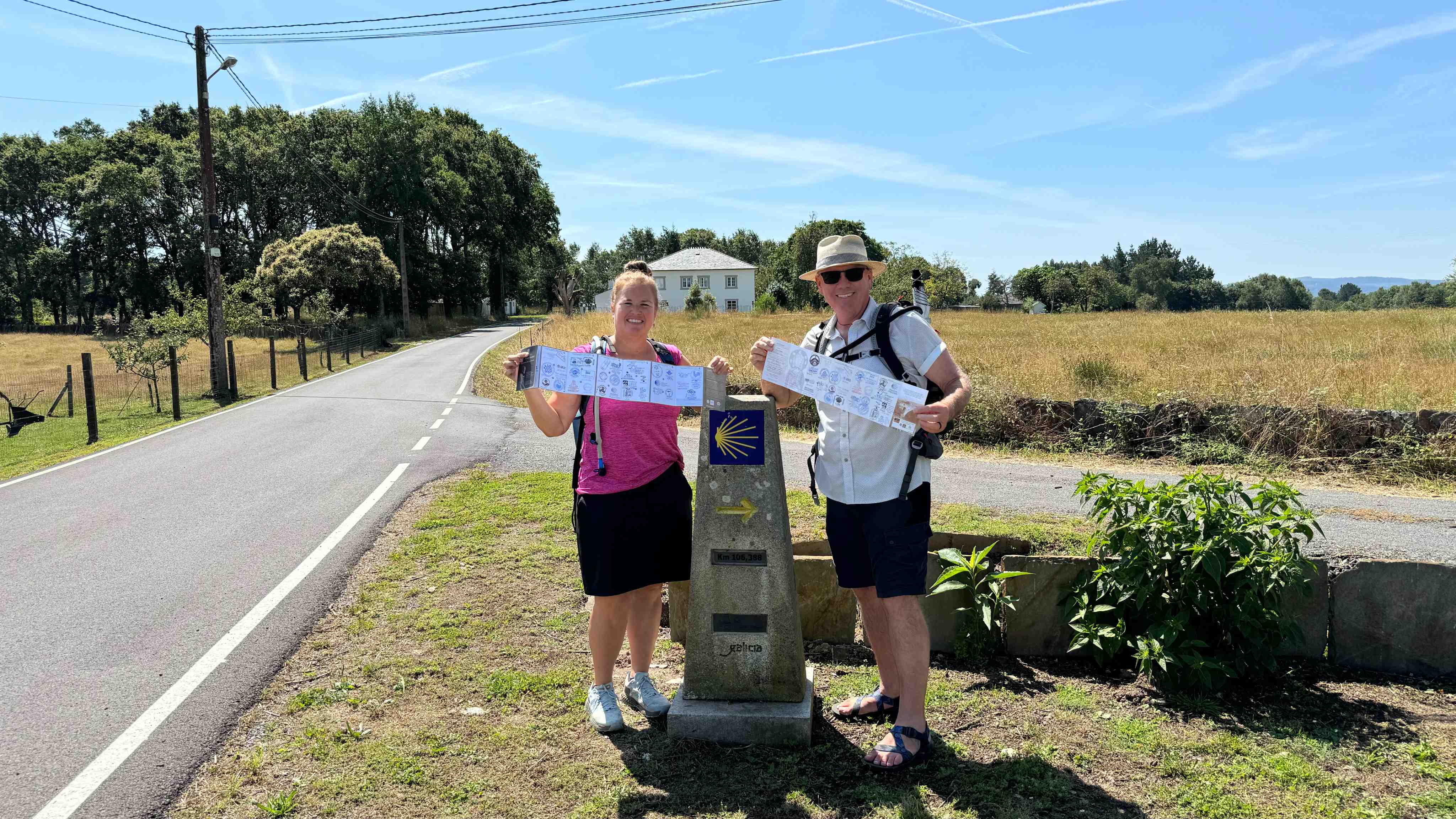
  9. Bring a fanny pack with your essentials. This includes your pilgrim’s passport (also called a credential), your US passport, and money for the day.
  10. A hat or a sun umbrella
  11. Some sort of stain remover pen. If you truly have a limited number of clothes, a stain-removing pen will be a blessing, so you don’t have to live with a stained item. Have one in your suitcase and one in your daypack unless you are using just a backpack.

AirTags: Be sure to place AirTags in everything from your suitcase to your daypack and even your fanny pack. It might seem like overkill, but you never know when you might misplace something, and you’ll be glad you have your AirTags!

You will find plenty of ATMs along the way. We carry a Charles Schwab card for our ATM transactions. CS reimburses your ATM charges, and there are no upcharges.

What type of SIM card do I need for my phone? We used to use Orange eSIM cards when we traveled abroad; however, we currently have an international Verizon cell plan. Choosing a phone plan involves several considerations. Contact us if you have questions about phone plans and traveling abroad.

If we have forgotten to include something on the list or if you have any questions, please let us know.

Thanks for reading! – Michelle

★ 25 years guiding ★ 48 U.S. states ★ 10 countries ★ 3,000+ Camino miles