My Favorite Things: Eating on the Camino de Santiago

You may not know this about me but I love food. I mean that I REALLY love food. Any time we travel, I spend a decent amount of time looking for local specialties and the best places to eat. That does not mean that we spend a lot of money on food. Yes, sometimes we will go to a fancy restaurant and drop a couple of Benjamins for a really nice dinner but some of our favorite and most memorable meals have been at dives that don’t know who Zagat is. With that in mind, my first Monday morning post that isn’t a recipe of the week is going to cover my favorite subject… FOOD!

Some of the most frequently asked questions we hear about the Camino deal with food. Do you have to carry your food? What’s the food like? How expensive is food? What if I have dietary concerns? What if I’m a picky eater? I hope to answer all of those questions here and assure you that you will not starve while walking on the Camino de Santiago, no matter how picky or restrictive your diet is.

First off, Michelle and I both try to live a relatively healthy lifestyle. We like to eat fresh, non-processed food as much as possible. We try to avoid excess sugar, but we will eat an occasional dessert and we both share a love of wine and cocktails. Michelle must eat gluten-free because of her Hashimoto’s disease (an autoimmune thyroid disease).

Going into the Camino, we knew that we were not going to be worried about counting calories. While walking 13 plus miles per day in the extreme heat that we were going to be burning plenty of them. One day I did do my best guess at tracking calories because I was curious and came up with over 3000. That said, we came back from Spain at nearly the same weight that we left home. The challenge was adjusting to not eating as much food as we had been used to while on the Camino and we each gained weight upon our return.

Upon arriving in Madrid after a long overnight flight, we were both starving. Once we navigated the Madrid subway and made our way to the Atocha train station it was time to find some food. We had done a little research ahead of time and new that there was a counter service fast food place that had gluten-free breakfast items. After a little searching, Michelle had a chocolate croissant and egg and cheese sandwich and I had a taste of my first bocadillo (not gluten-free). Our first meal was a success

Chocolate croissant, egg and cheese sandwich (both gluten-free), and breakfast bocadillo (not gluten-free) at the Atocha train station.

Finding food on the Camino is rarely a problem. Most days pilgrims pass through several villages and there is almost always at least one bar or cafe, and usually, several options are within feet of the marked path. Many albergues offer a pilgrim’s meal at dinner time for a small additional charge (€5-10). Before talking about dinner though, let discuss meals in Spain and how that fits into the pilgrim’s schedule.

Our first pilgrim’s meal in St. Jean Pied-de-Port

Breakfast in Spain is usually the smallest meal of the day and rarely consists of much more than toast (tostada) with butter and jam, pastries, and cafe con leche (espresso with steamed milk). Michelle sometimes was able to get rice cakes but often had to make do with a little fruit or an egg. Among the pilgrims we know, this is called “first breakfast” and you’ve probably already guessed that means “second breakfast” can’t be far behind. First breakfast was onfton included in the price of lodging.

First breakfast at a bed and breakfast in SJPdP.
Gluten-free breakfast option, if you’re lucky

Once we got through the Pyrenees, Spain was getting record high temperatures and in order to beat the heat, we were often leaving our albergue before 6 am. As a result, we needed to purchase breakfast the night before since most places to eat didn’t open until 6:30 or 7:00 a.m. Our breakfast of choice became a snickers bar and Monster as we walked in the dark. Not the best choice, but it helped in a pinch and we have a few ideas to help us when we are back on the Camino this June 2019.

After walking 5-8 km, most mornings we would come to our first village of the day and usually would run into a group of pilgrims sitting outside a bar or cafe eating second breakfast. Choices of food would range from tortilla and bocadillo to a more traditional “American” breakfast of fried eggs and bacon. We often spent less than €10 for second breakfast with two Coke Zero.

Lunch in Spain can be tricky for Americans. Lunch is typically the largest meal of the day and is often eaten at home but for pilgrims, everything closes down around 2 p.m. and doesn’t reopen until after 5 p.m. for siesta. If you arrive at your final destination for the day during that time, you will often not be able to find food because EVERYTHING is closed. We would typically get a similar meal to our second breakfast or if we were lucky, some tapas. Often by this time of the day, we would enjoy some amazing Spanish wine or beer if we were within the last 5k of our walk. The price here was often about the same as second breakfast, around €10 including wine.

Once we were done for the day, it was time to check into our albergue, hand wash our laundry, shower, and take a little nap. We were usually pretty hungry at this point and would often get a snack. Our go-to became a bottle of wine and Doritos for €5-8. So our not-so-processed lifestyle had gone out the window, but when you’re hungry you’ll eat anything!

Wine is often less expensive than soda. We often saw 750 ml bottles in the mercado for less than €1

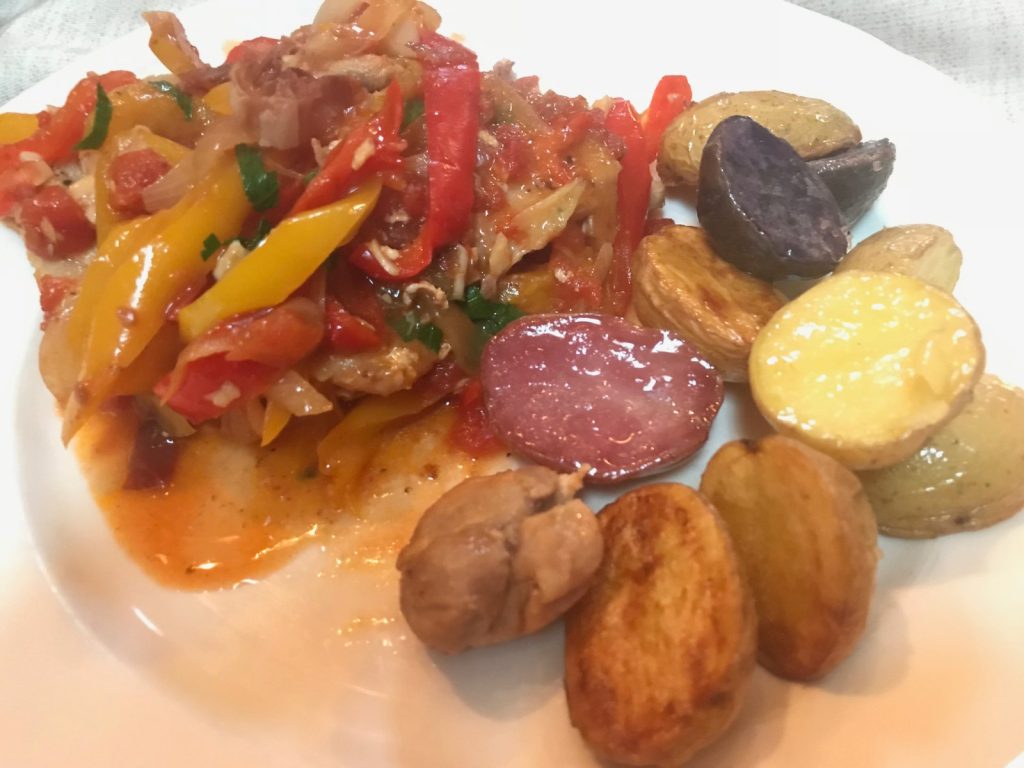
Dinner in Spain is often not served until 8 pm or later, long after most pilgrims have crashed into bed. Luckily, along the Camino, most villages work hard to serve the needs of pilgrims and dinner is available after 5 pm. When an albergue offers a communal meal it is usually at a set time and if you miss it, there’s no food for you. Fortunately, there is never a shortage of bars and restaurants to serve every food need for the average pilgrim. We ate a wide variety of regional and local specialties from ranging from €8 to much higher. The most economical dinner option is the pilgrim’s meal or menú del día. This dinner was usually three courses and included wine or bottled water (learn to ask for “agua del grifo” or tap water). The first course could be soup, salad, or even pasta. The second course was usually some kind of meat with fried potatoes. The final course would consist of dessert. I was always sure to ask for “especialidad de la casa” or the house special. I was able to try such unusual dishes as tuna ragu, garlic soup, home-made cheeses, and even chicken curry. We did spend a little more on dinner many nights with our total usually coming in at about €20-30 for two bringing our food total for the day to under €60 per day for two people. If you want to know more about our Camino budget, check out Michelle’s post here.

There are a couple of foods that I have to mention because they are too amazing to leave out. Once in Galicia, seafood is found nearly everywhere, is the freshest that I’ve every eaten, and very inexpensive by American standards

Many restaurants, bars, and even hotels will often serve wine or other alcoholic beverage that they make in house. Orujo, Patxaran, and Vermouth are popular regionally, make for a nice aperitif, and were served after dinner gratis in some places!

Sometimes you just need to eat something familiar and in larger cities, you may run across American fast food. We saw KFC, Burger King, McDonald’s but only stopped once because they had gluten-free buns!

We never cooked our own meals, but many pilgrims do. Markets, supermarkets, and even farmer’s markets are prevalent but be warned, in smaller villages most are closed during siesta and on Sundays. This is a great way to save money and get to know other pilgrims.

If you have special dietary concerns, most restaurants will work with you to accommodate our restrictions. Make sure you learn the names of your allergies in Spanish so you can communicate with the server. Vegetarians will probably have the greatest difficulty as Spaniards love their meat, but we did run across many vegetarians who said they were far from starving. Michelle did not have too many problems eating “sin gluten” and only got sick once during our entire time in Spain from cross contamination.

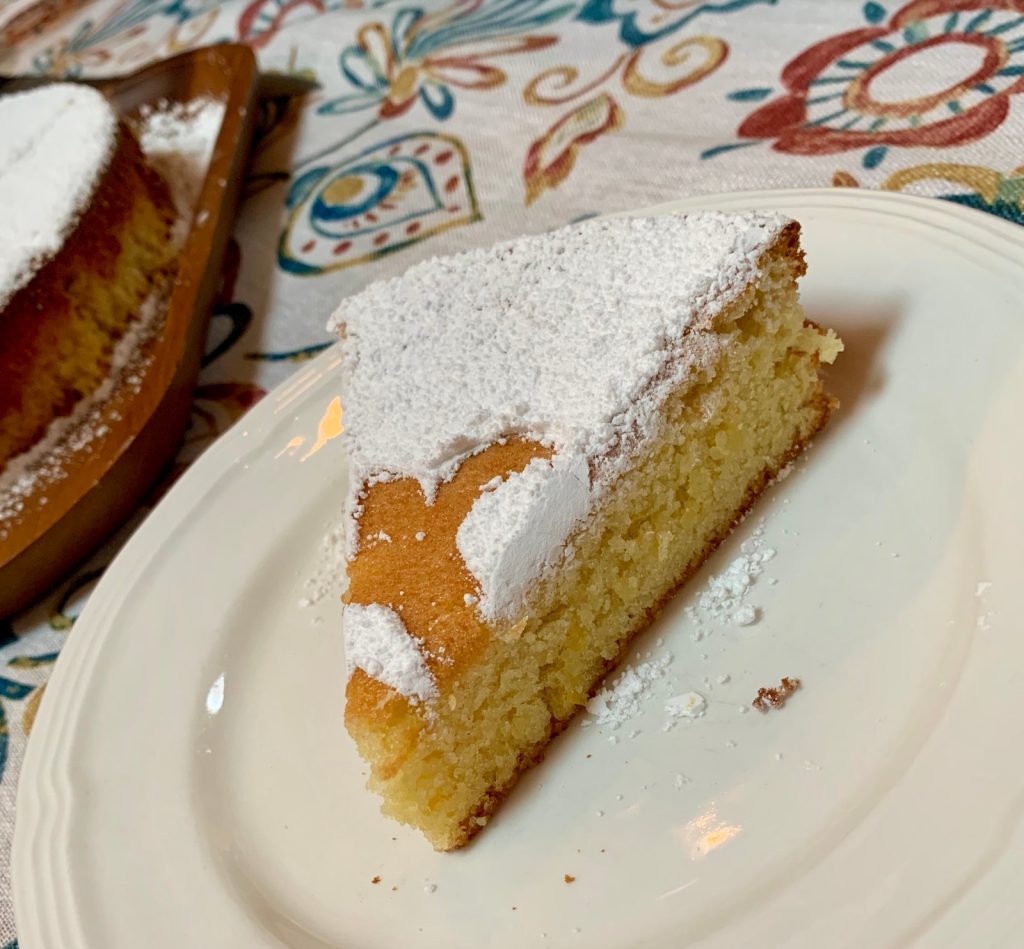
Tarta de Santiago is a staple of the Camino and this almond cake is naturally gluten-free when made properly. Often in bars it isn’t.

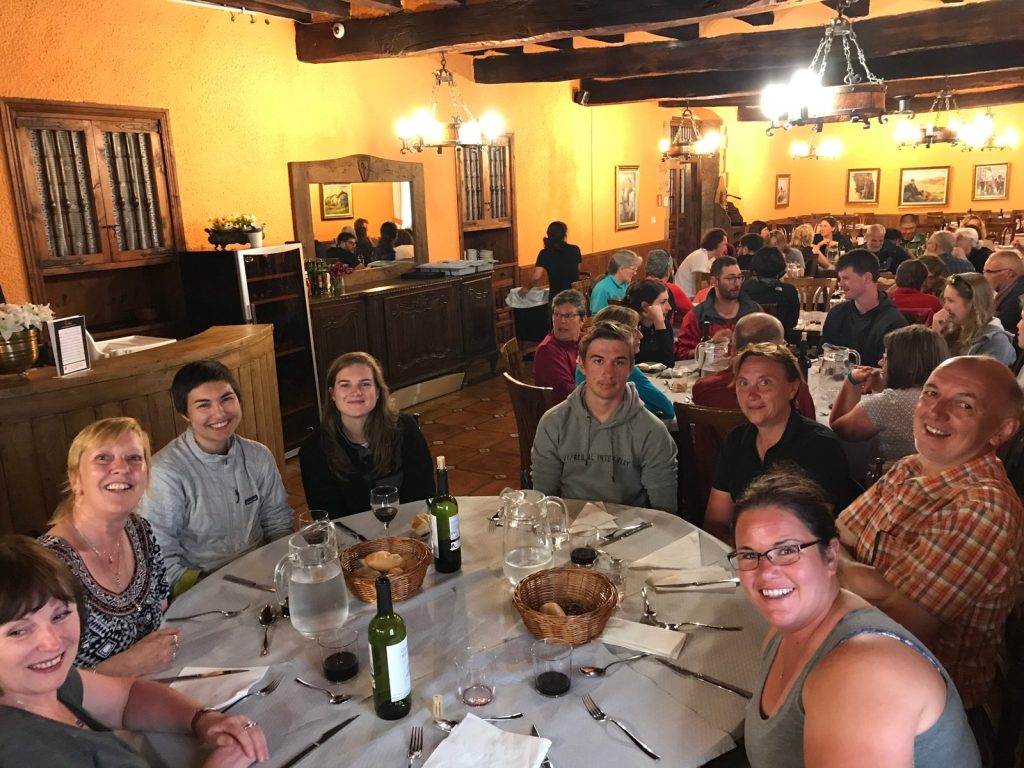
Never pass up an opportunity to eat a communal dinner, we met wonderful friends and had a great time, even when the food was only mediocre.

Communal dinner in Roncesvalles – the food wasn’t the best but the company was fantiastic

Finally, I can’t recommend enough to use common sense when eating in Spain, just as you would anywhere in the states. If an establishment looks dirty or seedy, don’t go in or leave. We never had any problems and NEVER felt unsafe while in Spain, but there were times we decided not to go into a bar or down a certain street because it didn’t look like our scene. Another thing to be wary of is looking for fresh food. We often didn’t go into places because they had a sign like this outside. All of the food pictured is premade, frozen food that is just reheated. Food is so inexpensive in Spain, why waste your time eating a frozen meal?

If you have additional questions about food or any other subjects on the Camino, let us know in the comments below. If you’ve been, what was your favorite meal?

Rock Bottom: Why I Almost Quit My Camino

When I look through the Facebook group, American Pilgrims on the Camino, I feel like I am the only one who wanted to quit. I know there are those who needed to quit because of physical problems, but somedays it feels like I am the only one who wanted to quit. Let me set it up for you.

Michelle on the Meseta after trying her first Tart de Santiago. She is all smiles.

We had been planning our Camino for about 6 years. We couldn’t contain our excitement the closer it got to our departure date. I, Michelle, am a Professor of Communication so the thought of interacting and engaging with people from all over the world filled me with joy. We are hikers with 10 years of hiking experience including quite a bit of long-distance day-hiking and some backpacking so we were looking forward to the physical elements of the walk. I was a bit anxious about the food because I have an auto-immune disease, can’t eat gluten, and I am a bit of a picky eater but hate to admit it. Though I tried to have an open mind and share Brian’s enthusiasm for embracing food culture, I quietly struggled with the thought of it. Though it took forever to get there, June 2017 arrived and we set off on the Camino filled with excitement and a small case of anxiety.

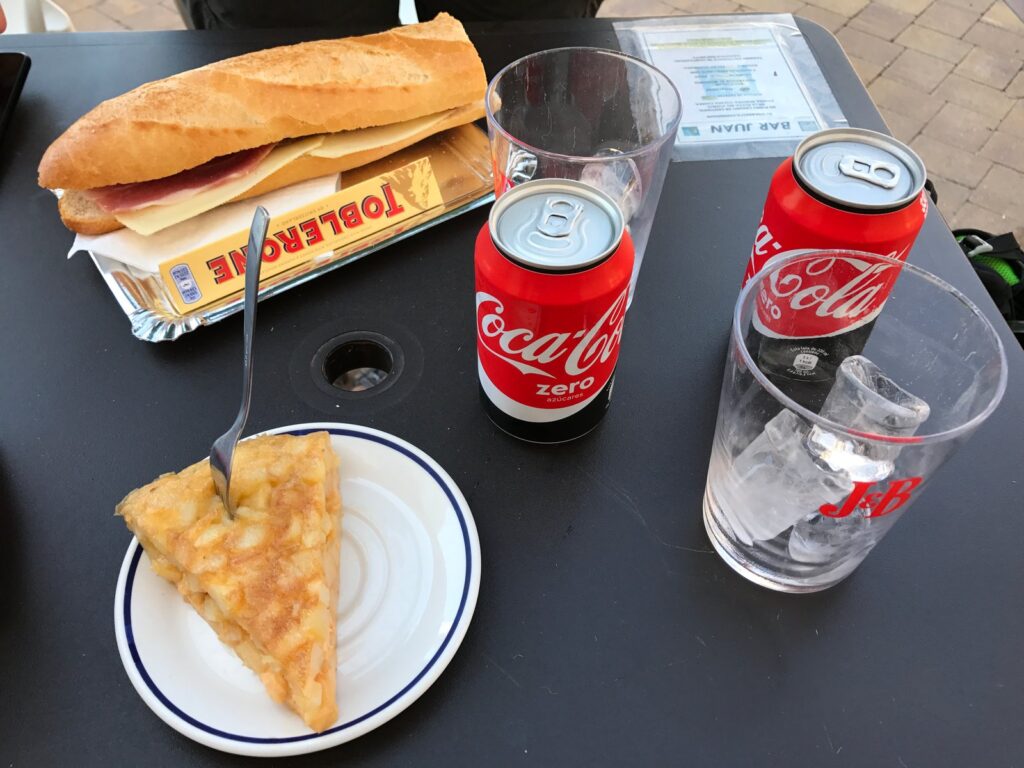
“Second breakfast” Spanish tortilla for Michelle, Bocadillo for Brian, Toblerone to share, and Coca-Cola light

I took the photo above of our first “second breakfast” as it’s affectionately called on the Camino. Second breakfast is what you have after hiking about 5-10 km. First breakfast is typically bread and coffee. So begins my first challenge, I can’t eat bread and I don’t drink coffee. I wish I liked coffee, I do, it’s just not my flavor so I usually found a Monster energy drink at a store the night before and started my day with it. Next, I initially loved Spanish tortilla. It’s eggs and potatoes, what’s not to love. On a side note, Brian wasn’t a big fan of bocadillo, he called it a baseball bat of bread with a thin layer of ham and cheese. Fortunately, Brian usually had a lot of other choices. But this isn’t why I wanted to quit the Camino.

Hiking early in the morning to beat the heat

Challenge number 2, oh how we both hate early mornings. We had to leave our albergue by about 5:30 – 6 a.m. for most of our Camino because Spain was experiencing record heat. When we didn’t leave so early in the morning the heat was so bad we had to quit early so leaving early was a better alternative. But this isn’t why I wanted to quit the Camino.

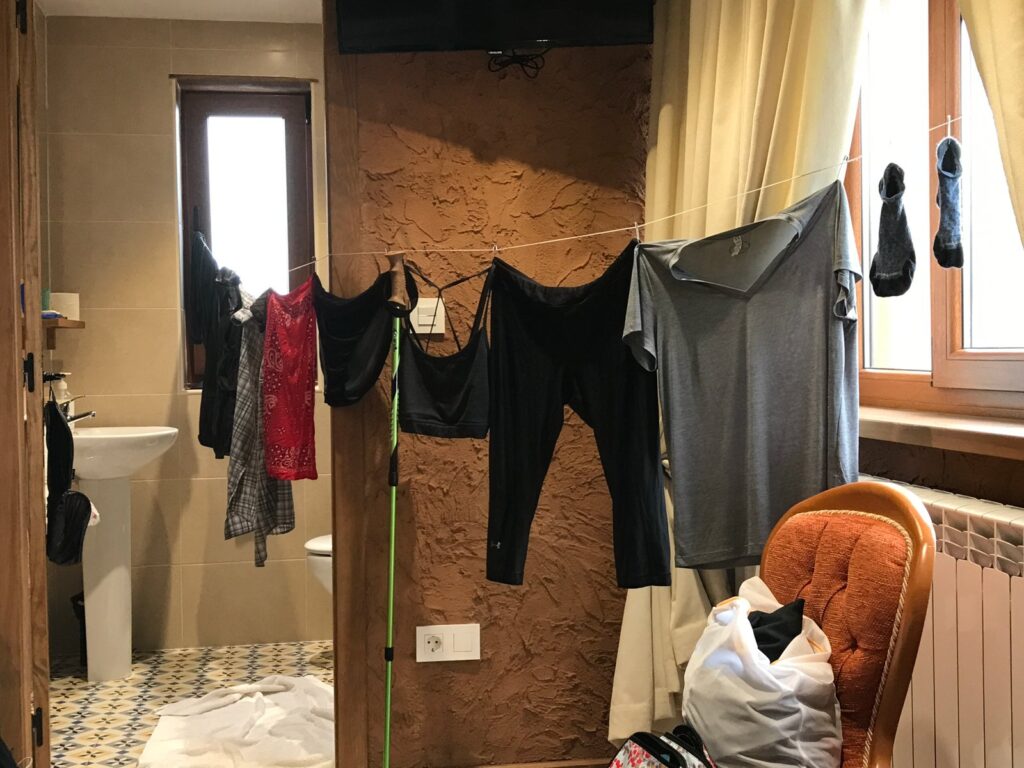
Laundry, Camino style

Then there is doing the laundry by hand, day after day. After a long day of hiking in the heat, all I wanted to do was take a nap. Brian had to talk me into showering and washing the clothes with him before passing out on the bed. Some days it took a lot of convincing. But that is not why I wanted to quit.

I don’t know where my husband got so much energy but his drive to see every inch of every town after hiking an average of 13 miles a day and hand washing our laundry astounded me. He was so happy – all the time – happy. I was tired, exhausted, crabby and weak. That is why I wanted to quit the Camino but I hadn’t hit rock bottom yet. I felt so inadequate. It wasn’t Brian’s fault.

I also felt very isolated. I didn’t have anyone else to talk to on the Camino. We were hiking together, so yes we had each other, but after Pomplona, we went for several days without meeting anyone who spoke English. Feeling isolated in our room one night I even looked up flights. I was ready to max out a credit card and fly home the next day. Brian convinced me to give it one more day and if I wanted to quit he was ready to come home with me. What? He would quit too! Ugh, the pressure of not wanting to end his Camino. But I agreed to give it one more day and I was convinced we were going home.

I really don’t remember the next day except that it wasn’t as hot, the shade was plentiful, the hills weren’t too bad, and we walked into a town to have second breakfast only to find a group of pilgrims all speaking English. The signs were everywhere, I knew by the end of the day we were to continue walking on the Camino.

I was re-establishing a good rhythm on the Camino again until our third day on the Meseta and our 17th day of walking. The Meseta is a week-long stretch of flat hiking from Burgos to León where you feel like you can see the entire week ahead of you because it is so flat. It is also normally the hottest part of the Camino but for us, it was the coldest, wettest, and windiest part. We had awful winds, up to 25 mph.

Then we walked into Carrión de los Condes. When we arrived, we walked into a convent where cloistered nuns were sitting in the back singing. It left us speechless. A fellow pilgrim was sitting in a pew, crying, so I sat with her. Later that evening she saw us again and she told her friend that we were her angels. Apparently, we helped her out a few different times but didn’t realize what we did was so meaningful.

“The singing nuns” who asked that we don’t show their faces

That evening we met a different order of nuns who are affectionately called, “the singing nuns.” We knew this was an evening we could not miss. There was also a priest who we had been following on and off all day. We first met him chanting in a church earlier that day. He brought us to our knees in that church. That evening he led mass and we learned he was from Poland, delivering the mass in Latin, Spanish, and English. Wow.

The best part of the evening was when the nuns asked everyone why they were walking the Camino. When they learned we were walking to celebrate our 10 year wedding anniversary, they dedicated a song to us. Sobbing in an overcrowded room full of strangers, I realized this was my rock bottom. I knew I needed to continue on the Camino. I had to complete this walk. I felt so broken and so energized all at the same time. We left that room full of friends to find our dinner and ran into a group of Spaniards celebrating a reunion. They invited us to dance with them. I wanted a do-over with the energy I was feeling that evening. I started my Camino over again the next morning, renewed.

It was that evening when we opened ourselves up, sharing our story with strangers, that everything changed. From that day forward we met friends from all over the world, people we are still friends with today. I don’t know what took us so long, but I am so very thankful for that evening and finally hitting my rock bottom.

Leaving my burdens at Cruz de Ferro

Only a short 8 days later we left the weight of our burdens at Cruz de Ferro. We even shared this moment with two new friends from Hawaii who kindly took the photo above. Please don’t wait to connect with people. They are a big part of the Camino. I continued to struggle with the food, hand washing the laundry, and heat exhaustion, but I had new friends to help us along the way as I hope we helped them.

Brian, my partner, best friend, husband

I am thankful to have Brian walking by my side. We pushed each other, lifted each other up, and we know when it’s time to be patient with one another. It is my hope that you have someone to walk with along your Way or find someone faster than I did.

Buen Camino friends, see you along the Way!

Our Camino Budget

This is a controversial topic – money! Before you read any further, we ask that you are kind to us. This is our budget for our Camino – you can spend a lot less and even spend a lot more than we did! We know there are a lot of ways to plan or not to plan your Camino, this is just what we did in 2017 and what we are doing for our 2019 Camino, we hope this budget helps a few people. Let me begin by giving you a summary of our goals when planning our Caminos:

  • Flight cost – find it cheap and the least amount of connections
  • Plan a few luxuries – this so we have little things to look forward to along the way.
  • Private rooms – this is important to us so we don’t have to pack sleeping gear/sleeping clothes and towels. It saves weight and we know we will get a good night sleep.
  • Enjoy the culture – this means we plan to have evenings out to enjoy the local food and don’t eat as many pilgrim meals in the evening.
One of the many rooms along the Way

Ok, so this is another way we are different than other pilgrims. We planned out our Camino from beginning to end, meaning we planned our stops and reserved all of our rooms in advance. We knew this meant that if we were suffering from illness or injury, we would have to taxi ahead to the next town vs. walking to it. Some will not agree with this philosophy, but this was how we planned our pilgrimage. In the end, for our Camino in 2017, we taxied about 20-25 km of our entire Camino. This is a number we could live with for the peace of mind of knowing where we were sleeping every night. We have to travel on the Camino during the busiest time of the year because we are teachers, so planning the rooms in advance helped ease our minds and helped us stay on budget.

Jean-Michel with us at his Bed and Breakfast in Saint John Pied de Port, France wishing a Buen Camino!

Let’s talk about flights first, I discussed this a little bit in our blog post entitled, Our Top 10 Pieces of Essential Camino Gear if you want to read it later. We monitor flights using the apps Skyscanner and Hopper and when they tell us to buy, we do. The best thing to do is look at direct flights from one hub to another. For us, we have found inexpensive flights from Boston to Madrid. In 2017 we flew Iberia Air and our Boston to Madrid tickets were $500 total, for both of us, and then we spent another $500 total getting from Ohio to Boston. For our 2019 Camino we are flying Air Portugal from Boston to Madrid and our tickets were the same price at $500 for both. We are still monitoring flights to Boston. You have to know where you are looking to fly, monitor flights, and be willing to wait to buy the tickets.

A foot bath and massage in Pamplona, I wouldn’t even call it a luxury because my body needed this treat!

We always plan a few luxuries on our trips because it gives us things to look forward to when we are exhausted, tired, or just plain grumpy. In Pamplona, we didn’t know where it would happen but we budgeted for massages. This city comes after hiking about 3-4 days (depending on if you stop in Orrison, as we did) and your feet will be so happy that you are treating them. This cost 100 euros for us both and was so worth! We planned to have a few more massages along the way but didn’t have as many opportunities as we hoped. Our total budget for luxuries was 500 euros, we mainly spent this money on nicer restuarants and wine.

Don’t fret, we planned other luxuries, like in the places we stayed at. Our lodging budget was to average 50 euros a night for a room. Fortunately, we had plenty of rooms that only cost about 35-45 euros so we could splurge a bit in other places. For example, we read in another blog (sorry, I can’t remember the name of the blog) that Casa de Tepa in Astorga was their absolute favorite hotel on the entire Camino so we booked a room. This room came in at 82 euros, sadly prices have gone up because the website says it costs 115 euros today. We stayed in the Napoleon Room, I encourage you to go to the website and check out their videos of the different rooms. This wasn’t just called, “The Napoleon Room,” it was the actual room that Napoleon stayed in! Crazy! The best parts of this hotel were the location to the Gaudi museum and the town square, the gorgous backyard patio, the reading rooms throughout the hotel, and the cash bar on the patio. It was a fantastic find and a well-planned luxury.

Private rooms were so important to us, as it’s an important way to end a long day of walking. I am a light sleeper and I heard so many people complaining about not getting a good night’s sleep on the Camino because of the sounds and smells of others. This meant our budget was higher than it was for others in a shared room, but sometimes not too much higher. The best part was that we did not have to carry sleeping bags, pillows, towels, or even sleeping clothes. We didn’t always have a private bathroom, that was something we were willing to give up in order to stay on budget.

Luxuries came in many forms from private rooms, to air-conditioned rooms, to massages, to couple fancy restaurants (the one featured below is not considered a fancy place – lol).

We found “Mexican” cuisine in Leon, Spain

Finally, we had to find luxuries by exploring the local life and local food. It was important for us to experience the culture, not just the pilgrimage. Sometimes that meant finding out what food tasted like in a Spanish-Mexican restaurant. The takeaway was that we full-filled the urge we had for tacos but don’t get a margarita (you’ll thank me for that advice, I promise)! Other times our goal was to truly experience the local food. For example, when in Galicia you must try pulpo (octopus)! I am not a fan of octopus here in the States, but I am not going to lie, I loved pulpo. As far as our food budget goes, we planned to spend 50 euros a day for both of us in 2017 but we were closer to averaging 60 euros a day. What can I say, we do love our food…and wine!

Pulpo in Galicia

In summary, the 2019 Coleman budget for the two of us combined breaks down like this:

  • Flights: 1000 dollars
  • Private Rooms: 50 euros a night
  • Food: 60 euros a day
  • Other transportation: 300 euros
  • Luxuries: 500 euros total

We hope this helps you in your Camino planning because if you are still reading this blog post, we will assume you are a planner. Click the like button to show us some Camino love. We would appreciate hearing from you – in the comments please tell us about your Camino, what you are looking forward to on the Camino, or what you are nervous about.

Buen Camino! Brian and Michelle

Our Top 10 Pieces of Essential Camino Gear

We’re in Florida! It’s time for two weeks of fun in the sun and Camino training, so I am thinking about gear! Everyone loves to talk about gear and I get it. When you prepare for your 1st Camino you research like crazy because you desperately want to know what to bring, but more importantly, what not to bring. Before I get to the gear, you may want to know how we are training for the Camino in Florida. This is a great question because, yes, you can combine RV’ing, Florida beaches, rum runners, and fun in the sun! Our plan is to start every day (except for some travel days) with a 7-10 mile walk. We have all of the routes planned out based on where we will be so we can easily get our miles knocked out before we start the fun. Follow our Instagram page to see how we will spend our days in Florida. We won’t be carrying gear beyond water, it is a vacation you know, haha. Our plan is to pack our Camino backpacks when we get home from Florida so we can train through the cold Ohio winter months, hiking fewer miles but with fully-weighted down packs.

Before I digress too much with my enthusiasm for our trip, let’s get back to the Camino. I remember when we first start planning our Camino I wanted to bring so many pieces of gear that I thought were “essential” even though we have backpacked enough to know the difference between essential and non-essential. The movie The Way had me feeling the not so practical side of planning for our Camino as I wanted to unload my entire closet into my backpack. But you can’t, and at the end of a long day on the Camino, you will so thankful you didn’t pack too much gear.

There are a lot of opinions about gear on every forum you read, and there will be plenty of people who want to assess what you have in your pack once you are in Spain. Have you checked out the Facebook group, American Pilgrims on the Camino? It is very helpful. Our first night in St. John Pied de Port, France, the hospitalero lifted my packed and told me immediately my bag was too heavy. He was right, it was too heavy but I had seen a lot worse and at the time I had done my best to purge the nonessentials. When you arrive in Roncesvalles you will see tables and tables of gear that people have purged after climbing over the Pyrenees Mountains.

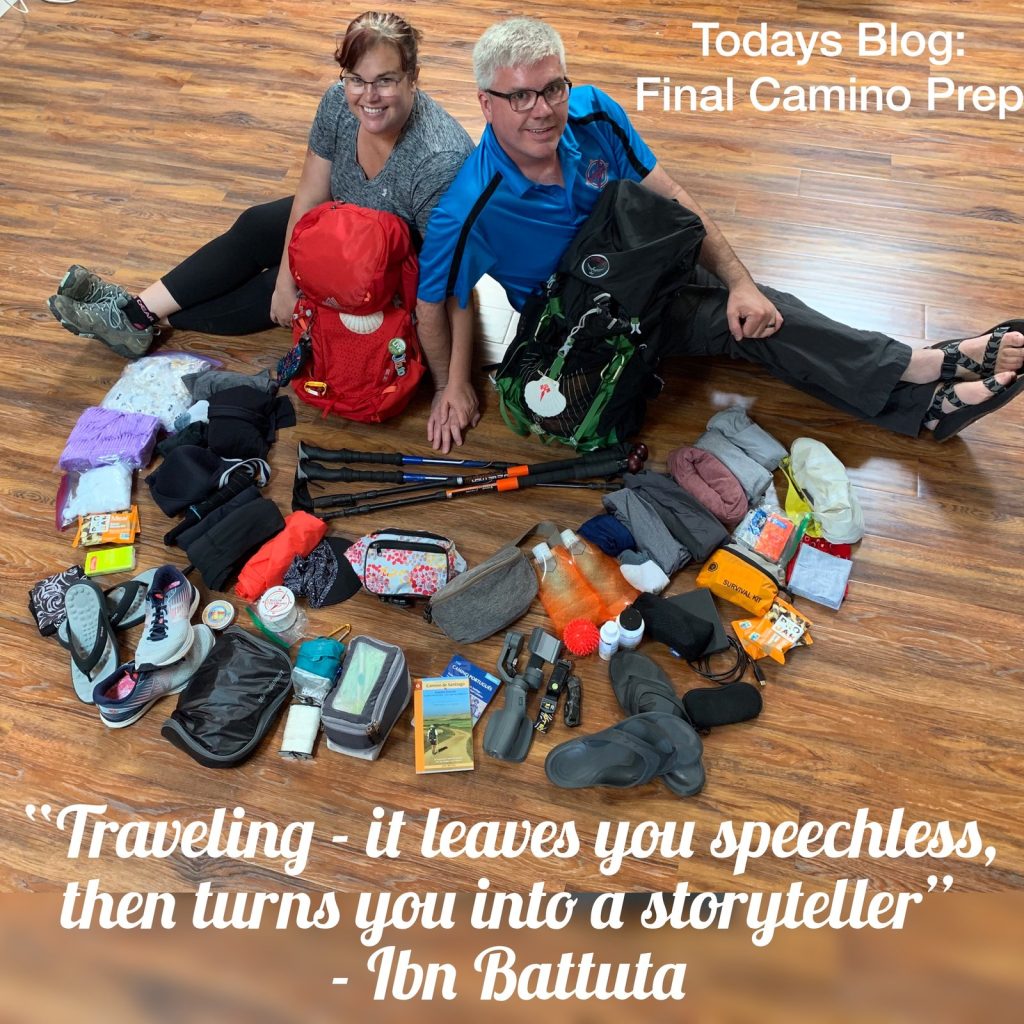
Everything we took, laid out on the table before we packed

With all of that being said, this is our top 10 items to carry on your Camino. It’s not a perfect list. It is your job to create a packing list that works for you. As Brian and I prepare for our 2019 Camino, we will probably talk about gear again. Leave your questions so we know what you want us to talk about next.

(1) Backpack: Your most important piece if equipment is a backpack. You need to find a backpack that makes you feel like you don’t even know it’s there. We strongly recommend going to an REI near you. REI has a large selection of backpacks, they will fit you to help you find a pack that works with your body shape/size and have a return/exchange policy like none other. Brian was lucky, he was fitted and loved the first backpack he purchased. Brian found the Osprey Exos 48, and surprisingly, you can find this pack in the outdoor stores in St. Jean Pied de Port, France. Me? I am never easy. I tried the same pack in a women’s version, bought it, hiked in it, and it bruised my hip bones. I hated it. REI graciously exchanged this pack for another one. I am still not totally happy with my pack but it made it through our 2017 Camino. I am heading to REI to look at backpacks in January to prepare for our 2019 Camino. Seriously, it is important to get your pack as soon as you can, load it up, hike with it in your neighborhood, and make sure you absolutely love it. You will be carrying it on your back every day, up to 8 hours a day, for as long as you are in Spain. You have to love it.

(2) Clothing. This is the first place people overdo it and I get it, you want to look at feel good. However, I promise you will feel much better if your backpack is lighter. For pants, you need zip-off or roll up hiking pants that are made of polyester and have UV protection to help with the cool mornings/evenings and warmer or hot days. You are looking for lightweight pants that wick moisture and can be used in multiple ways. My absolute favorite pants are from REI, they are the Sahara Roll-Up Pants, they are not available anymore. I just bought a pair of the Kornati Roll-Up Pants, they are almost the same but they have a snap instead of a button. I hate snaps so I may have to get those fixed. One of the things I love about both pairs is they have an adjustable waistband which is important on the Camino when you are mostly hand-washing your clothes. I have this pair of pants for the evening while the pants I wore during the day are being washed. During the day I liked wearing capri length leggings, if I liked my legs more I would wear a shorter length of leggings because we are typically traveling in the heat of the summer. As for Brian, his pants were a pair of zip-off hiking pants and a pair of hiking shorts, both are polyester and looked very similar to mine. Please, whatever you decide, don’t wear jeans, they are too heavy, they don’t wick moisture, and they don’t move well when you are hiking.

As for tops, Brian had 2 button-down tech shirts, a tech t-shirt for bedtime, and a long sleeve tech shirt for cold mornings. Could he have had less? Probably, but he was happy. I had 2 tank tops and a zip-up sweatshirt. They were all made from polyester and very lightweight.

We both had raincoats which are essential on the Camino. You want one that is lightweight and in a bright color so you are easy to see in the fog and rain. We don’t recommend ponchos because when it’s windy they are all over the place. Your backpack should have a cover so when it’s raining put the cover on your pack and put your raincoat on. I promise it’s all you’ll need for rain.

As far as undergarments, we suggest 3 pairs of socks. One for the morning, one to change into in the afternoon, and one for the evening/overnight. Regarding underwear and bras, we believe you should have one to wear and one for wear while washing. Again, they should be made of a polyester material.

Ladies, let me talk to you for just a second… I suggest wearing a panty liner so you feel fresh and clean all day long. Also, I suggest you find your favorite sports bra that you are willing to wear all day long. You don’t want one that feels like it’s pulling on our shoulders. I love the sports bras in this link. It is inexpensive, the most comfortable piece of clothing I own, and wicks sweat very well. In the evening, I like just an everyday bra, certainly nothing I have to pull over my head. I am too tired and like easy by this point in the day. The goal here is to find your comfort level.

Finally, you need a bandana to wick away sweat, dirt, whatever. We carried one on our backpack strap so we had access to it all the time. The goal is to think about what you are wearing all day, what you are wearing while your clothes are drying and when you’re sleeping (should be the same), and what you are adding to your layers when it’s cold. Some people wore hats, but it’s up to you.

(3) Toiletries: This should be easy. You need a toothbrush, toothpaste, brush/comb, maybe a face cleaner if you struggle as I do with oily skin, an all-in-one shampoo/conditioner/soap, and a towel. We absolutely loved this Turkish towel from Amazon. Then there is all the other stuff you feel like you need which complicates the “trying to keep the weight down” issue. I really didn’t carry much more. I had to carry vitamins which I put in individual bags for each day, I got the bags on Amazon. I carried a small roll of toilet paper, which I did need and would take again because many times by mid-afternoon the bars were out of toilet paper. You have to decide what you can live with and what you must have with you.

(4) Bedding: What bedding you need depends on the type of accommodation you will be sleeping in. We stayed in private rooms so we had a bed liner with us in case we needed it but we didn’t. All of our rooms had bedding, sheets, and a pillow. I am so thankful because I would not have wanted any more weight on my back. Those staying in dorm rooms will need a sleeping bag or just a bed liner in the heat of the summer. Many people rolled up clothes for a pillow, I would have had a travel or inflatable pillow.

(5) Fanny Pack: This is so important for everything you need to get to throughout the day so you don’t have to get in your pack. We kept our essentials in our fanny packs which included passport, money, pilgrim credential, phone, charger, and a snack or two. Be sure to put things in a freezer baggie to protect your stuff from rain and sweat.

(6) Two pairs of shoes: Brian and I left for the Camino each with a pair of Merrell hiking shoes and a pair of Chacos. Brian decided by Pamplona that he loved hiking in his Chacos so he mailed his Merrell’s home and bought a pair of flip-flops for the evening. As I have mentioned before, Brian is the easy one. I have foot problems; I have bunions and a hammer toe. It sucks, I will need surgery eventually. Therefore, I wore my Merrell’s in the morning, wore my Chacos mid-day, put my Merrell’s back on for the late afternoon walking, and then back in my Chacos for the evening. I am actually, very seriously, considering bringing a pair of tennis shoes as a 3rd pair for our next Camino. I get blisters and have a lot of foot pain if I am in a pair of shoes too long. I don’t want the extra weight, so I am trimming in other areas, but we have some long days planned for our 2019 Camino and I think this will be a smart decision. Time will tell what I decide.

(7) Basic First Aid: You do not need much here at all, there are plenty of pharmacies along the way. All you need is a small baggie with a few band-aids, needle/thread to deal with blisters, moleskin for blisters, and Advil. Spain sells an anti-inflammatory cream in their pharmacies that is amazing! Bring some home, you will love it! We also had a small exercise ball that we used on the bottoms of our feet at the end of the day, I strongly suggest it. Your feet will be bruised with all of this walking, make sure you are taking care of them.

(8) Hydration system: There are a couple of perspectives here – water bottle vs. water bladder. We chose water bladder and will again on our next Camino. There are some long days on the Camino and you need to make sure you have plenty of water. We knew the hostel/albergue had potable water so we filled up for the day. We never had water issues but we saw a lot of people who did. Between non-potable water or just not having enough, we saw it all. The other thing that will help you stay hydrated is electrolyte tablets. You lose a lot of salt when you are sweating so be prepared.

(9) Cell phone: You will need a cell phone for a variety of reasons – to call ahead to albergues to let them know when you will be arriving, to make reservations if needed, to be able to check maps, and to be able to call home if you wish. Therefore, you need to decide if you are going to get an international plan or unlock your smartphone and get a SIM card once you land in Spain. We opted for the SIM card and were very happy. We didn’t use it much, mostly used wi-fi but we did use the phone to confirm with albergues. Also, make sure you have a European charger. There are a lot of great smartphone apps that would we encourage you have including Google Translate, Google Maps, Wise Pilgrim, and Booking.com.

(10) Charles Schwab Card: Number 10 and the best thing we learned about before our Camino! We are so thankful someone told us about using a Charles Schwab card when on the Camino. Charles Schwab does not charge ATM fees, they rebate ATM fees from other banks, and they don’t have international charges. We transferred money from our checking account to our Charles Schwab throughout our trip and then took money out every week as we need it. Seriously – best advice ever!

If you are still reading this blog, you are serious about what to pack on your Camino and that makes us smile. Please click the “Like” button if this blog helped you at all. The Camino is a magical place. Enjoy your journey.

Buen Camino!

Five Steps to Planning our 2019 Camino

I can’t wait anymore – I have to talk about the Camino! There is so much to say! This is the first of several blog posts over the coming months on the subject of the Camino de Santiago. We hiked the Camino Frances in 2017 which was a life-changing experience for both of our adventurous spirits. Many times we had heard the phrase, “you never hike the Camino just once,” but we had no idea what it meant until the draw of the Camino pulled us so hard we could not resist it. I have to admit, I am still shocked at how much I want to go back and hike the Camino again. Brian felt the same draw to go back, but he wasn’t as surprised as I was. There will be more on the reasons we both felt the draw in future blog posts.
Let me begin by telling you some people decide to hike the Camino and don’t plan a thing. This is not who we are, we like to plan, I can go so far as to say we love to plan. Spreadsheets are life to us! For us, the spreadsheet takes something that can be quite intimidating – hiking across a country – and making it more manageable. Our spreadsheet broke down the 550 miles trek into small sections so we had more confidence and set achievable goals. All of that being said, we have a lot of respect for the many thousands of people who complete the Camino annually without any planning. There is something to be said about just picking up and going, just because it is not for us doesn’t mean we don’t admire those who do.
It was about May 2018 when we both finally admitted to one another that we wanted to go back to the Camino; it was less than a year from being back in the states from our Camino 2017. I remember where we were standing in the new house we just purchased in April 2018 when we admitted our desire to hike the Camino again because my heart skipped a few beats. It took a few months to make any progress on that decision, mainly because we were in the midst of preparing for our son’s wedding and our summer 2018 adventure but we knew we were going! We plan the details of our next big summer adventure the moment we finish the adventure we are on and often while we are on the current summer adventure. So in September 2018, the real planning began. Determining when we are going to travel is not a step for us because we are teachers so we know that we’re traveling in June and July whether we like it or not. With that being said, before I outline the steps we have taken thus far, I strongly encourage you to join the American Pilgrims on the Camino Facebook group. With over 18,000 members, everything and anything you need to know to plan your Camino is in that group! Ok, without further delay, here are the steps we have taken thus far to plan our Camino 2019:
Monitor International Flight Prices
I cannot tell you how important it is to sign up for some sort of flight monitoring website. We signed up for a few and the winner of finding our cheap airfare was Scott’s Cheap Flights. You can pay up to about $1500 a person to fly internationally but with a bit of legwork, you can fly a lot cheaper. A couple weeks ago, I received an email from Scott’s Cheap Flights that Air Portugal was having a great sale so did further investigating and found great prices. If you are willing to fly from one of the main hubs (we picked Boston), they had round-trip tickets as cheap as $300. This means we still need to get to Boston, but we will monitor flights until we find a good price to get to Boston.
Determine the Route
Next, you need to determine which of the Camino de Santiago routes you will choose to hike. The most popular and the one we did in 2017 is the Camino Frances. Many people are inspired to hike the Camino Frances because of the 2010 movie, The Way, starring Martin Sheen, and we were no different. The moment we saw this movie we knew it was a bucket list adventure, and it only took us seven more years to get there.
Screen Shot 2018-10-23 at 1.32.55 PM
This time we are going to hike the Camino Portugués which is 640 kilometers. Since we have the time, and we want to go back, we are going to hike part of the Camino Francés from Leon to Santiago. Finally, we are going to hike the “extra loop” to the “end of the Earth” which is Santiago de Compostela to Finisterre to Muxia and back to Santiago. We hiked to the end of the Earth in 2017 to celebrate our anniversary but this time we want to complete the loop and go on to Muxia and then walk back to Santiago. Our total hiking mileage is coming it at 1162.3 kilometers. This is epic for us! The last time we were there we had 38 hiking days, averaging about 14 miles a day. This time we will hike 44 days and average 26.4 kilometers or 16.4 miles a day. We like a challenge – and well – we have one before us!
Buy Guidebooks
There are several guidebooks out there about the Camino and we have two favorites. The first, and most popular, guidebooks are by John Brierly and you can find any of his books on Amazon. This is the basis for our spreadsheet and provided us with everything we needed to know about hiking the Camino from villages, distances, terrain, details about where to stay, and notes of stuff to watch out for as you travel. Many people carry his book with them on the Camino and just rip out pages as they don’t need them anymore or they have the electronic version on their Kindle.
The second guidebook we use is the Village to Village guidebook by Anna Dintaman and Matthew Harms, their books can also be found on Amazon. You should also check out their website too. It has been a great resource for planning where to stay, what to wear, what to take, and has links or email addresses to albergues.
Buy your guidebooks about 6-8 months before you leave. You don’t want to buy them too early because you want the latest edition; however, you want to buy them early enough to have the time to read the books so you can, at least, mentally prepare for this undertaking.
Make Spreadsheet
Disclosure: We were not the original creators of this massive spreadsheet! One of our fellow Ohio APOC friends, Greg, created this spreadsheet and shared it with us. We have shared it with others so as to pay it forward because if you are a planner, this spreadsheet is amazing!
Ok, here is where we went crazy! But you need to know that we plan our summer adventures with this type of spreadsheet every year. Our rationale is that when we are gone for two months, we need a spreadsheet to ensure we meet our goals for the adventure.
Screen Shot 2018-10-23 at 12.48.21 PM
For our first Camino, we were not going to plan anything because we heard that most people don’t plan their daily goals on the Camino. It was about five months before we left for the Camino when we decided the no-planning philosophy was not going to work for us. There were a few determining factors going on here – (1) we have to travel during the busiest season, (2) we heard stories of people coming into a village and there were no rooms left (and we saw this happen!!), (3) we wanted to know where we were sleeping each night even if we had to bus ahead due to illness or injury, and finally most importantly, (4) our minds were at ease the moment we started planning our stays. For us, the spreadsheet is our lifeline and we love having it. Would we ever go without one? We could, yes. If we were only going for a couple of weeks, a good possibility, yes. If we weren’t going during the busy season, possibly. It is all a matter of preference.
Training Time
If you have the time, we would strongly encourage you to start walking! Walk 5, 8, 10 miles at a time as much as you can, build up to longer walks whatever that looks like for you. Start where you are comfortable to prevent injury. Since we are still about seven months out, we are walking once or twice during the week and have one long walk on the weekends. Do what works in your schedule. If you can get consecutive long walking days in, that would be perfect for your training! If you have any old Roman roads in our neighborhood, walk on them! Haha But seriously, do not go for a walk in the woods, which is what we would normally be doing. Walk on gravel roads, brick roads, pavement, anything to toughen up your feet. Carry a backpack with about 12-15 pounds in it during the last couple months of your training. I will talk about gear, I promise, in another Camino post! For now, here are a few more big suggestions to train for your Camino:

  • See your podiatrist and get insoles. They saved our feet! You have to find the shoes and insoles that work for your feet. It is critical. We both love Merrell shoes and insoles that are fitted for our feet.
  • Know how to care for blisters (see the APOC Facebook group, everyone has an opinion on what to do)
  • Do lunges and squats, just 10-20 a day, 3-4 days a week. Your knees will thank you for that specific training, I promise you!
  • Have your backpack fitted, we went to REI and both love our packs for different reasons.
  • When you know what you are going to wear on the Camino, wear it in your training. You want to minimize gear surprises.

Don’t overthink the training, just walk. There are people of all ages, backgrounds, and fitness levels on the Camino. We met two 12-year-old girls hiking the Camino, lots of 20, 30, and 40 something folks, and even more 50, 60, 70+ folks walking the Camino. If you can walk, you can walk the Camino. Even if you can’t walk the Camino will provide, see the 2017 movie, I’ll Push You if you need the motivation to walk the Camino.
Extra Step: Making Reservations
This step is not for everyone but it certainly made our Camino the most “relaxing” adventure we have ever had! I referenced making reservations in the “Creating the Spreadsheet” point but it needs to be clarified. The site we used to make most of our reservations was Booking.com. It won’t help you with every single reservation, for some villages you will need to email the albergue to make your reservation because they are not on Booking.com.
Before you make your reservations, check out the APOC Facebook group because everyone is talking about various albergues and may provide you with insight about where you want to stay or avoid staying because it does not meet your needs.
I didn’t talk about the budget in this blog, it’s a topic for another post. However, in short, you can spend very little or stay at 5-star hotels throughout your journey. You can find municipal albergues for $3-5 a night. We averaged about $40 a night for a private room. Sometimes that included dinner but often, for us, it did not. I will talk more about our “teacher budget,” this means that we had more resources than a college student but not as much as someone from Corporate America.
There are so many blog posts about the Camino, this is just our point of view from our experience. Read as much as you can before you hike your Camino. It’s your journey, it’s your Camino, make it what you want it to be. As we say on the Camino, Buen Camino!

★ 25 years guiding ★ 48 U.S. states ★ 10 countries ★ 3,000+ Camino miles