
My Favorite Things: Eating on the Camino de Santiago

You may not know this about me but I love food. I mean that I REALLY love food. Any time we travel, I spend a decent amount of time looking for local specialties and the best places to eat. That does not mean that we spend a lot of money on food. Yes, sometimes we will go to a fancy restaurant and drop a couple of Benjamins for a really nice dinner but some of our favorite and most memorable meals have been at dives that don’t know who Zagat is. With that in mind, my first Monday morning post that isn’t a recipe of the week is going to cover my favorite subject… FOOD!

Some of the most frequently asked questions we hear about the Camino deal with food. Do you have to carry your food? What’s the food like? How expensive is food? What if I have dietary concerns? What if I’m a picky eater? I hope to answer all of those questions here and assure you that you will not starve while walking on the Camino de Santiago, no matter how picky or restrictive your diet is.

First off, Michelle and I both try to live a relatively healthy lifestyle. We like to eat fresh, non-processed food as much as possible. We try to avoid excess sugar, but we will eat an occasional dessert and we both share a love of wine and cocktails. Michelle must eat gluten-free because of her Hashimoto’s disease (an autoimmune thyroid disease).

Going into the Camino, we knew that we were not going to be worried about counting calories. While walking 13 plus miles per day in the extreme heat that we were going to be burning plenty of them. One day I did do my best guess at tracking calories because I was curious and came up with over 3000. That said, we came back from Spain at nearly the same weight that we left home. The challenge was adjusting to not eating as much food as we had been used to while on the Camino and we each gained weight upon our return.

Upon arriving in Madrid after a long overnight flight, we were both starving. Once we navigated the Madrid subway and made our way to the Atocha train station it was time to find some food. We had done a little research ahead of time and new that there was a counter service fast food place that had gluten-free breakfast items. After a little searching, Michelle had a chocolate croissant and egg and cheese sandwich and I had a taste of my first bocadillo (not gluten-free). Our first meal was a success

Chocolate croissant, egg and cheese sandwich (both gluten-free), and breakfast bocadillo (not gluten-free) at the Atocha train station.

Finding food on the Camino is rarely a problem. Most days pilgrims pass through several villages and there is almost always at least one bar or cafe, and usually, several options are within feet of the marked path. Many albergues offer a pilgrim’s meal at dinner time for a small additional charge (€5-10). Before talking about dinner though, let discuss meals in Spain and how that fits into the pilgrim’s schedule.

Our first pilgrim’s meal in St. Jean Pied-de-Port

Breakfast in Spain is usually the smallest meal of the day and rarely consists of much more than toast (tostada) with butter and jam, pastries, and cafe con leche (espresso with steamed milk). Michelle sometimes was able to get rice cakes but often had to make do with a little fruit or an egg. Among the pilgrims we know, this is called “first breakfast” and you’ve probably already guessed that means “second breakfast” can’t be far behind. First breakfast was onfton included in the price of lodging.

First breakfast at a bed and breakfast in SJPdP.
Gluten-free breakfast option, if you’re lucky

Once we got through the Pyrenees, Spain was getting record high temperatures and in order to beat the heat, we were often leaving our albergue before 6 am. As a result, we needed to purchase breakfast the night before since most places to eat didn’t open until 6:30 or 7:00 a.m. Our breakfast of choice became a snickers bar and Monster as we walked in the dark. Not the best choice, but it helped in a pinch and we have a few ideas to help us when we are back on the Camino this June 2019.

After walking 5-8 km, most mornings we would come to our first village of the day and usually would run into a group of pilgrims sitting outside a bar or cafe eating second breakfast. Choices of food would range from tortilla and bocadillo to a more traditional “American” breakfast of fried eggs and bacon. We often spent less than €10 for second breakfast with two Coke Zero.

Lunch in Spain can be tricky for Americans. Lunch is typically the largest meal of the day and is often eaten at home but for pilgrims, everything closes down around 2 p.m. and doesn’t reopen until after 5 p.m. for siesta. If you arrive at your final destination for the day during that time, you will often not be able to find food because EVERYTHING is closed. We would typically get a similar meal to our second breakfast or if we were lucky, some tapas. Often by this time of the day, we would enjoy some amazing Spanish wine or beer if we were within the last 5k of our walk. The price here was often about the same as second breakfast, around €10 including wine.

Once we were done for the day, it was time to check into our albergue, hand wash our laundry, shower, and take a little nap. We were usually pretty hungry at this point and would often get a snack. Our go-to became a bottle of wine and Doritos for €5-8. So our not-so-processed lifestyle had gone out the window, but when you’re hungry you’ll eat anything!

Wine is often less expensive than soda. We often saw 750 ml bottles in the mercado for less than €1

Dinner in Spain is often not served until 8 pm or later, long after most pilgrims have crashed into bed. Luckily, along the Camino, most villages work hard to serve the needs of pilgrims and dinner is available after 5 pm. When an albergue offers a communal meal it is usually at a set time and if you miss it, there’s no food for you. Fortunately, there is never a shortage of bars and restaurants to serve every food need for the average pilgrim. We ate a wide variety of regional and local specialties from ranging from €8 to much higher. The most economical dinner option is the pilgrim’s meal or menú del día. This dinner was usually three courses and included wine or bottled water (learn to ask for “agua del grifo” or tap water). The first course could be soup, salad, or even pasta. The second course was usually some kind of meat with fried potatoes. The final course would consist of dessert. I was always sure to ask for “especialidad de la casa” or the house special. I was able to try such unusual dishes as tuna ragu, garlic soup, home-made cheeses, and even chicken curry. We did spend a little more on dinner many nights with our total usually coming in at about €20-30 for two bringing our food total for the day to under €60 per day for two people. If you want to know more about our Camino budget, check out Michelle’s post here.

There are a couple of foods that I have to mention because they are too amazing to leave out. Once in Galicia, seafood is found nearly everywhere, is the freshest that I’ve every eaten, and very inexpensive by American standards

Many restaurants, bars, and even hotels will often serve wine or other alcoholic beverage that they make in house. Orujo, Patxaran, and Vermouth are popular regionally, make for a nice aperitif, and were served after dinner gratis in some places!

Sometimes you just need to eat something familiar and in larger cities, you may run across American fast food. We saw KFC, Burger King, McDonald’s but only stopped once because they had gluten-free buns!

We never cooked our own meals, but many pilgrims do. Markets, supermarkets, and even farmer’s markets are prevalent but be warned, in smaller villages most are closed during siesta and on Sundays. This is a great way to save money and get to know other pilgrims.

If you have special dietary concerns, most restaurants will work with you to accommodate our restrictions. Make sure you learn the names of your allergies in Spanish so you can communicate with the server. Vegetarians will probably have the greatest difficulty as Spaniards love their meat, but we did run across many vegetarians who said they were far from starving. Michelle did not have too many problems eating “sin gluten” and only got sick once during our entire time in Spain from cross contamination.

Tarta de Santiago is a staple of the Camino and this almond cake is naturally gluten-free when made properly. Often in bars it isn’t.

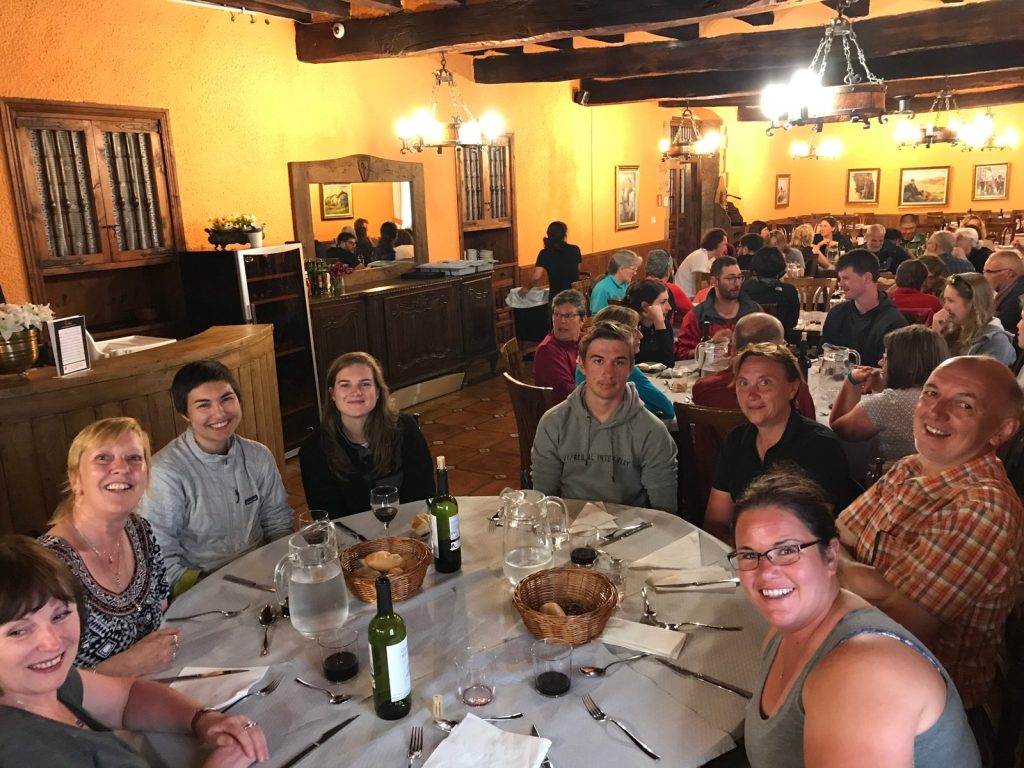
Never pass up an opportunity to eat a communal dinner, we met wonderful friends and had a great time, even when the food was only mediocre.

Communal dinner in Roncesvalles – the food wasn’t the best but the company was fantiastic

Finally, I can’t recommend enough to use common sense when eating in Spain, just as you would anywhere in the states. If an establishment looks dirty or seedy, don’t go in or leave. We never had any problems and NEVER felt unsafe while in Spain, but there were times we decided not to go into a bar or down a certain street because it didn’t look like our scene. Another thing to be wary of is looking for fresh food. We often didn’t go into places because they had a sign like this outside. All of the food pictured is premade, frozen food that is just reheated. Food is so inexpensive in Spain, why waste your time eating a frozen meal?

If you have additional questions about food or any other subjects on the Camino, let us know in the comments below. If you’ve been, what was your favorite meal?

Recipe of the Week – Creamy Chicken Soup

As the weather cools, we love to start making heartier meals and one of my favorite things to cook are creamy, thick soups. Krissy at SelfProclainedFoodie.com has created a wonderful rich and creamy soup with lots of flavor and wonderful texture. I’ve made a few adjustments to her recipe as I’ve given it here, but you can compare her original recipe here.
Begin by heating one tablespoon of olive oil in a large pot over med high heat. Add one pound of chicken thighs, making sure that the pot is not too crowded. The chicken will stick to the bottom of the pan, it will release on its own as the chicken cooks. Turn the chicken after about seven to nine minutes. Continue to cook until the chicken is done. Remove it to a bowl to cool.


Deglaze the pan with a half cup of dry white wine or dry sherry. A note on cooking with wine or sherry: never cook with wine that you wouldn’t drink. Most “cooking” wines have lots of added sugar and salt. If the wine tastes bad by itself, it will taste bad in a recipe. I never use expensive wine for cooking, but a $10-20 bottle that tastes good will add depth and complexity to any recipe that you add it to. Adding wine to the pan at this time will allow you to scrape up the bits of stuck chicken and browned bits that are full of flavor. Remove the bits and remaining liquid to the same bowl as the chicken.

While the chicken is cooking, dice one large onion, four stalks of celery, and two large carrots. Add two tablespoons of butter to the pot and once melted, add the diced veggies, called a mirepoix, to the pan and lower the heat to medium. If the butter starts to brown, the heat is too high. The liquid released from the veggies should help keep things from burning. Let the vegetables cook until soft and lightly browned. Remove the veggies to another bowl.

Add three more tablespoons of butter to the pot along with three or four cloves of minced garlic. Cook until fragrant and bubbly. Add six tablespoons of gluten-free flour blend and stir well. Cook the roux over medium heat until lightly browned, about five minutes, stirring constantly. Roux can be tricky, once the color starts to change, it can burn very quickly. If the roux gets too dark, or if you see black flecks, toss it out and start over because it will make the entire soup tasted scorched and bitter.

Add two cups of half and half and whisk until the soup thickens. Add four cups of chicken broth along with all of the accumulated juice and wine from the bowl of chicken. Add the cooked vegetables and use an immersion blender to partially puree the mixture. I like some larger chunks left behind.

Dice up the chicken, add it to the pot, and season to taste with salt and pepper.

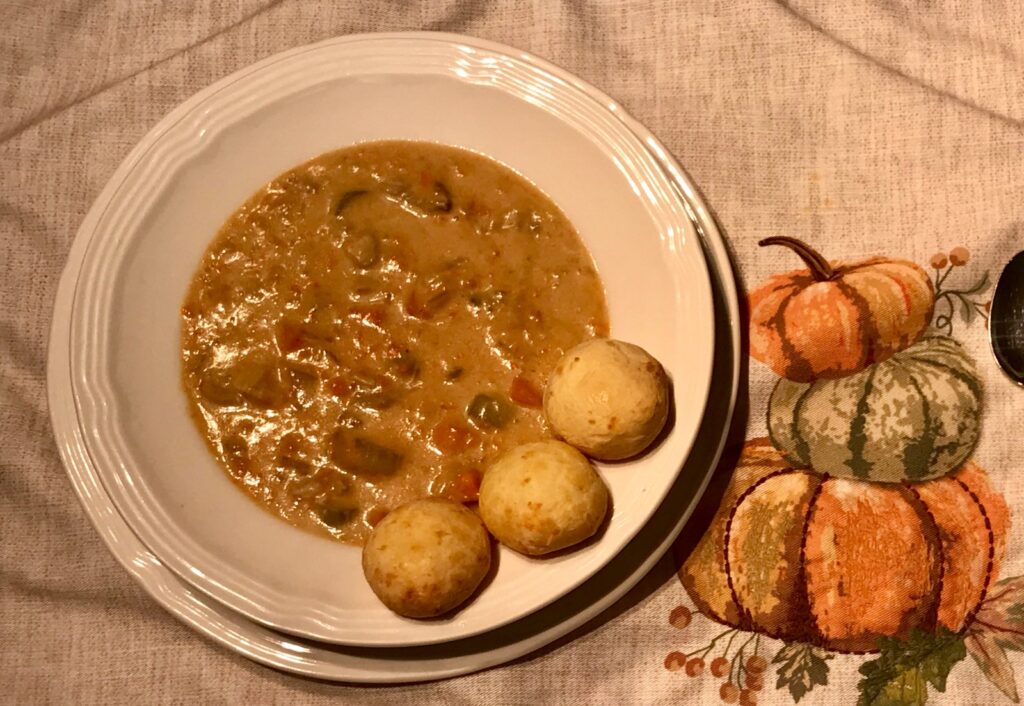
We love to serve the soup with Pao de Queijo, a Brazilian cheese bread that is naturally gluten-free and a glass of the wine that was used to deglaze. If you try the soup, let us know in the comments what you serve on the side.

Creamy Chicken Soup (based on the recipe from Self Proclaimed Foodie)

  • 1 lb boneless, skinless chicken thighs
  • 1 T olive oil
  • 1/2 c dry white or dry sherry
  • 5 T butter, divided
  • 1 large onion, diced
  • 4 stalks of celery, diced
  • 2 large carrots, peeled and diced
  • 3-4 cloves of garlic, minced
  • 6 T gluten-free flour blend
  • 2 c half and half
  • 4 c chicken broth
  • salt and pepper, to taste

In a heavy pot, heat olive oil over medium high heat and cook chicken thighs until browned, about 7-9 minutes on each side. The chicken will stick and then release from the pan when ready to be turned. Transfer the chicken to a bowl.
Deglaze the pot by adding wine and scrapping the browned bits from the bottom of the pot. Add bits and remaining liquid to the chicken bowl.
Add 2 T butter and lower heat a little. Add all vegetables except garlic to the pot and cook, stirring occasionally, until vegetables are soft and slightly browned, about 10 minutes. Remove to another bowl.
Melt remaining 3 T of butter and add garlic. Cook until fragrant, 2-3 minutes and add flour. Stirring constantly, cook flour until a rich light brown color. Be careful not to burn or scorch the roux. If it begins to burn, toss it out and start this step over after cleaning the pot.
Add half and half to the roux and whisk until thickened. Whisk in the chicken broth and accumulated juices and wine from the bowl of chicken.
Add the cooked vegetables to the pot and use an immersion blender to slightly puree the mixture. Leave chucks to your liking or puree completely smooth.
Dice the chicken and add to the pot. Taste the soup and adjust the seasonings to your liking with salt and pepper. Makes 5-6 servings.

Recipe of the Week – Cheesy Risotto

Today’s blog post starts with a picture of Pepe in front of the fireplace because he’s adorable and it brings us to our favorite fall thing… comfort food! Jessica Vu, swing dancer extraordinaire, teacher, and lovely friend, also happens to be an amazing cook! Her blog Purple Leopard Recipes has some wonderful gluten-free cooking and this Cheesy Risotto will make your never want for mac and cheese again.  While we were traveling through Wisconsin this summer, the cheese and sausages made me think of this recipe so I made some adjustments in honor of the Cheese State. I hope that Jessica approves!

Dice 6 oz of kielbasa, a red or sweet onion, and two cloves of garlic.

In a large pot, saute the sausage in 1 tablespoon of canola oil over medium high heat until it begins to get crispy. Don’t worry about the brown bits in the bottom of the pot, but don’t let them burn.

Add the onions and garlic and cook until soft.

Add one and a half cups of Arborio rice. Arborio is a short grained rice that is perfect for risotto because of its high starch content.  It has a creamy texture and yet remains firm when cooked for longer periods. Do not make risotto with other types of rice, you WILL be disappointed.
Risotto is notorious for home cooks because it needs to be watched non-stop. Now is the time to focus.  Toast the rice in the until some grains begin to pop. You will need 4 cups of chicken broth for the remainder of the cooking process. Put it in a sauce pan and warm it to the point of steaming, but not simmering. This will speed up the cooking process over using room temperature broth. Add broth 2/3 of a cup at a time, stirring frequently with a rubber spatula.
img_7376
Let the rice simmer until the liquid is absorbed. Run the rubber spatula down the center of the pan. If the rice runs back together, it is not time for more liquid.
[wpvideo YnXEOHaW ]
When the rice and broth stays in place, add another 2/3 cup of broth.
[wpvideo mbOujDAe]
Continue this process until you are down to the last 2/3 cup of broth. Rice will absorb moisture from the air. This means that some times you may need more broth than others depending on the relative humidity in your environment, the age of the rice, and other factors. Taste the rice to see if it is done. There should be a little bite and firmness to it, but you may want to add the last of the broth and cook longer. Our rice is kept in an airtight container and I pretty much always use all of the broth.
Remove the pan from the heat and add 1/2 cup of dry white wine or dry sherry.  You can leave this step out, but it does add some nice flavor. Stir until absorbed.
Next add 1 1/2 teaspoons of Coleman’s ground mustard (hello, of course it’s Coleman’s), 1/2 cup of FAGE 2% Greek Yogurt, and 1 cup of shredded cheddar cheese. Stir until everything is well incorporated, creamy, and melty (one of my favorite cooking techniques)!

Now to take things over the top, add two slices of plain old Velveeta cheese slices. Based on the name of the recipe, you didn’t think that this was going to be healthy did you? Add salt and pepper if needed.  I also like to stir in a little Crystal hot sauce.

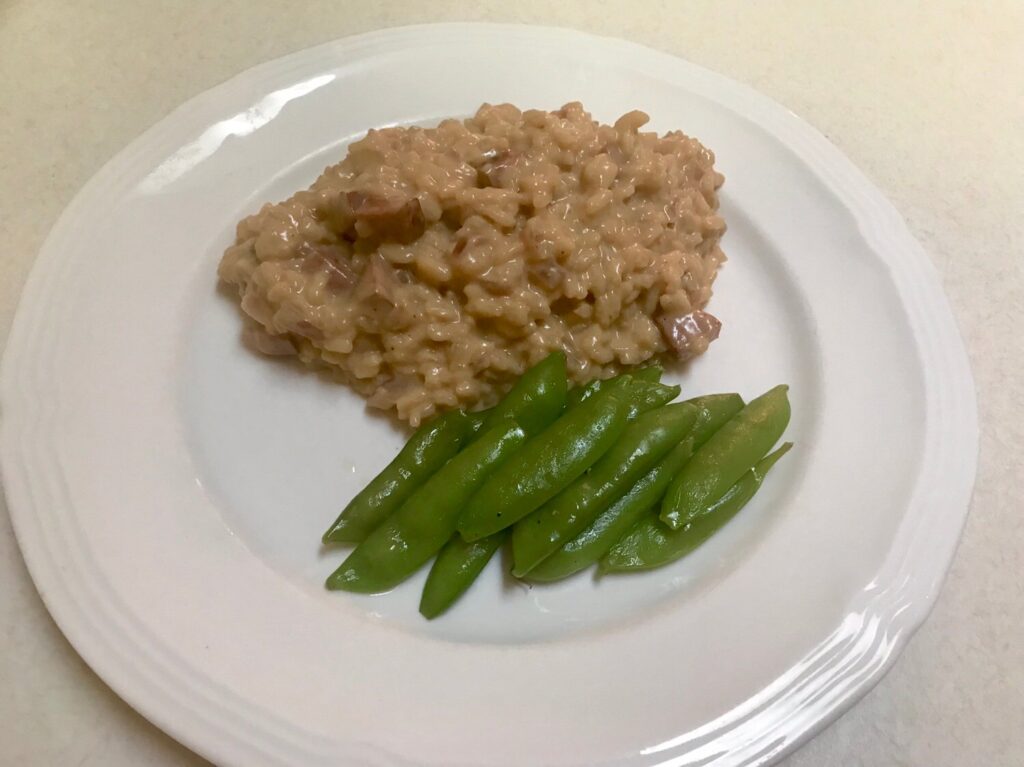
Serve with something green so that you don’t feel bad for going in for seconds.  The recipe should serve 6, but good luck! I’ve doubled it and taken it to a carry-in in a crock pot and never come home with leftovers.

If you are lucky enough to have leftovers, it is very good reheated the next day, but try this instead: spoon about 1/2 cup into a frying pan with a little olive oil and press down with the back of a spatula.

Cook on medium heat for about 3-5 minutes and carefully flip to cook the other side until brown and crispy (my second favorite cooking technique when it comes to cheese).

Cheesy Risotto (Mock Mac & Cheese)

  • 4 C chicken broth (or one 32 oz carton), heat in a sauce pan until just steaming
  • 1/2 C dry white wine or dry sherry
  • 1 1⁄2 t Coleman’s ground mustard
  • 1 C shredded cheddar cheese
  • 1⁄2 C FAGE 2% Greek yogurt
  • 2 slices Velveeta cheese
  • 6 oz kielbasa
  • 1 T canola oil
  • 1 medium red or sweet onion, diced
  • 2 cloves garlic, crushed
  • 1 1⁄2 C Arborio rice
  • salt and pepper to taste
Over medium/high heat, fry the kielbasa until crisp in oil.
To the hot oil and sausage, add onion and garlic. Sauté for 3-4 minutes or until soft.
Add Arborio rice and stir until slightly toasted, just 1-2 minutes should do it.
Add 2/3 cup chicken broth. Gently stir and adjust heat to just a simmer, not boiling. Stir gently and frequently (at least once every two minutes).
When to add more broth: Run the rubber spatula down the center of the pan, making a trough. If the risotto runs back together, it is not ready for more broth yet. If the risotto does not run back together and the trough remains, add another 2/3 cup broth.
Keep adding broth in 2/3 cup increments every time the trough is ready, until you have just a bit of broth left (Making sure you are stirring gently and frequently).
Taste the risotto. Is it done to your liking? It should be soft yet firm to the bite. If not, add the remaining broth until the risotto is the tenderness you desire. If it is done, add the white wine and remove from the heat.
Stir until white wine is absorbed and mostly evaporated. (If this is taking too long, you can reintroduce the pan to the heat momentarily).
Add ground mustard, shredded cheese and yogurt. Stir until melty and creamy.
Add two slices of Velveeta. Stir until fully incorporated. Salt and pepper to taste.

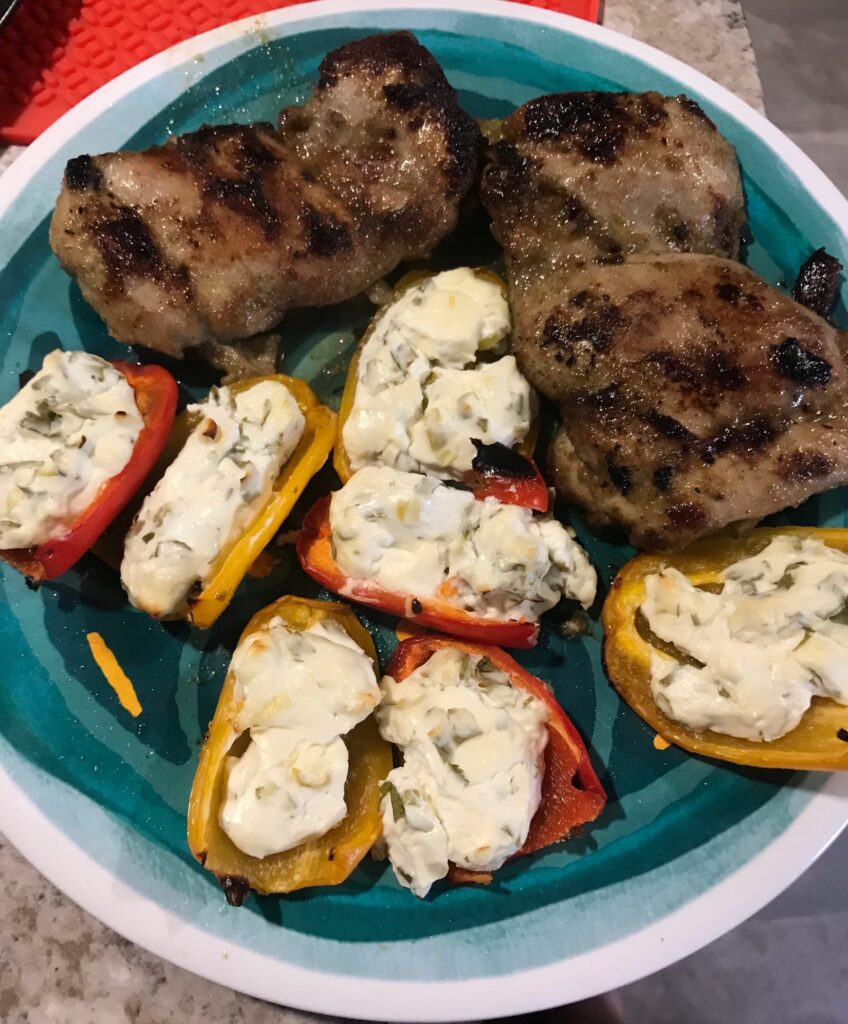
Recipe of the Week – Jerk Chicken and Stuffed Mini Bell Pepper Poppers

Who doesn’t love stuffed pepper poppers? Well, probably anyone who doesn’t like too much heat or is trying to eat healthy since they are breaded and deep-fried. The only guilt that you will feel eating these stuffed peppers is how many of them you will end up eating, but don’t worry they are actually pretty healthy too. The grilled jerk chicken is just a bonus yummy!
IMG_2251
I know, it looks like a lot of ingredients, but lots of flavor takes a little work and it’s not really so much stuff. By the way, this recipe works best on the grill but it was pouring rain outside, so everything was done on the stove or in the oven and worked out just fine!
IMG_6442
Start out by making the world’s worst smoothy. Combine 2-3 green onions (white and green parts), 1 large shallot, 1 T brown sugar, 2 T fresh lime juice, 2 T olive oil, 1/2 t allspice, 4 cloves of garlic, and a large Serrano chili in a food processor (or in our case, the Ninja cup). Someone will notice that in the first picture, we did not use a serrano. The store didn’t have them so I subbed an Anaheim. Use the chili of your choice based on heat and flavor preferences (our favorite is poblano). Blend it until smooth, and remember, be careful of touching your eyes, nose, mouth, or anything else you love. (On a side note, be really careful cleaning up afterwards, those pepper oils can really mess up the next thing you make in the same bowl.)
IMG_4252
Pour the mixture into a bowl or baggie and add 6-8 chicken thighs, legs, drums, breasts, or what ever else you have lying around.  We’ve used different cuts but prefer thighs for this recipe.  Let it sit while you prep the peppers.
IMG_5175
In another bowl, combine 1/4 c finely chopped green onion, another finely diced shallot, 1 T lime juice, 2 T chopped cilantro, 4 oz (half a package) of reduced fat cream cheese, 1/2 C FAGE 2% Greek yogurt and mix well.  Scoop it all into a baggie and toss it back in the fridge for a minute.
IMG_9140
Take a bag of mini sweet peppers and cut in half and core them. Arrange onto a grill pan. Take the bag of filling and snip the corner of the bag off to create a piping bag. Pipe filling into each pepper. I missed taking a picture of this step, guess I was too hungry!


Heat your grill and start the chicken first.  The peppers will take almost as long so get them going right away.  I usually place them directly on the grate but if the peppers are small, you may want to put down a piece of foil or use a grill pan so they don’t fall through.  Turn the chicken and rearrange the peppers if your grill heat is uneven.  You want the chicken crispy on the edges and the bottoms of the peppers blistered but not burnt.  The filling will not get very melty if you use reduced fat cheese, so you have to peek underneath.
IMG_6525
Serve with some fresh lime wedges and some crusty bread.  Let us know how hot you like your jerk in the comments below!
Here’s the original recipe from Cooking Light magazine and here is the version with my modifications.

How to Make It

1. Preheat grill to medium-high heat. After preheating, reduce one side to low.
2. Combine topping ingredients (except chicken) in a mini food processor; process until smooth. Combine mixture and chicken in a medium bowl or large baggie; toss well.
3. Combine remaining green onions, remaining shallots, remaining juice, cheese, cilantro, and sour cream. Cut and core the bell peppers lengthwise; discard seeds. Put cheese mixture in a bag, cut off the tip, and pipe filling into peppers. Place peppers on grill rack coated with cooking spray over medium-high heat. Grill 7 minutes or until peppers are lightly charred.
4. Place chicken on grill rack coated with cooking spray over medium-high heat. Cover and grill 5 minutes on each side. Move chicken over low heat. Cover and grill 5 minutes on each side or until done.
 
 
★ 25 years guiding ★ 48 U.S. states ★ 10 countries ★ 3,000+ Camino miles