
Did the Via Francigena Break the Bank? A Pilgrim Budget and How we Plan Pilgrimage

A budget for any vacation/holiday is a personal topic. It’s scary to allow others to see how we chose to spend our money. We risk judgment and ridicule. However, the benefits of sharing go back to the theme of all my blogs which is to share all parts of our Camino experiences despite what others think. I am an open book and will remain that way. You’re welcome. ❤️

We have walked 3 pilgrimages, the Camino Frances, Camino Portuguese, and the Via Francigena from Switzerland to Rome. We found it was the cheapest to walk the Camino Frances and the most expensive was the Via Francigena. If you want to see our YouTube videos on our latest walk, the Via Francigena, please click here.

A typical bunkroom in Switzerland

With some exceptions, you can find lodging from as cheap as a donativo where you make a donation for a bed, typically in a shared bunk room, with a shared bathroom. Sometimes that accommodation has bedding but you usually need to bring your own. Occasionally your host will serve a communal dinner but it is expected that you would leave more money. A typical donation is anywhere from €10-20 per person.

On the Via Francigena, you can camp in many places if you have a tent but I don’t know much more than that because we have never made the decision to camp. I know it’s illegal to wild camp in Spain but I also have known those who do it from time to time. Again, not my area of expertise. 

The entrance of our donativo lodging in Cort St. Andrea

With all of the pilgrimages we have done, we use guidebooks. They include lodging suggestions ranging from a donativo, camping, churches, municipalities, and private lodgings. When creating our reservations we always start with the guidebooks and create a plan from there.

Speaking of a plan, that’s another factor – to plan your reservations ahead or not. Some people will reserve a night or two ahead, especially in the busy season. Some people will just wing it every day, letting their feet decide how far they will walk each day. Others, like us, plan out all of our reservations ahead of time. There is no right or wrong way to plan…or not. It’s up to you and your personal preference.

Why do we choose to plan every night in advance? It’s a great question, haha. I mean, what if there’s an injury? What if we just can’t walk that far? What if we meet people we really want to walk with but can’t because they are staying in different places? Life is full of “what ifs.” We have also experienced every one of those challenges.

On our Camino Portugues, I had a foot injury and we had to rent bikes for a few weeks to give my foot a break. This meant we didn’t bike very far every day because we had to stick to our lodging plan. We made a few changes along the way to have some longer days more suited for a bike but only with the refundable reservations.

We always have days when we just can’t walk as far as we planned. However, we aren’t purists so we are ok with grabbing a bus, train, or taxi. We have to walk during the hottest part of the year so there are always going to be challenges, heat or not honestly. Creating a plan works for us because we enjoy trip planning. We enjoy making a few decisions while walking a pilgrimage. We like looking forward to planned rest days in villages/cities we have developed an interest in during our planning. Finally, as a couple, it gives us one less thing to debate when we are hot, tired, and crabby. My philosophy is I can argue for free at home but when on vacation/holiday, I don’t want to argue. Haha! Plus, planning gives us something to think about when the school year is getting exhausting or the winter months are feeling long.

Knocking on the budget door!

But you came here for a budget talk. There are a lot of factors that go into a budget for anyone. We have a few basic expectations if possible: (1) A private room because it’s the summer when we are walking and it’s too hot to be in a room with others. Additionally, snoring and the noise of a shared room are not something we prefer. A good night’s sleep is critical. (2) A private bathroom is ideal but not required. A shared bathroom is ok from time to time if it saves us money but we really like a private bathroom. (3) We want shared experiences with other pilgrims so we look for accommodations for pilgrims with a communal dinner and then ask if they have private rooms. Many times they do if you ask early enough, as these tend to book up early. (4) Since we are walking in the heat of the summer we look for places with air conditioning from time to time and more often when we are experiencing excessive heat. These are the most expensive rooms but necessary for relief from the heat. I get terrible heat rash in the summer and only a cool night’s sleep brings me relief from it. (5) When we are booking a two-night stay we always look for a private room, with a private bathroom, with air conditioning. This is the ideal situation unless the air conditioning isn’t working but that’s another subject. 

The joys of a private room

I mentioned you can find rooms for €10-20 a person and in order to make our budget work we find rooms like this from time to time. Other rooms in accommodations for pilgrims can run us €35-50 total for both of us. A room from websites like Booking.com can run €50 to over €100, depending on the city. Of course, your bigger cities will have all types of accommodations for any budget.

For comparison, in 2017 on the Camino Frances, our budget averaged €50 a night but if we were to do it again we could do better to lower that budget. We didn’t stay in as many pilgrim accommodations as we could have then. We’ve learned a lot since 2017. Though with inflation, who knows for sure what our budget will be?

In 2019, on the Camino Portuguese, we walked the coastal route which is more expensive. Our budget averaged €65 a night. However, we struggled to find pilgrim accommodations on the coast. In retrospect, I think we could have done a better job and lowered that cost a bit.

In 2022, on the Via Francigena, we averaged €75 a night. Our cheapest nights were donativo’s at €20. We had a few pricey nights because we took rest days in Marina de Massa and on Lake Bolsena. But we have no regrets. This was our 15 wedding anniversary trip and our 50th birthday trip. It was all we dreamed about and more.

We didn’t spend money on laundry because we hand-washed our clothes every day. Our only other expense was the occasional pharmacy run for compeed or anti-inflammatory cream, food, and of course, wine.

Sometimes you just need Doritos and wine… in bed while your laundry is drying 😆

A food budget is extremely subjective. There is no way we can compare food budgets and be helpful. First, I am married to a foodie so getting him to pull back on trying every new dish is impossible. Second, we are wine lovers so there has to be a wine budget. And why not, it’s Italy!

We saved food money by utilizing any free breakfast food offered even if it didn’t appeal to us. We packed them as snacks or enjoyed them immediately. We limited our espresso budget and only enjoyed a good cappuccino from time to time, sorry we aren’t coffee lovers. We would grab food in a market whenever possible. But our love of cocktails, wine, and outstanding dinners made our budget a bit bigger. We spent about €75 a day on food.

As the CFO of our family, my goal is to stay within our budget and never have credit card debt. We want to retire debt-free and retirement gets closer every year. We did what we set out to do. Are we more cash-poor because of it? Yes! But the memories are priceless and you can’t take it with you! ❤️

Our trips may look extravagant to some but when you’re on pilgrimage there are no souvenirs. We took a long walk to Rome and enjoyed every step, even the rough ones. 

The VF Day 14 & 15: Toilet Paper, Food, & A Soft Bed

Ramblings from the Via Francigena…

I don’t ask for much when we’re on pilgrimage. Having our most basic needs met is really all we desire which means availability of decent toilet paper, food, and a soft bed. 😆 Unfortunately, that is asking too much at times. 😏 The biggest difference between the pilgrimage we are on and the traditional understanding of backpacking is the aforementioned luxuries.

Remember the toilet paper crisis of 2020? How could we forget! Toilet paper is still an important topic though, right? Let me tell you during the first week of this pilgrimage, we had outstanding toilet paper. Oh Switzerland, I don’t know what you do to make your toilet paper so grand but I would love to invest stock in it and bring it to the United States. I mean, it’s that good, friends. Since we have arrived in Italy the quality has diminished. I think you understand the challenge and I’m sure I have said enough on the topic.

You read about my challenges with finding food in an earlier blog, if you didn’t, click here. Lately, finding food has not been too much of a problem. We do need to review where we are walking each day to ensure there will be a stop for food. If there isn’t, we have to prepare for the long stretch without food by finding a market the night before. We start walking early in the morning to beat the heat. Unfortunately dinner isn’t typically served until at least 7 p.m. but I am grateful at this point for finding food at all. I’m sure there will be more on good in future blogs.

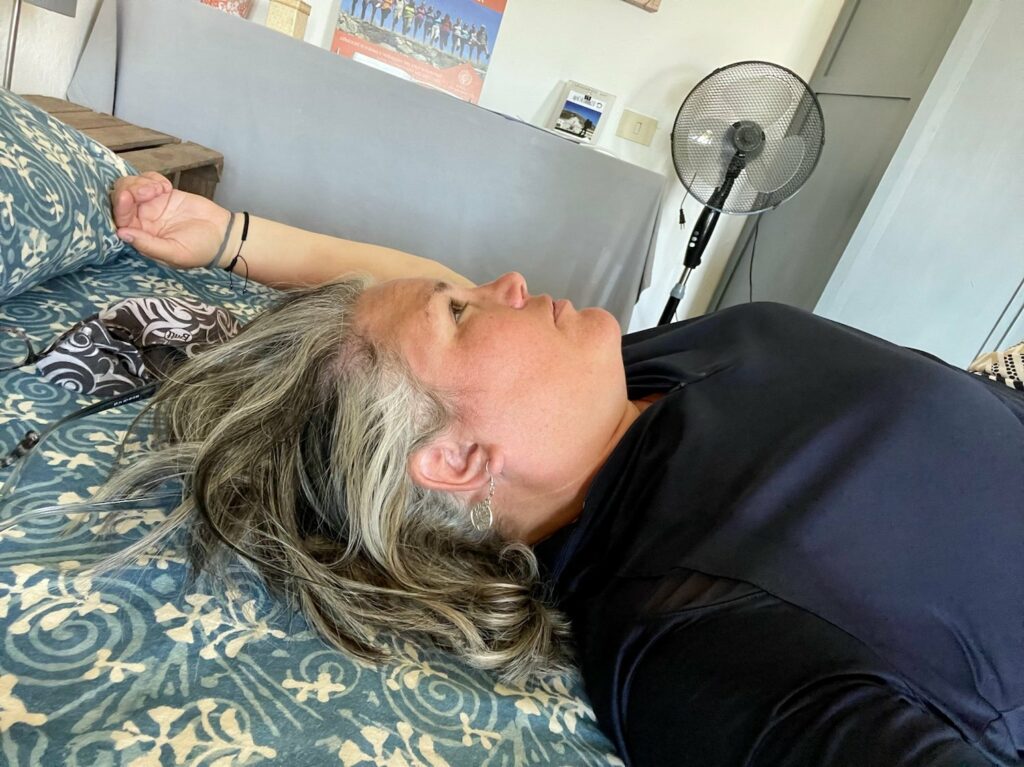
My last rambling today is about the importance of a good nights sleep. Let me say, as a backpacker, my lightweight backpacking inflatable mattress is often more comfortable than the beds we have slept in since entering Italy.

Mattresses for sale in Vercelli!

I wish I would have brought my inflatable mattress but I didn’t know it would be this much of a problem. I thought the snoring of other pilgrims would be my biggest issue. But, nope! Don’t get me wrong, I am not looking for the most luxurious feather bed. I would just prefer the bed be more comfortable than the ground. It is hard enough to walk this many miles day-after-day but when you add a bad nights sleep to the mix, it makes the walking even more challenging.

Last night was the first time in a week I had an outstanding night’s sleep. I wish I could take that bed with me. Today’s walk was easier because my low back and hips weren’t screaming at me.

Maybe I’m asking too much. Maybe I want to think about more than just my most basic human needs. I am a researcher of Maslow and I know I can’t self actualize if I am always worried about my basic needs. Maybe I should stop worrying and be thankful for a roof over my head and any toilet paper at all. Maybe I shouldn’t worry about self actualizing. Maybe I already have or maybe I should just stop rambling about all of it.

That’s all I have for you today. Be thankful for your bounty, your bed, of course, your toilet paper!

Stats walking from Santhià to Vercelli – 10 km plus a train for 16 km so we could enjoy an afternoon in Vercelli. We definitely should have planned a rest day here, what a great town! Check out our YouTube video too!

  • Lodging at La Terrazza Vercelli Bed & Charme – €118 – outstanding bed and air conditioning on a very hot day. Paid too much but worth it for an outstanding nights sleep!

Stats walking from Vercelli to Robbio – 17.64 km. Check out our YouTube video here!

  • Lodging for at Agriturismo Pescarolo/Casa del Pellegrino – €60 for a private room with a shared bathroom and back to the typical bed with no air conditioning.

*Listing our accommodation is not an endorsement. This is just a point of information for fellow pilgrims. See our reviews on Booking.com, the guidebooks, and fellow pilgrims for more details to make the decision best for you.

My Favorite Things: Eating on the Camino de Santiago

You may not know this about me but I love food. I mean that I REALLY love food. Any time we travel, I spend a decent amount of time looking for local specialties and the best places to eat. That does not mean that we spend a lot of money on food. Yes, sometimes we will go to a fancy restaurant and drop a couple of Benjamins for a really nice dinner but some of our favorite and most memorable meals have been at dives that don’t know who Zagat is. With that in mind, my first Monday morning post that isn’t a recipe of the week is going to cover my favorite subject… FOOD!

Some of the most frequently asked questions we hear about the Camino deal with food. Do you have to carry your food? What’s the food like? How expensive is food? What if I have dietary concerns? What if I’m a picky eater? I hope to answer all of those questions here and assure you that you will not starve while walking on the Camino de Santiago, no matter how picky or restrictive your diet is.

First off, Michelle and I both try to live a relatively healthy lifestyle. We like to eat fresh, non-processed food as much as possible. We try to avoid excess sugar, but we will eat an occasional dessert and we both share a love of wine and cocktails. Michelle must eat gluten-free because of her Hashimoto’s disease (an autoimmune thyroid disease).

Going into the Camino, we knew that we were not going to be worried about counting calories. While walking 13 plus miles per day in the extreme heat that we were going to be burning plenty of them. One day I did do my best guess at tracking calories because I was curious and came up with over 3000. That said, we came back from Spain at nearly the same weight that we left home. The challenge was adjusting to not eating as much food as we had been used to while on the Camino and we each gained weight upon our return.

Upon arriving in Madrid after a long overnight flight, we were both starving. Once we navigated the Madrid subway and made our way to the Atocha train station it was time to find some food. We had done a little research ahead of time and new that there was a counter service fast food place that had gluten-free breakfast items. After a little searching, Michelle had a chocolate croissant and egg and cheese sandwich and I had a taste of my first bocadillo (not gluten-free). Our first meal was a success

Chocolate croissant, egg and cheese sandwich (both gluten-free), and breakfast bocadillo (not gluten-free) at the Atocha train station.

Finding food on the Camino is rarely a problem. Most days pilgrims pass through several villages and there is almost always at least one bar or cafe, and usually, several options are within feet of the marked path. Many albergues offer a pilgrim’s meal at dinner time for a small additional charge (€5-10). Before talking about dinner though, let discuss meals in Spain and how that fits into the pilgrim’s schedule.

Our first pilgrim’s meal in St. Jean Pied-de-Port

Breakfast in Spain is usually the smallest meal of the day and rarely consists of much more than toast (tostada) with butter and jam, pastries, and cafe con leche (espresso with steamed milk). Michelle sometimes was able to get rice cakes but often had to make do with a little fruit or an egg. Among the pilgrims we know, this is called “first breakfast” and you’ve probably already guessed that means “second breakfast” can’t be far behind. First breakfast was onfton included in the price of lodging.

First breakfast at a bed and breakfast in SJPdP.
Gluten-free breakfast option, if you’re lucky

Once we got through the Pyrenees, Spain was getting record high temperatures and in order to beat the heat, we were often leaving our albergue before 6 am. As a result, we needed to purchase breakfast the night before since most places to eat didn’t open until 6:30 or 7:00 a.m. Our breakfast of choice became a snickers bar and Monster as we walked in the dark. Not the best choice, but it helped in a pinch and we have a few ideas to help us when we are back on the Camino this June 2019.

After walking 5-8 km, most mornings we would come to our first village of the day and usually would run into a group of pilgrims sitting outside a bar or cafe eating second breakfast. Choices of food would range from tortilla and bocadillo to a more traditional “American” breakfast of fried eggs and bacon. We often spent less than €10 for second breakfast with two Coke Zero.

Lunch in Spain can be tricky for Americans. Lunch is typically the largest meal of the day and is often eaten at home but for pilgrims, everything closes down around 2 p.m. and doesn’t reopen until after 5 p.m. for siesta. If you arrive at your final destination for the day during that time, you will often not be able to find food because EVERYTHING is closed. We would typically get a similar meal to our second breakfast or if we were lucky, some tapas. Often by this time of the day, we would enjoy some amazing Spanish wine or beer if we were within the last 5k of our walk. The price here was often about the same as second breakfast, around €10 including wine.

Once we were done for the day, it was time to check into our albergue, hand wash our laundry, shower, and take a little nap. We were usually pretty hungry at this point and would often get a snack. Our go-to became a bottle of wine and Doritos for €5-8. So our not-so-processed lifestyle had gone out the window, but when you’re hungry you’ll eat anything!

Wine is often less expensive than soda. We often saw 750 ml bottles in the mercado for less than €1

Dinner in Spain is often not served until 8 pm or later, long after most pilgrims have crashed into bed. Luckily, along the Camino, most villages work hard to serve the needs of pilgrims and dinner is available after 5 pm. When an albergue offers a communal meal it is usually at a set time and if you miss it, there’s no food for you. Fortunately, there is never a shortage of bars and restaurants to serve every food need for the average pilgrim. We ate a wide variety of regional and local specialties from ranging from €8 to much higher. The most economical dinner option is the pilgrim’s meal or menú del día. This dinner was usually three courses and included wine or bottled water (learn to ask for “agua del grifo” or tap water). The first course could be soup, salad, or even pasta. The second course was usually some kind of meat with fried potatoes. The final course would consist of dessert. I was always sure to ask for “especialidad de la casa” or the house special. I was able to try such unusual dishes as tuna ragu, garlic soup, home-made cheeses, and even chicken curry. We did spend a little more on dinner many nights with our total usually coming in at about €20-30 for two bringing our food total for the day to under €60 per day for two people. If you want to know more about our Camino budget, check out Michelle’s post here.

There are a couple of foods that I have to mention because they are too amazing to leave out. Once in Galicia, seafood is found nearly everywhere, is the freshest that I’ve every eaten, and very inexpensive by American standards

Many restaurants, bars, and even hotels will often serve wine or other alcoholic beverage that they make in house. Orujo, Patxaran, and Vermouth are popular regionally, make for a nice aperitif, and were served after dinner gratis in some places!

Sometimes you just need to eat something familiar and in larger cities, you may run across American fast food. We saw KFC, Burger King, McDonald’s but only stopped once because they had gluten-free buns!

We never cooked our own meals, but many pilgrims do. Markets, supermarkets, and even farmer’s markets are prevalent but be warned, in smaller villages most are closed during siesta and on Sundays. This is a great way to save money and get to know other pilgrims.

If you have special dietary concerns, most restaurants will work with you to accommodate our restrictions. Make sure you learn the names of your allergies in Spanish so you can communicate with the server. Vegetarians will probably have the greatest difficulty as Spaniards love their meat, but we did run across many vegetarians who said they were far from starving. Michelle did not have too many problems eating “sin gluten” and only got sick once during our entire time in Spain from cross contamination.

Tarta de Santiago is a staple of the Camino and this almond cake is naturally gluten-free when made properly. Often in bars it isn’t.

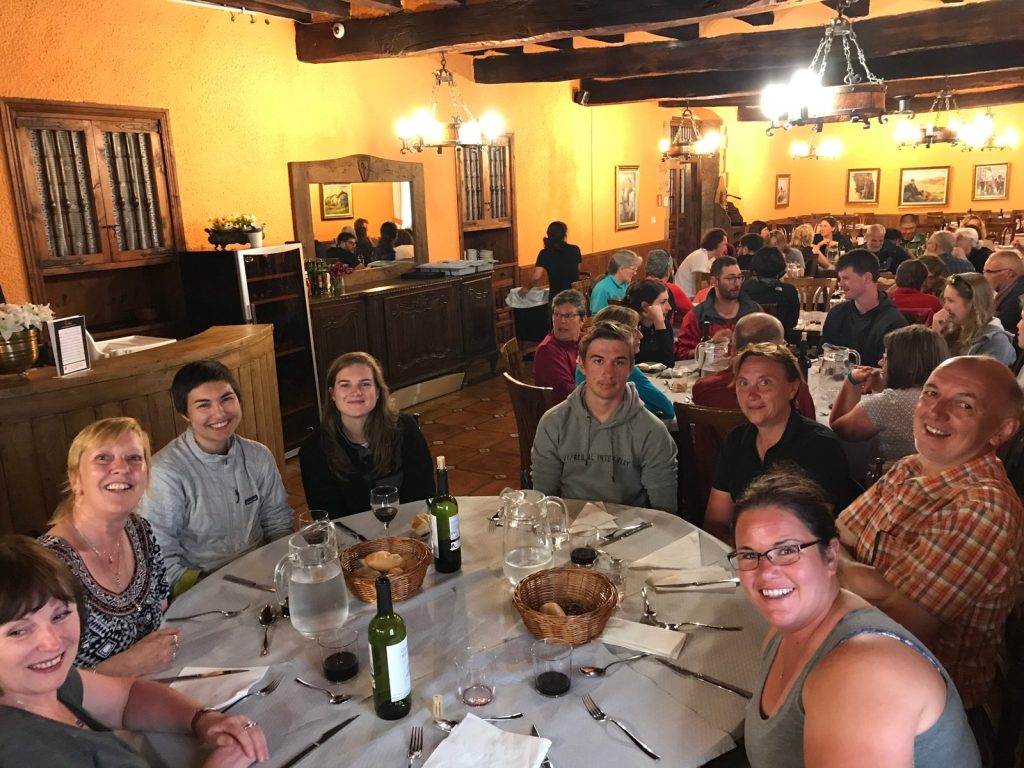
Never pass up an opportunity to eat a communal dinner, we met wonderful friends and had a great time, even when the food was only mediocre.

Communal dinner in Roncesvalles – the food wasn’t the best but the company was fantiastic

Finally, I can’t recommend enough to use common sense when eating in Spain, just as you would anywhere in the states. If an establishment looks dirty or seedy, don’t go in or leave. We never had any problems and NEVER felt unsafe while in Spain, but there were times we decided not to go into a bar or down a certain street because it didn’t look like our scene. Another thing to be wary of is looking for fresh food. We often didn’t go into places because they had a sign like this outside. All of the food pictured is premade, frozen food that is just reheated. Food is so inexpensive in Spain, why waste your time eating a frozen meal?

If you have additional questions about food or any other subjects on the Camino, let us know in the comments below. If you’ve been, what was your favorite meal?

★ 25 years guiding ★ 48 U.S. states ★ 10 countries ★ 3,000+ Camino miles