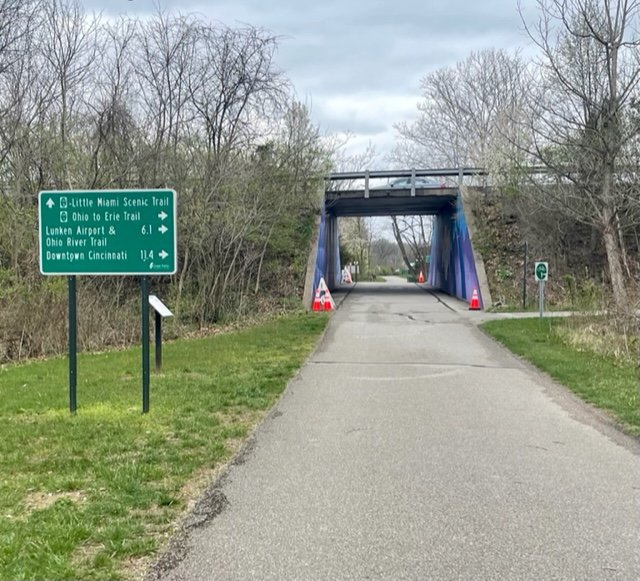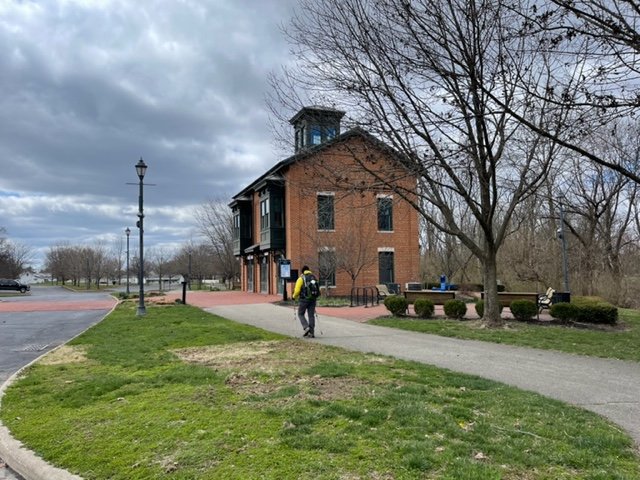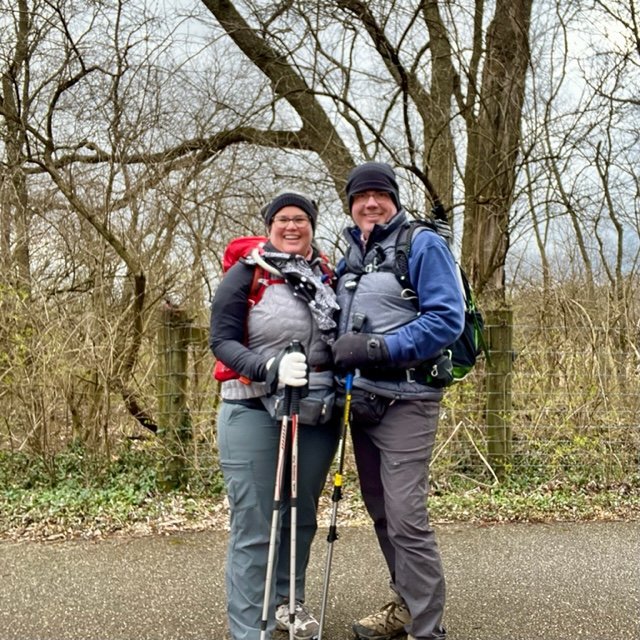
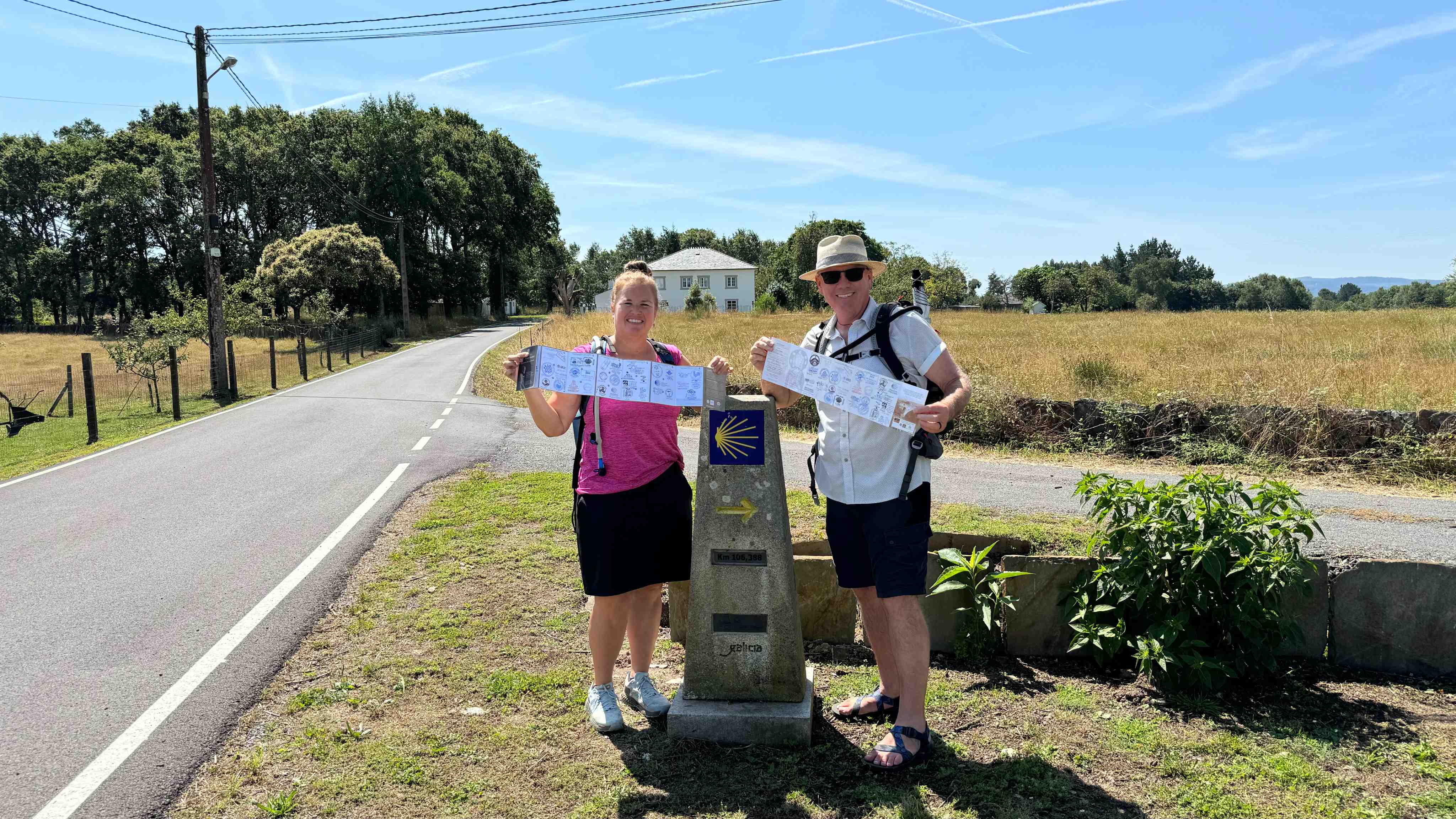
It’s cold, snowing, and the wind attempted to knock us off our feet most of the day. Fortunately on this bike trail we were a bit protected from the wind because the reality of how windy it actually was illustrated at every street crossing. 😩
Have I set the scene? We’re ridiculous, but we’re even more ridiculously motivated to get a week of backpacking under our belt. We haven’t been on a long backpacking trip since the summer of 2019 because of my necessary foot surgeries and then, well everyone knows what happened in March 2020.
The goal: To walk from Springfield, OH (north of Dayton) to Covington, KY on the Little Miami River Trail. Throughout the week, we are staying with fellow hikers, friends, an albergue-style home, and two hotels (because a good Camino always needs a splurge). It will be 90 miles over 7 days of walking, averaging just under 13 miles a day.
Today was supposed to be an easy 8.5 mile flat trail walk and Mother Nature tried to challenge us but alas we pressed on. Tonight we’re staying in an Air B&B in Yellow Springs at the Corry Street Retreat. It’s adorable and definitely feels like a Camino accommodation with 3 rooms, 3 detached bathrooms, and a common area with a full kitchen.
Corry Street Retreat from Air B&B in Yellow Springs, Ohio
It’s going to be a great week. We’ll have more cold, another dash of wind, sunshine, and even a 74 degree day. But we’re together and our only goals are walking, washing our clothes, and eating. If you want more, here’s a video from day 1 and day 2 on the trail: click here.
Total for today: 8.5 miles; $213 with $137 for food and $76 for our accommodations.
It has been wonderful to extend our 2019 Camino into the fall season as we wrap up the editing and posting of our Camino YouTube videos. In preparation for this wrap-up blog, I re-watched all of our Camino videos – what a treat, re-living the ups, downs, the culture, and the sheer joy of our shared experiences. Today I am going to tell you about my favorite videos from the trip and let you know what is coming next for us.
Of all the videos we created from our Camino, my number 1 favorite video is reflecting on our Camino Frances and entering Santiago. It’s a long video, but I love it because it’s raw, in the moment, emotion. We don’t have too many moments like this but I hit a low point right before entering Santiago.
I’d suffered serious anxiety that plagued me for the rest of our time in Europe. We thought it was just about my foot but later concluded it also had to do with eating gluten. I don’t normally eat gluten because I suffer severe digestive problems. However, over there I wasn’t having any of my typical problems so we didn’t know it was an issue. I was having a lot of inflammation issues which should have been a sign but I attributed it to the wine, the walking, and not enough water. I should have taken a break from gluten to see the difference, but alas, hindsight is a great teacher. Once the gluten was completely out of my system, about 10 days after we got home, the anxiety stopped too. Lessons learned.
My second favorite video was our walk from Astorga to Villafranca del Bierzo. I love this video because it’s classic, iconic, all you want from the Camino, and just all-around “this is the Camino” video.
At this point, we had not hit any lows, actually, we were on the biggest high of the entire Camino. We were on a high metaphorically and hit our highest evaluation point. We may look tired in our videos but we were re-living moments from our 2017 Camino, developing fantastic relationships, working extremely hard, capturing amazing views to memory, and having a ton of fun!
My next favorite video was on our Camino Portuguese. We had settled into a new rhythm of riding bikes vs. walking. We were embracing “holiday” time, less work and more play. We also experienced a festival that only happens once every four years.
If you want to know about the Festival of Trays, here’s a link: http://www.centerofportugal.com/events/trays-festival/. There was something wonderfully authentic about this festival and the village of Tomar. We highly recommend everyone visit Tomar, even when the festival is not happening.
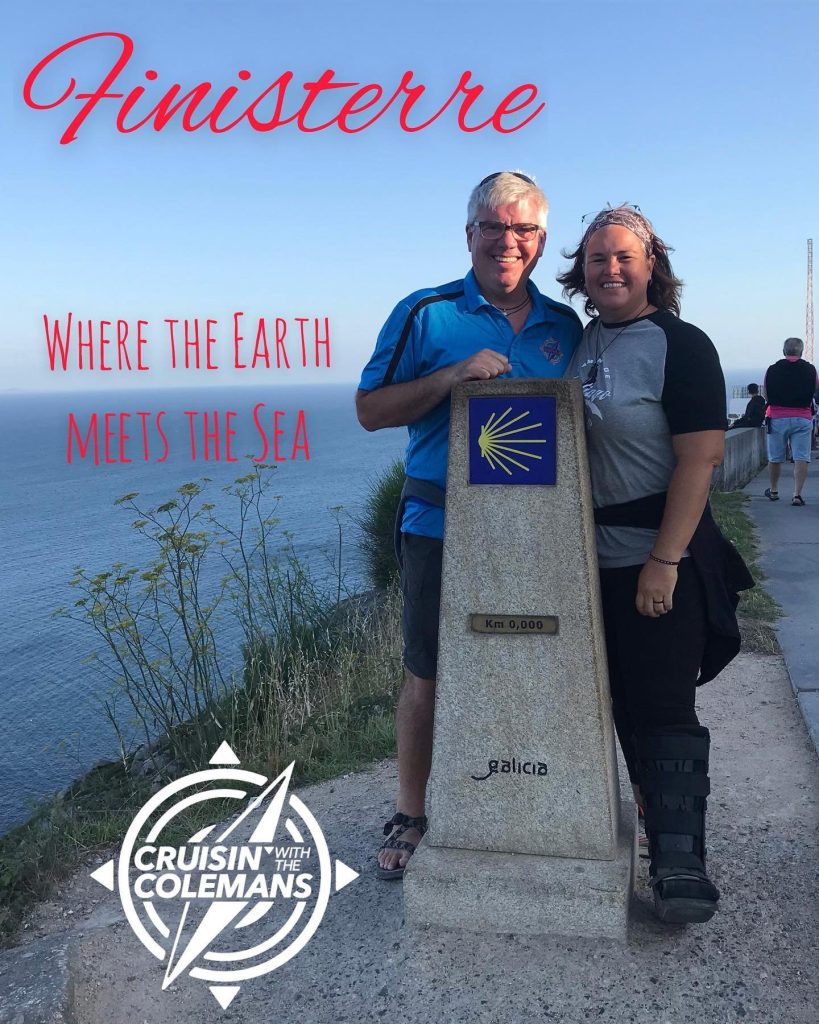
My final video in my top favorites is the video in Finisterre. The end of the Camino. We love this village! It has a bit of a bohemian vibe, a 2.5 kilometer wide beach, and a perfect way to end our Camino.
There is one more video coming out which will cover a little more Porto and our final 48 hours in Lisbon as we wrap up our tourist time and make our final purchases before heading back to the states. We are still processing our takeaways from our Camino 2019. We blogged about what we have learned thus far, you can find that blog by clicking here.
What is next for the Colemans?
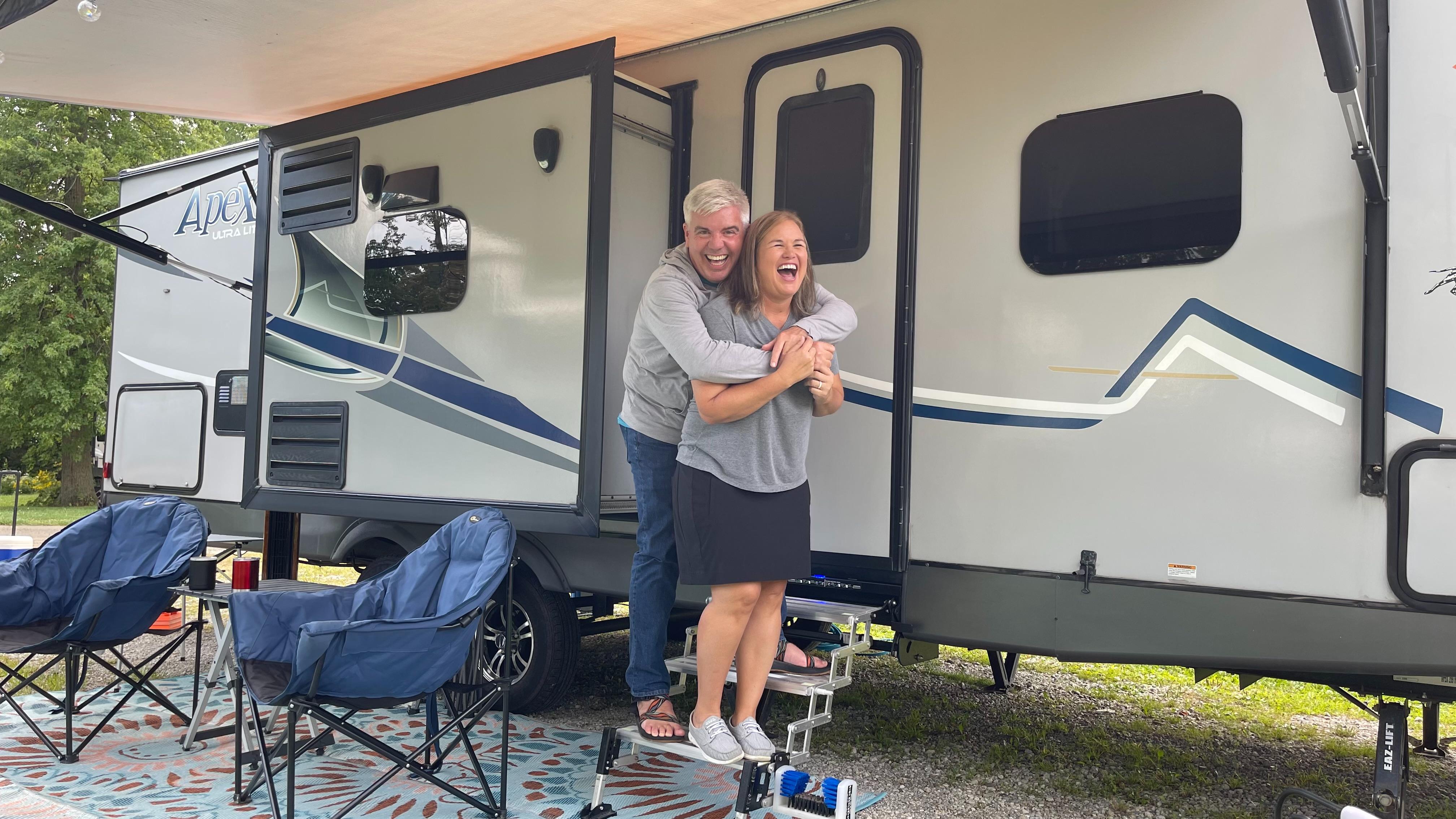
We are still discovering the medium we enjoy most to share our journey with all of you, blogging, YouTubing, or a combination called vlogging. We have a lot of videos to share as we have been making renovations to our travel trailer. We are going to attempt more vlogging which we interpret as a combination of video and blog and the subjects coming up will include RV’ing and hiking.
If there is something you have enjoyed from our videos and/or our blogs, please comment below and tell us about it. If there is something you want to hear more about, let us know that too. Blogging/vlogging is a journey we have been on for just over a year and we are still finessing and fine-tuning the direction our channel is taking but your feedback means a lot to us. What we love most of all is connecting with all of you – so don’t be shy!
UPDATE: Check out our new how-to video to make Tarta de la Abuela Borracho here: https://youtu.be/gbQQPMR_Nf4
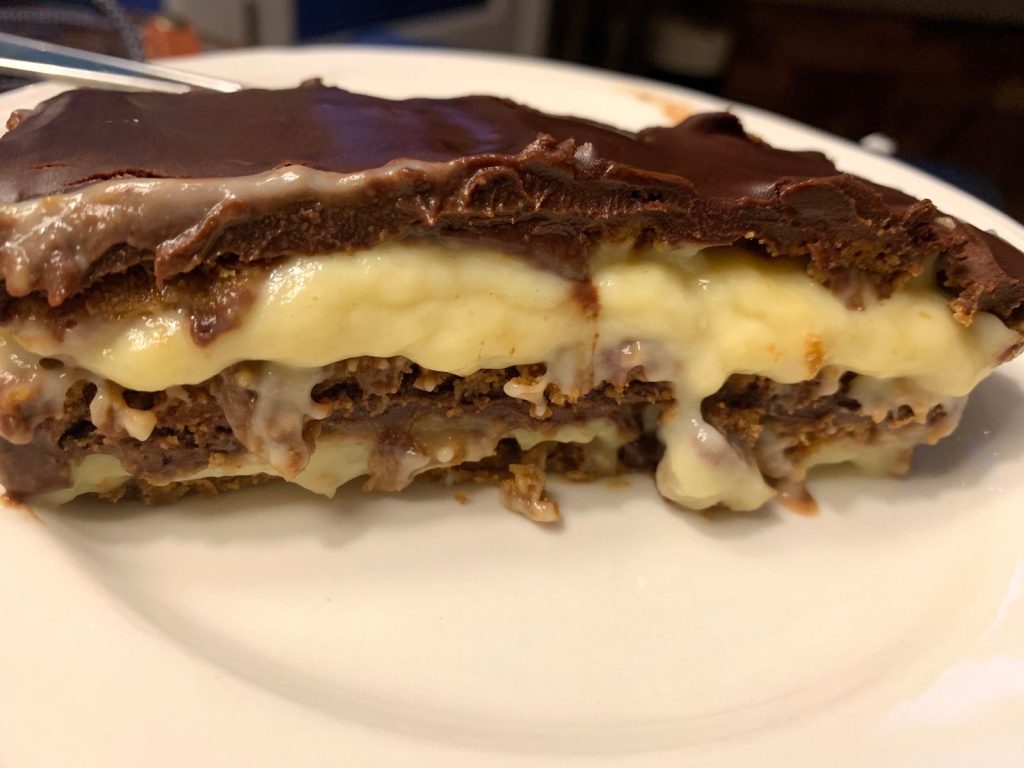
While walking across Spain and Portugal during the summers of 2017 and 2019, we were offered Tarta de la Abuela many times. It was always the same basic recipe, but with small variations such as vanilla, caramel, or even banana custard. We also ran into several abuelas (and more often abuelos) who would enjoy a little nip almost any time of the day, so we thought why not incorporate it into this delicious cake.
A Tarta de la Abuela that we were served in Pontevedra.
This cake is really a breeze to make and here in the States is often called an icebox cake. They’re not very common anymore, but I don’t know why. Let’s try to bring them back! If you want to simplify the recipe, you could always use instant pudding but grandma would not approve, plus the custard is actually really easy to make.
Everything you need for a pan of delicious cake.
Start by warming four cups of milk in a saucepan along with a stick of cinnamon. Before it starts boiling, remove the pan from the heat. Cover and let it stand until slightly cooled. If it is too hot when added to eggs in the next step, they will cook (not good). Remove the cinnamon stick and put 1 c of milk into a bowl.
In a small bowl, mix four egg yolks, a quarter cup of corn starch, and one cup of sugar. It will be a thick paste.
Begin combining the milk little by little, stirring constantly, with the egg mixture. Return to stove and heat, stirring frequently until the mixture is thickened and somewhat reduced. Keep the heat low so that the custard does not burn to the bottom of the pan. This custard should be thick.
The milk and egg mixture most be monitored closely so that it does not burn on the bottom of the pan. If you burn it, throw it out and start over.
The egg and sugar mixture.
Once the custard has your desired texture, remove from heat and allow to cool slightly then add a half cup of Orujo Tostada. Orujo is a traditional liqueur made from distilled grapes after they have been pressed for winemaking. The result is Spanish white lightening. It is often flavored and served as a digestive after dinner. The most popular flavors are an herbal and a coffee flavor, but one store we visited had more than twenty flavors available! You probably won’t be able to get Orujo in the U.S. so substitute caramel vodka or even butterscotch schnapps.
Cream and butter
Chocolate chips added to make ganache
Finished ganache
To make the ganache layer, heat a half cup of cream and four tablespoons of butter in another saucepan until it starts to steam a little. Remove from heat and add one cup of chocolate chips. Stir until thoroughly melted and combined.
At assemble the cake, begin by soaking several cookies in the bowl of milk and transfer to a loaf pan. Don’t soak them too long or they will break apart.
Who doesn’t love to dip cookies in milk?
Cover the cookies with a layer of half of the custard. Put another layer of milk-soaked cookies. Top with half of the chocolate ganache. Repeat with cookies, the remainder of the custard, and the fourth layer of cookies.
Layer one
Add more cookies
The final layer
And finally, add the last layer of chocolate custard. Cover with plastic wrap and refrigerate for at least 2 hours or overnight. By allowing the cake to sit, the cookies will absorb some of the liquid from the custard and become soft and cake-like. The photos in this post are of a half recipe so the layers are a little thinner.
The smaller the pan, the thicker the final layers will be.
Tarta de la Abuela Borracho (Drunken Grandma’s Cake)
4 cups milk
1 cinnamon stick
2-3 packages of gluten free graham crackers (or shortbread style cookies)
1 cup sugar
1/4 cup cornstarch
4 egg yolks
1/2 cup caramel liqueur
1 cup dark chocolate chips
4 T butter
1/2 cup cream or half and half
Warm the milk in a saucepan with the cinnamon. Before it starts boiling remove from the heat. Cover and let it stand until slightly cooled. If it is too hot when added to eggs, they will cook (not good).
Remove the cinnamon stick and put 1 c of milk into a bowl.
Mix the egg yolks, the corn starch and the sugar in a bowl. It will be a thick paste.
Start adding the milk little by little mixing constantly with the rest of the ingredients. Return to stove and heat, stirring frequently until the mixture is thickened and somewhat reduced. Keep the heat low so that the custard does not burn to the bottom of the pan. This custard should be thick.
Once the custard has your desired texture, remove from heat and allow to cool slightly then add the liqueur.
Heat cream and butter in another saucepan until it starts to steam a little. Remove from heat and add chocolate chips. Stir until thoroughly melted and combined.
To assemble the cake:
Begin by soaking several cookies in the bowl of milk and transfer to a loaf pan. Don’t soak them too long or they will break apart.
Cover the cookies with a layer of half of the custard.
Put another layer of milk-soaked cookies.
Top with half of chocolate ganache.
Repeat with cookies, remainder of the custard, and a four layer of cookies.
And finally, add the last layer of chocolate custard. Cover with cling film and refrigerate for at least 2 hours or overnight.
Last week I began reflecting on our 2019 Camino, sharing five of our top ten reflections from our Camino. You can find that blog by clicking here. In June and July of 2019, we biked and hiked about 550 miles or 882 kilometers on the Camino. We walked from León, Spain to Santiago de Compostela. Then we flew down to Lisbon, Portugal where we biked from Lisbon to Porto and walked from Porto to Santiago de Compostela. This was our second Camino as we walked the Camino Frances in its entirety in 2017.
Astorga is breathtaking in the summer
We were blessed with fantastic weather, being the summer season. In June we had cold mornings and cool afternoons, by July we were thrilled to have quite a few weeks in the mid-70s. It only rained twice, which probably wasn’t great for the farmers but we relished in the weather.
Though the weather was kind to us I struggled throughout much of the Camino. I had foot problems which wasn’t anything too unusual for me. But more importantly, I developed anxiety while on the Camino which stunned both of us. Unfortunately, I had to go to the emergency room the night before we walked into Santiago on the Camino Frances because my shortness of breath was at an all-time high. I was convinced it was a heart attack. Thankfully we found a hospital with an interpreter who stayed with us all night and had fantastic staff who ran a lot of tests before concluding it was anxiety. They taught me to remember I was on holiday and needed to start acting like it. I am still coming to terms with the “why” I had such high anxiety but I think the answer lies somewhere in the remaining five reflections.
#5 – Live Like Locals
This reflection comes from the idea that when you walk the Camino you are on vacation, or on holiday as my nurses reminded me. In general, when we travel we try to follow the philosophy of “living like the locals” by minimizing tourist attractions, avoiding chain restaurants, seeking out local activities, and finding ways to engage with local residents.
A wonderful picnic lunch with locals and owners of Camino by Boat
On the Camino Portuguese, there are a lot of locals and not much else; however, many pilgrims stick with other pilgrims. It may be seeking what we have in common with one another, the language barriers, you’re only with a local for a night or two, or just the ease of talking with those you walk by every day. But if you can spend time getting to know the locals, I promise you will have a richer experience. There are several ways this can happen.
Camino swag made by Portuguese Artisan
When you are looking for a room for the night stay in a small albergue, stay an extra night if you meet a local that you really connect with, and seek out places to eat where you can engage with the locals. Also, if someone is selling something on the side of the road, talk to him or her. We each bought Camino necklaces made by a local and the stories he shared made our experience much richer (photo above). We learned so much about the communities, the culture, the neighborhoods, just by talking to the locals. They are certainly the most knowledgable about the country you are experiencing.
#4 – Find the Festivals
This is a must-do for us whenever we travel for several reasons. (1) If prices are usually high, a festival is usually the reason why. Then you have to decide if you want to stay in that town for the festival or press onward. (2) You can learn what’s important to a community based on what they are celebrating. (3) We make a reservation in advance to make sure we have a room, and if you book early, you usually can find a better price. (4) It helps us decide if we want to plan an extra rest day in that town/village.
The Festival of Trays happens once every 4 years in Tomar, Portugal
On our Camino, we knew about two festivals that we made sure were included. The Festival of Trays in Tomar, Portugal which included a competition of “best-decorated neighborhood” in the photo above (not the winner, that we know of), parades, and processionals. We only planned one rest day here but wished we would have had two days in Tomar. The second festival was the Apostle Festival in Santiago de Compostela, Spain. It happens every year during the Feast of St. James. It is the largest festival of the year and we have been able to attend during both of our Caminos. However, if you don’t book early, it will be tough and expensive to find a room.
#3 – Alone vs. Lonely
This is an interesting reflection for me and one that surprised me deeply. Let me set up. In 2017, on the Camino Frances, we were with people all the time. We were rarely alone and we are still friends today with several people we met on the Camino. Was it because we walked the entire Camino? I don’t think so. Were we different? I don’t think so except that I was in a lot of pain this time so I may have been more introverted. So that may have been one reason.
Brian capturing the perfect water shot on an empty beach
On this Camino, we decided to walk part of one Camino and all of another. Does that mean we split our focus and didn’t have the time to build relationships? Maybe. Upon reflection, I wish would have only walked the Camino Portuguese. We were too “all over the place” on this Camino.
However, and this is big, the friendships we still have today from our 2017 encouraged us to walk on the Camino Frances. Why? I am still processing but here is what I have concluded thus far about our Camino Portuguese. (1) We were on bikes from Lisbon to Porto which means we were not walking day by day with other people. (2) Pilgrims were shockingly judgemental about those who bike the Camino. This hurt me deeply but we had fellow pilgrims tell us we were cheating. The locals were kinder than pilgrims. (3) By the time we were walking again, many people already had their “clicks” and we were not a part of them. (4) There were a lot of larger groups on the Camino. (5) When we talked to pilgrims, we learned that many people walk the Camino Portuguese in part because there are fewer people and they were more interested in the solitude. In the end, Brian and I had each other and we certainly grew closer together.
#2 – Planning Extends the Fun
We absolutely love planning our travels. The planning time gives us something to do when we can’t travel because we are working, it gives us experiences to look forward to, and it gives us time to research what is happening during the time we will be at a certain place. I don’t see us ever traveling without planning something. Even if we don’t make reservations, just researching where we are traveling gives us a lot to look forward to when we get there!
The day we were riding into the village of Águeda was filled with anticipation because we knew about the Umbrella Sky Project. We didn’t, however, know how many streets are decorated. Above is the main street but there is so much more to this village. It’s this anticipation that got us through the tough days, the hot days, and the days we wanted to quit.
We encourage everyone to at least do some research when you are traveling to a new place. Whether you learn how they interact, what they eat, what they celebrate, and what makes the town special. This research will give you a lot to look forward to and enrich the anticipation of what is to come.
#1 – In the End, Don’t Plan Everything
Here it is, the number one reflection so far. I can’t believe this is my number one, Brian is still on the fence about it. But based on both of our Caminos and all of our years of travel, I have to say don’t plan it all.
Let me set this one up and explain why we plan everything. We plan our routes and make all of our reservations for one specific reason – we can only travel during the busiest times of the year which is school holidays because we are teachers. When we travel it is the busiest and most expensive time of year so planning helps us same money, find deals, helps us do a lot in the time we have, and gives us travel to look forward when the workdays are rough.
I am sure you already know the downside, we did but it didn’t change our way of doing things. When you plan everything out, you are locked into a route and a time frame. We have been ok with that because we always have contingency plans. If we were too hot, too tired, sick or injured, we were ok with taxing/bussing ahead. For us, that normally works. Here’s the problem this time, there are a few of them.
First, when we walked into Sierra, Spain, the starting point for those who only want to complete the last 100k of the Camino required to earn your Compostela, there were busloads of students. Multiple busloads. A lot of people. If we would have stayed an extra night, maybe we would have avoided that crowd. However, maybe there would have been more the next day. I don’t know but we didn’t have the flexibility to learn.
Second, when my foot started giving me trouble, it would have helped if we would have done half days. Yes, we could have walked half the day and taxied/bussed the other half, but I was too stubborn until the pain reached a breaking point. 🙁 Half days would have also helped my anxiety but I didn’t know what the problem was at the time. Slowing down period would have helped because I was feeling the pain in many ways.
Yes – and it taught us so much!
Finally, not planning the Camino in its entirety would have given us time to stick around a village longer if we needed or wanted to stay. However, we had festivals to get to, an ambitious route planned, and we were determined. In the end, we walked a lot less than we wanted to and I pushed myself way too hard.
Do you sense my inner conflict? Because it’s there. I know there is a lot to be said about going with the flow. I want to, I really do, we will see where life takes us next. I will say, we are doing a better job of planning with flexibility. For example, our next two trips, Nashville for Thanksgiving and Naples, Florida for Christmas, are planned, but minimally. We have reservations for our campgrounds which are necessary because of the time of year. Our Naples campground was sold out by August. However, we don’t have daily plans. We made a general list of things we would like to do while at each destination. However, what we actually do will simply be what we are in the mood to do.
There you have it, our top 10 reflections from our 2019 Camino. From footwear, to festivals, to going with the flow. At this point, it has only been a month and I am sure there will be more reflections as we work on the presentations we are giving in the future about our Camino experiences. For now, head over to YouTube for a lot more Camino content.
We would love to hear from you! What did you learn from your Camino? What do you wish we would have talked about? What questions do you still have for us?
“OUR TOP TEN REFLECTIONS MAY NOT SURPRISE YOU, BUT OUR NUMBER ONE WILL LEAVE YOU STUNNED”
We walked part of the Camino Frances and all of the Camino Portuguese in June and July of 2019. As of today, we’ve been home for exactly a month. We have been extremely busy since we’ve been home with little time to reflect but the Camino is always on our mind. Creating a list of our top 10 reflections is tough because it may be too early to genuinely process our experiences. However, we think this is a pretty good representation.
#10 – Every Camino is Different
We didn’t consciously go into this Camino with a list of expectations; however, since we walked the Camino Frances, from St. John Pied de Port, France to Finisterre, in 2017 we unconsciously had more expectations than we realized. For example, being teachers the overall time of year we walked was the same for both. However, we started in León, Spain this trip around the 10th of June when last time we didn’t arrive in León until the 4th of July. A month makes a difference that we didn’t expect. Last time it was the festival season, this time it was large groups of school children walking the Camino as their end of the year school trip.
Additionally, we heard the Camino Portuguese has fewer people; however, we figured that would make people want to bond more. Not in our case, remember every Camino is different, people were already in self-proclaimed groups or wanted to be alone. The other factor we had is we biked from Lisbon to Porto and then walked from Porto to Santiago so we didn’t have the ability to follow at the same pace as others. The final major unexpected factor was the sheer foot pain I was in for most of the trip. I wasn’t the happiest person all of the time and it greatly impacted our experience.
#9 – The Camino Tells You When to Stop
The Camino Provides – In Room Massages
This is a tough one for me to admit because I want to be unstoppable. However, the Camino will humble anyone. In January through March of 2017, I was in a walking boot for a stress fracture on the top of my left foot. We walked the Camino Frances that year in June and July. The Camino wasn’t too bad, I had my bad days and I should have had foot surgery as soon as we returned home. But I didn’t. Sadly, after more over-training and overuse, I was back in a walking boot from March to May 2019 for two stress fractures on the top of the same foot. I needed surgery but the Camino was calling. I scheduled my surgery for August 2019. As of now, I am 2 weeks post-op and though I can’t bear weight on my foot, I am in significantly less pain.
If you skip to the end of the video below, you will see my reflections about walking the Camino after only 3 weeks into our 8 week trip. I was humbled, broken, and yet inspired by what I was learning from the Camino. Another pilgrim on the Camino said, “listen to the whispers before they become screams.” He was right, great advice, the Camino is always talking to you.
Our Last 2 days on the Camino Frances and Reflections of 300 Miles Walking this Camino
#8 – Never Judge Someone’s Footwear
No, these aren’t our hiking shoes, but they are shoes made of cork that we brought home from Portugal
Yes, there is an unintentional theme going on here regarding feet but when it comes to the Camino it is the most important discussion, food is second and it’s next on our list so hang tight. Brian and I are completely different when it comes to foot problems, I have a lot and he has none. He walked our 2017 and 2019 Caminos entirely in Chaco sandals, linked below, and had zero feet problems. He used O’Keeffe’s Healthy Feet cream every night to help with dry skin.
I need to wear one specific pair of shoes, they need to fit my feet with bunions and hammertoes and need to be wide-ish but my feet are not wide enough for wide shoes. Not all Merrell shoes work for me but the Moabs, linked below, are a great shoe for me. Additionally, I love toe socks and wool socks. I alternate wearing them both when hiking. Unfortunately for this Camino because I was in a boot for so long and I was trying out a different pair of Merrell’s I didn’t wear my Moab’s. Big mistake, always trust the shoes you know. If you can walk all day around an amusement park and still want to continue the next day, those are the shoes to walk in.
Every single person on the Camino is wearing the shoes they think will be the best, some based on experience, others based on someone else’s input. So many people expressed shock when they saw Brian in his Chacos but never said anything to me. However, I was the one struggling.
#7 – The Food in Portugal is Amazing
We didn’t know what to expect when it came to Portuguese food as it’s not a cuisine that you hear about in restaurants. But holy cow were we pleasantly surprised when we arrived! The food was flavorful, colorful, and though there were common staples, there was a nice variety. The one thing we knew was Portugal was known for their pastries and they did not disappoint. They had both sweet and savory, you could find them on every corner, and we ate a lot of them! Haha
Our favorite restaurant on the Camino Portuguese was Tudo aos Molhos in Sao Joao da Madeira. Jorge, the owner and host, takes a level of pride in the food he serves that is rarely seen in home kitchens, let alone busy restaurants. For us, this place is probably the biggest not to miss stop of Portugal! You can see our meal beginning at 2:52 in the video below.
The bottom line is we ate our way through Portugal and it was amazing! If you have favorite Portuguese food, leave a comment.
#6 – Porto has Port, Lisbon has Soul
The view of Porto from across the river
We thought for sure we would love Porto more than Lisbon. Why? I have no idea, maybe something we heard, maybe the draw of Port wine, maybe the water, who knows. I am not sure why we were trying to pick one over the other except that we had 3 days at the end of our trip and we were trying to decide where to spend those days. Early in our trip planning, we picked Lisbon without much thought and then we changed our minds but we were locked into a non-refundable hotel. This all happened before we saw either city but we had to stick with spending our 3 days in Lisbon and we pouted about it for a few months. Now, I am disappointed that we spent so much time pouting because from the moment the plane landed for a 7 hour layover in Lisbon we were in love.
The neighborhood of Alfama in Lisbon
The beach, the buildings, the character, the Tuk-Tuks, the people, the wine, the music, and the neighborhoods, there is so much to say about Lisbon. Brian created a “48 hours in Lisbon” video, it’s linked below. There will also be another 48 hour video about Lisbon in the coming weeks, subscribe to our YouTube channel to get notified when that video drops.
We stayed in the neighborhood of Alfama both times we were in Lisbon, both during our layover between Camino’s and at the end of the trip. The first time we were in Lisbon they were celebrating the Festa de Lisboa which celebrates the barrios (neighborhoods) of Lisbon for the entire month of June. The whole city is decked out for the party and it is sure not to disappoint. Grilled sardines in the street, fado music floating out of doorways, vino Porto, Ginja, sangria, and so many more drinks to sample keep partiers going all night long for the entire month! Alfama is one of Lisbon’s oldest neighborhoods having survived the earthquake of 1755 and they take the party up a notch. During the rest of the year, Alfama is a little quieter during the day, but in the evenings this neighborhood comes to life and should not be missed.
48 hours in Lisbon – The 1st of 2 Mini Travel Guides
Wait? Where are the last 5 reflections? I’m sorry, you’ll have to wait until next week. But I promise it will be worth the wait. There is still much to reflect upon, it’s too much for one blog post. I will give you a hint – when we walk the Camino again, we won’t do it the same way. Our number one reflection even shocked us!
We will have a YouTube video out on Sunday and another blog post will come out on Wednesday. Be sure to subscribe to both our blog and our YouTube channel if you like what you are reading.
We haven’t been blogging this summer but we’ve been posting about two videos a week about our Camino adventures. Have you checked them out? We’d love to share our Camino with you! Go to YouTube.com/CruisinwiththeColemans to catch up on our videos.
We walked about 300 kilometers on the Camino Frances from León to Santiago in June. Then we flew down to Lisbon, Portugal to complete the Camino Portuguese. We rode bikes from Lisbon to Porto, walked the coastal route from Porto to Caminha, took a boat over to Tui, then finished by walking Tui to Santiago. We arrived in Santiago on July 24th to enjoy the beginnings of the Feast of St. James.
We have one more adventure before we say goodbye to the Camino. We will leave on July 27 to walk to Muxia and then walk on to Finisterre.
You can follow the remainder of our journey on Instagram and Facebook. Our YouYube channel is a few weeks behind where we are now but they are worth the wait for sure!
For now we say, “Buen Camino,” and we will see you when we’re blogging again this fall.
While walking along the Camino de Santiago, there is always plenty of food to choose from, but one of my favorite things is to ask for “especialidad de la casa” or specialty of the house. Whether it is garlic soup, barnacles, home-made cheese, tuna ragu, or octopus, they were always fresh, usually delicious, and definitely a taste of the local culture. One of our favorite local specialties was Tarta de Santiago, an almond cake commonly found in Galicia, but popular across Spain. With only six simple ingredients, the cake is actually quite easy to make and delicious for any occasion. If you are going to walk the Camino, many local stores will sell metal knight’s cross stencils to use for decorating the cake, but a quick google search for the cross of St. James will give you plenty of options to print out. I printed mine on card stock to make it easier to lift off the cake once it was covered in powdered sugar.
After working through several recipes and a couple of different methods, this cake is most like the ones we preferred while doing our taste-test research in Spain. This cake is naturally gluten-free but we did find some that were commercially baked that did contain wheat flour. After some experimentation, here is my recipe for Tarta de Santiago.
Prepare a 9-inch cake pan by cutting. piece of parchment paper to fit the bottom of the pan. Butter the bottom and sides of the pan and place the paper in the pan. Buttering the bottom keeps the paper from moving when you pour the batter in.
In a small bowl, separate 5 large eggs. Use a cereal bowl and then pour the whites into a large bowl so that if a yolk breaks you don’t ruin the entire batch of whites.
Beat the egg yolks with one cup of powdered sugar until they lighten in color and stream off the beaters in thick ribbons.
Zest a lemon and then mince the lemon west until it is very fine. I don’t like biting into a piece of zest when I’m eating the cake. Mix the zest and one teaspoon of pure almond extract into the egg yolk mixture.
Add two cups of finely ground almond flour into the egg mixture by hand. Try to find almond flour that is pale white in color. Many brands are ground before the skins are removed and have brown flecks in them. This will not affect the flavor, but the cake isn’t as pretty in the end. This mixture will be very thick
In another bowl, beat the egg whites with half a teaspoon of salt and a quarter cup of powdered sugar until stiff peaks form.
Take a quarter of the egg whites and mix into the yolk mixture to begin to lighten it. Add another quarter and continue to gently mix together. Finally, add the last half of the eggs whites and mix gently until fully incorporated. Don’t over mix at this point or the cake will be less light. Some recipes skip the step and the whole eggs are added at the beginning. These versions of the cake will be more dense and heavier. We did taste some like this in Spain but they weren’t as good, in my opinion.
Pour the batter into the prepared pan and bake at 350º for 30 minutes. Check the cake and if the center seems too wet, bake for another 5-10 minutes but don’t wait for it to be dry in the center. Also, I would not recommend putting the cake tester directly in the center because you will see the hole since the powdered sugar will not cover it.
Let the finished cake rest in the pan until it is cool and then use a thin knife to cut around the edge to help the cake release. If you are not serving it immediately, wrap it in plastic wrap so that it doesn’t dry out. Gluten-free baked goods are notorious for becoming more dense and dry as they sit, so do not refrigerate it either. I baked this cake the night before we were serving it and it was still perfect the next evening and leftovers on the third day were just as good.
Right before serving, place the cross on the cake and dust with powdered sugar poured into a sieve. Carefully lift off the cross using the tip of a knife to leave the imprint behind.
Tarta de Santiago
5 large eggs
1 1/4 c powdered sugar, divided, plus more for dusting the finished cake
1 lemon, zested
1 t almond extract
2 cups finely ground almond flour
1/2 t salt
Separate the eggs into two large bowls. Using a mixer, combine the yolks and 1 cup of sugar until pale in color and thick ribbons form. Beat in the finely minced lemon zest and almond extract. Stir in the almond flour until well combined. The mixture will be very thick.
In the other bowl, beat the egg whites with the salt and 1/4 cup of sugar until stiff peaks form. Work a quarter of the egg white mixture into the yolk mixture. Continue adding the white a bit at a time until fully incorporated, being careful not to overmix and deflate the whites.
Pour into a 9-inch cake pan that has been buttered and lined with parchment paper. Bake at 350º for 30-40 minutes, being careful to not dry out the cake. It should still be moist in the center. Fully cool before removing from the pan.
Before serving, place a cut-out of the cross of St. James on the cake and dust with powdered sugar. Remove the stencil with the tip of a knife.
Serve the cake with cafe con leché, orujo, or your favorite glass of Spanish wine and enjoy this taste of Northern Spain and the Camino! We hope you’ve enjoyed our journey so far across Spain and now up the coast of Portugal. If you haven’t already, make sure to hit the subscribe button and check us out on Instagram and YouTube.
Today we are sleeping in as we prepare to begin walking our Camino, leaving from Leon, Spain, tomorrow morning. I don’t know what we will find to eat today in Leon, but if we can’t find anything inspiring we know of a fine little Mexican restaurant called King Kong near the Cathedral.
On our 2017 Camino, the first real meal that we ate on the Way was a Pilgrim’s dinner in a small restaurant in Saint-Jean-Pied-de-Port the night before we started walking. We didn’t know it at the time, but the meal was the classic Poulet a la Basque or Basque Chicken. It was so tender, piquant, salty, and oh-so-good that I had to figure out the recipe. On my birthday later that year, Michelle bought me Yosmar Martinez’s Tastes of the Camino Cookbook. The first recipe is for Basque Chicken. Her recipe is not exactly like the one we had in SJPdP, but it gave me a jumping off point. So with Yosmar’s forgiveness for “borrowing” parts of her recipe, here is my version of Basque chicken. This version will serve 2-3 people.
Begin by seasoning one and a half pounds of boneless skinless chicken thighs with salt and pepper and browning it in a pan with olive oil. It does not need to be cooked through. Set the chicken aside.
Add sliced onion, red and yellow pepper, four cloves of minced garlic, and a cup of petite diced tomatoes to the pan and cook until everything is softened, about ten minutes.
Add half a cup of dry white wine and cover to simmer on low for thirty minutes. Taste the sauce and season with additional salt and pepper if needed but be careful to not make the dish salty due to the garnish later. Also, a small amount of sugar may be added if the tomatoes are particularly acidic. Add the chicken back in and continue to simmer on low for an additional 20 minutes or until the chicken is cooked through and slightly falling apart.
During the simmer, prepare the potatoes. Preheat the oven to 400º and cut fingerling potatoes in halves or quarters depending on size. Toss them in some olive oil and salt and place them in a roasting pan or cookie sheet. Roast for fifteen minutes, tossing several times to make sure they get browned evenly.
Meanwhile, for the garnish, cut four ounces of Serrano ham (I used Prosciutto) into thin strips and cook over medium-high heat in a skillet. There is no need to add oil as the ham will render some fat quickly. Cook until the strips begin to brown and get crispy. Roughly chop some flat leaf parsley for additional garnish. Don’t skip this, the green brightens the final dish and lightens the flavor too.
Spoon the sauce into a large serving bowl and place the chicken on top. Garnish with the ham strips and parsley. Serve the potatoes on the side. Don’t forget the white wine!
Basque Chicken with Roasted Potatoes
1-1/2 pounds of boneless skinless chicken thighs
4 T olive oil, divided
1 large onion sliced
4 cloves of minced garlic
1 red and 1 yellow bell pepper, sliced
1 c petite diced tomatoes
1/2 c dry white wine
4 oz Serrano ham
2 sprigs flat leaf parsley
1 pound of fingerling potatoes
optional sugar
salt and pepper to taste
Begin by seasoning the chicken thighs with salt and pepper and browning it in a pan with half of the olive oil. It does not need to be cooked through. Set the chicken aside.
Add onion, red and yellow pepper, minced garlic, and diced tomatoes to the pan and cook until everything is softened, about ten minutes.
Add wine and cover to simmer on low for thirty minutes. Taste the sauce and season with additional salt and pepper if needed but be careful to not make the dish salty due to the garnish later. Also, a small amount of sugar may be added if the tomatoes are particularly acidic. Add the chicken back in and continue to simmer on low for an additional 20 minutes or until the chicken is cooked through and slightly falling apart.
During the simmer, prepare the potatoes. Preheat the oven to 400º and cut potatoes in halves or quarters depending on size. Toss them in the remaining olive oil and salt and place them in a roasting pan or cookie sheet. Roast for 15 minutes, tossing several times to make sure they get browned evenly.
Meanwhile, for the garnish, cut the ham (I used Prosciutto) into thin strips and cook over medium-high heat in a skillet. There is no need to add oil as the ham will render some fat quickly. Cook until the strips begin to brown and get crispy. Roughly chop some flat leaf parsley for additional garnish.
Spoon the sauce into a large serving bowl and place the chicken on top. Garnish with the ham strips and parsley. Serve the potatoes on the side.
On a side note…
We hope you enjoy following us along our journey across Spain and Portugal in the coming weeks. Hit subscribe for up to date blog posts, and make sure that you check out our Instagram feed for real-time, up to the minute posts along the Way. Our goal is to post on Instagram daily, and YouTube and blog at least once a week. Thanks for coming on this adventure with us! Our July recipe will be for Tarta de Santiago, an almond cake that is popular across Spain but especially in Galicia. Buen Camino!
Traveling – it leaves you speechless, then turns you into a storyteller.
Ibn Battuta, Travels of Ibn Battuta
We have been planning for over a year, had a multitude of setbacks, a lot of excitement, and a huge set of nerves as we take on our biggest adventure ever! We hope we’re ready, we pray the weather is kind to us, and we want to bring all of you along! During June and July, we will be hiking about 722 miles or 1162 kilometers. We will hike part of the Camino Frances from León to Santiago, then we will hike all of the Caminho Portugués from Lisbon to Santiago. We will then conclude with the Camino Finisterre from Santiago to Muxia to Finisterre and back to Santiago.
There are so many paths to take when you are planning a Camino, it’s hard to pick a route. Just look at the maps below – that is just the routes in Spain, Portugal, and a bit of what is in France. We wanted something new and a bit of what we have done before to reminisce on our favorite parts. Last time we walked all of the Camino Frances and then from Santiago to Finisterre, so much of what we will be doing this time will be new.
There are Camino routes throughout Europe and we want to walk so many of them! It’s like a bug that has lovingly bitten us hard. When we travel in the US, our goals have been to visit every state and every national park and we are getting very close to reaching those two goals. Therefore, we are coming up with new travel goals, and though we may not walk every Camino path, but we are sure going to have fun picking a new route each time we travel to Europe.
I sometimes envy those who don’t plan or train at all for their Camino pilgrimage. When it comes to a quick weekend getaway, we usually don’t have a plan. If we are going away for a week’s vacation, we have a rough idea of “things to do” but nothing too rigid. However, in both cases, we know where we are sleeping each night, which in turn is all we know about our Camino. Honestly, we don’t even know if we will walk or bus/taxi to our destination village every night. We plan to walk, we hope to walk, but sometimes life says, “today you aren’t going to walk.” We are flexible. We know from our Camino 2017 that sometimes you just have to taxi/bus to your destination. We ended up taking a bus/taxi 3 times, about 12 km total, in 2017 because of the heat and illness. It happens. Our “plan” is to simply walk without worry and trust that each day will go exactly as it is supposed to go. However, we are well aware that just like in 2017, Spain is expecting record high temperatures. Therefore, we will be waking up early and hoping for the best.
We will arrive in Madrid on June 10th, so at this point, the only things left to do are (1) pack our backpacks and (2) take a few more short walks. When it comes to your backpack there are a couple of major considerations, they are:
How can I keep the weight down?
What can and can’t I live without?
What clothing will dry easily overnight?
Can I get it along the Way if I need it so I don’t have to carry it?
We have assessed, evaluated, considered, and paired down as much as we can. Some will say our packs are too heavy while others will say our packs are too light. They weigh less than the last time we walked the Camino and they will get lighter as we go. The goal for clothing is to have something to wear during the day, wear in the evenings, and wear in the pool/while the other clothes are getting washed.
As for Michelle, with her pack coming in just over 15 pounds before water, here is what she is carrying (including the clothes on her back):
2 tank tops, 1 short sleeve shirt, 1 zip-up jacket for cool mornings, 1 raincoat
1 pair of leggings, 1 pair of roll-up hiking pants, and 1 pair of lightweight shorts
1 pair of compression socks, 2 pairs of double layer socks
2 pairs of underwear
Panty liners to help with overall freshness. Yes, I could buy them as I go but I have a brand I love and my pack will get lighter as I go.
2 sports bras, not the ones that slip over your head because it will be too hot for pulling anything over my head (I remember well from our last Camino)!
Hiking shoes and tennis shoes for the daytime and super lightweight Crocs for evenings and rest days. I have a lot of foot problems and I am praying this variety helps.
Toiletries include: conditioner, razor (Brian has shave gel for us both), brush, tweezers, nail clippers, camp soap (it will wash my hair/body and our clothes), cotton balls, face cleaner, q-tips
Misc: Bandana, head wrap that has a visor on it, hair clip, 2 ponytail holders, 2 Pro Bars in case of an emergency, a bottle of electrolytes, roll up water bladder, tissues, one small roll of toilet paper, main water bladder, rain cover for the backpack, and wide angle lens
Vitamins and medications. Yes, I can get vitamins in Spain but I have them all portioned out so I don’t have to think about it. I have an auto-immune disorder and I am anemic so this is my assurance that I will be ok.
As for Brian, with his pack coming in just over 18 pounds before water, here is what he is carrying:
2 tech t-shirts, 1 polo shirt, 1 long sleeve shirt, and a rain jacket
1 of each hiking shorts, zip-off pants, and gym shorts
1 pair of socks and 2 pair of underwear
Chacos to walk in and Crocs for evenings and rest days
Buff and bandana
A roll of string and safety pins for drying laundry
Vitamins and medication
Toiletry kit including soap, shampoo, razor with extra cartridges, shave gel, q-tips, cotton balls, face cleaner, sun screen, toothbrush, and toothpaste
Misc: 2 Pro Bars in case of an emergency, a bottle of electrolytes, roll up water bladder, tissues, main water bladder, extra carabiners, rain cover for the backpack, battery back-up, portable keyboard for blogging, and Camino guidebooks
The gimbal for recording video along the Way
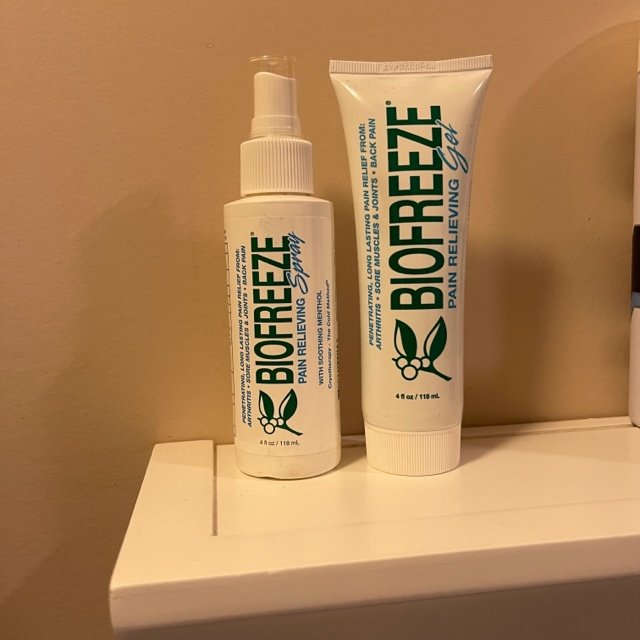
Foot balm and tension ball for easing foot pain
Cruisin’ with the Colemans stickers to pass out
The first aid kit which is explained below
We carry a small first aid kit, as everyone should, in case of an emergency on the trail. Here is what we have in our kit:
Various sizes of band-aids and steri-strips
Moleskin
Wet ones to clean your hands before cleaning a wound on the trail
One pair of disposable gloves in case we have to help another pilgrim
Tape, gauze, Neosporin, tweezers, and scissors
A bottle with Benedryl, Advil, and Aleve
Anti-inflammatory cream and Cortizone from our last trip to Spain. We will be bringing more of this stuff home because it’s amazing!!
Needle and thread for draining blisters
Tums and anti-diarrhea meds
What we carry in our fanny packs
Our fanny packs include the essential things that you need access to while we’re walking. This includes:
Passport, pilgrim passport, money, credit cards
Phone, headphones, charging cords, European charger, and wide-angle lens
Probars
Chapstick, gum, tissues, Charmin wipes, and utter smooth butt cream
Shells to leave along the Way and rocks to leave at Cruz de Ferro
The only thing left to do is take a few short walks with our final backpack loads in the week leading up to our departure date. We want to keep our legs loose but we don’t need to do anything big this week. We certainly don’t want to injure ourselves.
Just a short hike around the neighborhood to test out our loaded packs.
The final thing we did this week was to have a conversation with the fantastic Dan Mullins. Dan has a weekly podcast called My Camino (this is the link to our talk with Dan). He talks to pilgrims from all walks of life, from all over the world. This podcast has been very inspiring to us and we are blessed to be able to have a conversation with Dan. We look forward to listening to a new episode every week and going back to listen to old episodes. If you need inspiration while you wait to walk your Camino, check out Dan’s podcast. Oh, and don’t forget to buy his song, Somewhere Along the Way, I have it on my playlist to enjoy while we walk!
During the podcast, I talked about how our Camino 2017 overwhelmed my senses. I don’t know if you find this a positive statement or not, or if you even know what it means, but to me, it summarizes the wheel of emotions I felt along the Way. From hearing the many languages and trying to communicate in a foreign land, to smelling the new foods and flowers, to seeing new sights daily, to tasting new foods and wine daily, and to feeling a huge array of emotions, the Camino overwhelmed me. It made it tough at times but now I am drawn to it. I want to feel those feelings again. I want to embrace my emotions more than feel overwhelmed by them. We travel all over the US and my senses are never as overwhelmed because it’s not like everything I experience is new. For example, the landscape may be different when we travel out West, but the food and language are similar. I believe that feeling overwhelmed by your senses is why people bungee jump, skydive, or zipline. The Camino changed our lives and I can’t wait to see what changes will follow this Camino. I talked a bit more about our Camino 2017 in this blog post, Rock Bottom: Why I Almost Quit My Camino. Thank you, Dan, for allowing us to reminisce on our 2017 Camino and get us excited for the new journey just around the corner.
Thank you to our blog subscribers for indulging our many passions from the Camino, to RVing, to traveling, to cooking. We enjoy reminiscing about our adventures, we hope you appreciate reading about them. If you are not a subscriber, scroll to the bottom of this page and add your name to our email list. The only emails you will receive from us are notifications of our blog posts.
Buen Camino friends. We hope to see you Along the Way.
As the school year winds to a close, we are getting very excited about our upcoming trek on the Camino de Santiago. As you probably already know, in 2017 we hiked the 550 mile Camino Frances from Saint Jean-Pied-de-Port to Santiago and then on to Finisterre. This summer we will be repeating part of that trek, walking from Leon to Santiago but also walking the Camino Portuguese from Lisbon to Santiago and the Camino Fisterre, walking from Santiago to Muxia to Finisterre and back to Santiago for a total of 1,162 km (722 miles) over a two month period. Today we bring you “his” thoughts and “her” thoughts about our upcoming adventure as we answer the top five questions that we hear most often.
What are you most excited about?
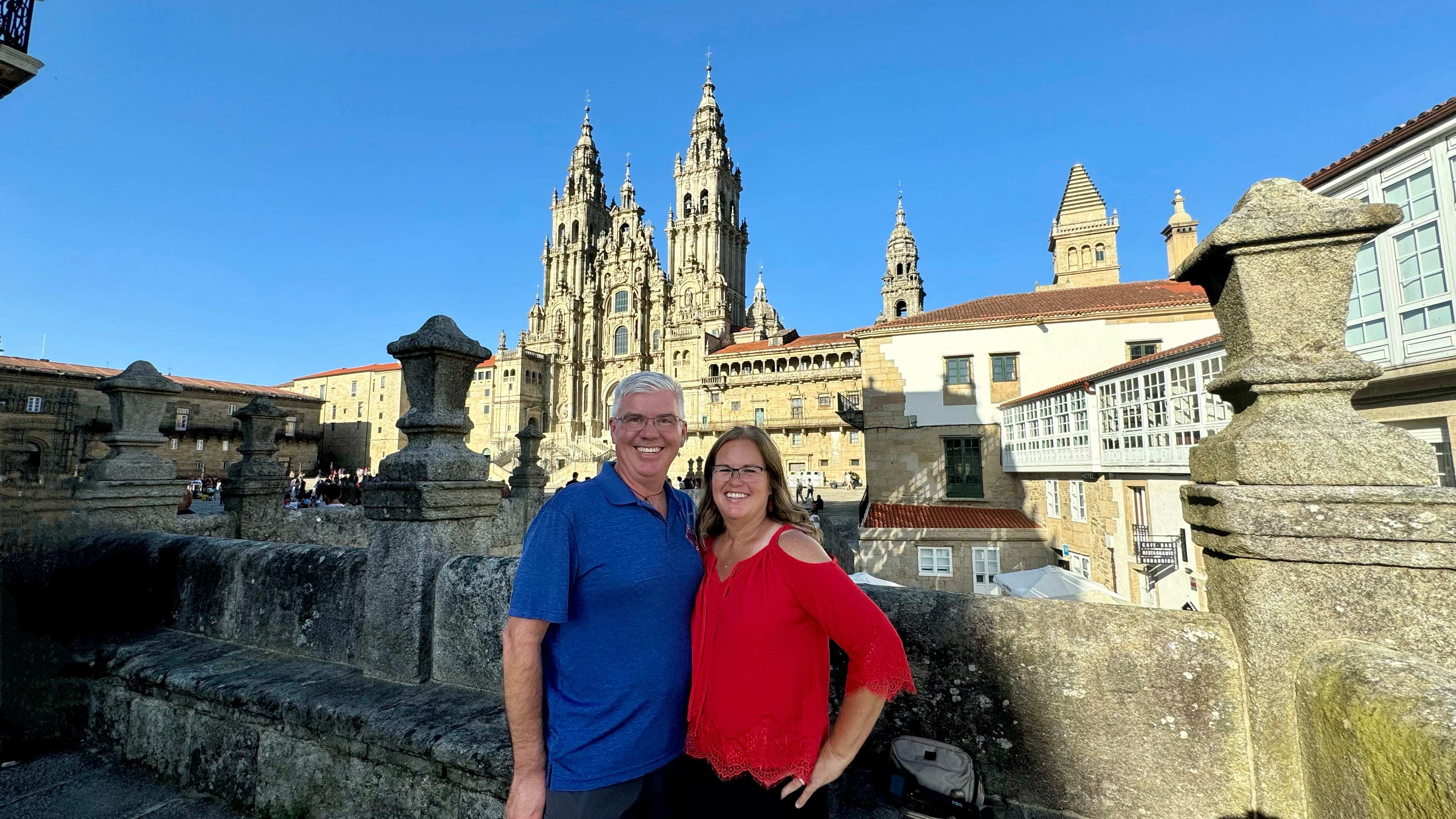
Brian: Revisiting some of our favorite cities (such as Astorga and O’Cebreiro) along the Camino Frances is really exciting but I am most looking forward to being back in Santiago on Feast Day. Seeing the fiesta from a pilgrim’s perspective was a great experience and getting to participate again now that the exterior of the Cathedral is finished is going to be awesome.
The opening of the Festival at the Cathedral in Santiago
Michelle: I agree that seeing the Fiesta in Santiago again will be fantastic, especially since the Cathedral is complete on the outside so I hope the projections will be on the Cathedral this year. But, ultimately, I am most excited about walking every day with friends! Walking next to my best friend, meeting new friends, meeting up with an old friend in Portugal, and sharing this incredible moment in time with so many other pilgrims.
What are you most nervous about?
Brian: On the Camino Frances we were averaging about 13 miles a day with frequent stops every 5-8 km. In Portugal, the villages are further apart and our days will be significantly longer with an average of 16 miles a day. Add to that the fact that we are further south and the summer heat can be brutal, I think there is plenty to be nervous about!
Michelle: Yes, what he said! I am nervous about how early we will have to get up in the morning to beat the heat. Also, the last time we walked the Camino, we were so lucky with the rain. It only rained twice while we were walking the entire summer. I am hoping for cooler temperatures and the rain is tolerable. But, what I am most nervous about, and it’s something I haven’t shared with people who don’t see me in person. I injured my foot when we were in Gatlinburg in March. I have been walking with a boot because of two stress fractures on the top of my foot. The doctor said I will be healed by the end of May and can do light walking until we leave on June 10th. Unfortunately, I fear re-injury. However, we have accepted that we may need to taxi ahead and accommodate as needed. There is magic on the Camino and I am praying some healing magic comes my way. Brian is quite patient and we always have each others back in tough situations like this one. Safety is always goal number one.
Along the trail
What village are you most looking forward to?
Brian: Duh, Porto, the home of Port wine! We plan to do plenty of Port tasting while we are there. I’m also really excited about Tomar. While we are there, the Fiesta de los Tabuleiros will be happening. The Festival of Trays only takes place every four years and just happens to coincide with our layover. For me, one of the primary reasons for hiking the Camino is to experience the local culture and big festivals are a great way to meet locals.
Michelle: Mmmmm port, tinto, cheese, pastries, festivals. Let me dream about all of that for a moment! I don’t have one particular village in mind but I am excited that the first and last legs of our trip will be a repeat of some of our favorite spots. I love Foncebadón because it’s this super tiny village that many pilgrims stay at in order to hike to Cruz de Ferro at sunrise. O Cebreiro is another tiny village that we couldn’t stay at last time because they didn’t have any rooms, I am looking forward to staying there this time. If the village is tiny, I am looking forward to it. The big cities overwhelm me because Brian wants to walk them! Haha
What are you doing differently this time?
Brian: My packing list is a little different this time. I’m taking less clothing and getting rid of some of the same extras that Michelle mentions below. I’ve decided to take a dice game (Farkle) for evenings in the albergue (but to save weight, I’ve created an online score sheet on Google Drive). I also have some new camera gear that you can read more about in the next question.
Michelle: I am taking a smaller pack going from 48 liters to 36 liters. I am not taking a sleeping liner or towel because we will be in private rooms and they are provided for you. The biggest thing I am doing differently, beyond the “stuff,” is a shift in attitude. I was overwhelmed last time. This is a big adventure, far from home, where nobody speaks your language (or so I thought). I didn’t know if we could do it. This time, I know we can. I am more open to the relationships that form on the Camino. I am open to whatever food we eat as a pilgrim. I am open to the entire experience, in a way that I was not before. What a blessing.
Pilgrim’s dinner at Orrison
What is the most essential piece of gear you are taking?
Brian: Because we are documenting this trip more actively on YouTube and our blog (we hope), my gear is probably the most essential equipment. I’ve found new trekking poles that can double as a monopod and I have a gimbal to help with better video quality. I’ll also be bringing a boom mic for voice-overs. All of the videos will be shot on a new iPhone X that I’ll be upgrading to in the coming weeks.
Michelle: I am adding extra shoe insoles because mine were quite beaten up last time. Finally, as of this moment and this could change, I am taking 3 pairs of shoes to help manage my foot problems. I am taking my Merrell Moab 2 hiking shoes and my New Balance 880 tennis shoes which I will switch between during the day, and then my Chacos for evenings and rest days. Again, we’ll see but I have to figure out how to manage my foot problems.
There you have it, another edition of He Said, She Said. We are just counting down the days, practicing our tinto arm, making sure we have all of our gear, purging as much as possible, and most importantly wrapping up the school year so when we return we will be ready to start another year. Do you still have a lingering question about the Camino? Leave a comment below! Your question may just show up in our next He Said, She Said blog post.
Outside the Templar castle in Ponferrada
If you haven’t already, make sure you click the subscribe button on our YouTube channel at www.youtube.com/cruisinwiththecolemans and click on the bell so you will be notified when a video is posted.
★ 25 years guiding★ 48 U.S. states★ 10 countries★ 3,000+ Camino miles
RV tips, travel inspiration, and updates on the trips we're planning — delivered to your inbox each month.
Questions about this trip?
Send us an inquiry.
Tell us what you'd like to know about this trip and we'll get right back to you.
Know before you go
Activity Level.
Every Cruisin' with the Colemans trip comes with an activity level so you know, before you lace up, roughly how hard the walking will be. Think of it as the overall rhythm of the trip — a few days might push a little past it and a few will feel gentler, but it's an honest read on what your legs are signing up for.
Nobody knows your body better than you do. We're all for a good challenge, but pick a level that matches your current fitness and trail experience and the whole walk gets more fun. Not sure where you land? Reach out — we've walked every one of these ourselves and we're always happy to talk it through.
Grades
EasyEasy0–8 km (0–5 miles)
Gentle, mostly flat days on well-kept, easy-to-follow paths. Ideal if you're new to multi-day walking or simply want a relaxed pace with plenty of time to soak it all in.
Easy – ModerateEasy–Moderate8–16 km (5–10 miles)
A little more distance over mixed ground — mostly maintained trails, quiet lanes, and the occasional gentle climb. A good fit if you're reasonably active and ready for a few longer stretches.
ModerateModerate16–20 km (10–12 miles)
Fuller days on varied, sometimes rugged terrain with regular ups and downs. Great for steady hikers in good shape, or determined first-timers chasing a real sense of accomplishment.
Moderate – StrenuousModerate–Strenuous20–24 km (12–15 miles)
Long days with sustained, often steep climbs and descents on rough trail. You'll want solid fitness; a few exposed spots call for a head for heights, and navigation can get trickier when the weather turns.
StrenuousStrenuous24–28 km (15–17 miles)
Big days on demanding, often remote mountain terrain — serious distance and elevation for experienced, fit hikers. Expect rough footing, the odd exposed or aided section, and higher altitude on some routes.
ExtremeExtreme+28 km (+17 miles)
Our toughest walking, built for very fit, very experienced hikers. Rugged, sometimes remote mountain terrain with scrambling, exposure, and aided sections — plus altitude, weather, and navigation that all add to the challenge.
Where you rest
Accommodations Levels.
Where you sleep is part of the story, so we hand-pick locally run places that welcome you like an old friend. The level shifts a little from trip to trip depending on the route, but the goal never does: a clean, comfortable, genuinely local stay at the end of every walking day.
Most nights you'll land in friendly, independent or family-run hotels, guest houses, and B&Bs chosen for their charm and the little touches that feel like home. Some trips lean a touch more luxurious; others, especially in the remote stretches, mean simpler refuges or huts. Either way, we've picked each one to help you rest up and wake ready for the trail.
Basic – A Place to Rest Your HeadBasic
Mountain huts, refuges, and simple B&Bs. Ensuite rooms aren't a given, and you may share a dorm with fellow walkers — but what you trade in polish you more than gain back in camaraderie and a big, rustic welcome.
Classic – Charming Without the FrillsClassic
Locally owned B&Bs, guest houses, and small inns that feel like a home away from home — usually family-run, cozy or freshly kept, and well placed for the next day's walk. A warm welcome comes as standard.
Comfort – A Little More...ComfortableComfort
Characterful, locally owned hotels and B&Bs with the little extras that make a stay feel special — décor rooted in the region, the occasional spot to unwind, and sometimes a kitchen worth lingering over.
In Style – For Those who Want to Treat ThemselvesIn Style
First-class stays in boutique hotels, vineyards, and country manors — often in the best seats in the house, from hilltop towns to the water's edge, with standout service and, now and then, a truly memorable table.
Mixed – Boutique Hotels to Mountain Huts, all in One TripMixed
One trip, a bit of everything. You might bed down in Classic or Comfort rooms through the towns and villages, then a refuge or other Basic spot up in the mountains where that's all there is — an honest, memorable mix that matches the journey.