My Favorite Things: Eating on the Camino de Santiago

You may not know this about me but I love food. I mean that I REALLY love food. Any time we travel, I spend a decent amount of time looking for local specialties and the best places to eat. That does not mean that we spend a lot of money on food. Yes, sometimes we will go to a fancy restaurant and drop a couple of Benjamins for a really nice dinner but some of our favorite and most memorable meals have been at dives that don’t know who Zagat is. With that in mind, my first Monday morning post that isn’t a recipe of the week is going to cover my favorite subject… FOOD!

Some of the most frequently asked questions we hear about the Camino deal with food. Do you have to carry your food? What’s the food like? How expensive is food? What if I have dietary concerns? What if I’m a picky eater? I hope to answer all of those questions here and assure you that you will not starve while walking on the Camino de Santiago, no matter how picky or restrictive your diet is.

First off, Michelle and I both try to live a relatively healthy lifestyle. We like to eat fresh, non-processed food as much as possible. We try to avoid excess sugar, but we will eat an occasional dessert and we both share a love of wine and cocktails. Michelle must eat gluten-free because of her Hashimoto’s disease (an autoimmune thyroid disease).

Going into the Camino, we knew that we were not going to be worried about counting calories. While walking 13 plus miles per day in the extreme heat that we were going to be burning plenty of them. One day I did do my best guess at tracking calories because I was curious and came up with over 3000. That said, we came back from Spain at nearly the same weight that we left home. The challenge was adjusting to not eating as much food as we had been used to while on the Camino and we each gained weight upon our return.

Upon arriving in Madrid after a long overnight flight, we were both starving. Once we navigated the Madrid subway and made our way to the Atocha train station it was time to find some food. We had done a little research ahead of time and new that there was a counter service fast food place that had gluten-free breakfast items. After a little searching, Michelle had a chocolate croissant and egg and cheese sandwich and I had a taste of my first bocadillo (not gluten-free). Our first meal was a success

Chocolate croissant, egg and cheese sandwich (both gluten-free), and breakfast bocadillo (not gluten-free) at the Atocha train station.

Finding food on the Camino is rarely a problem. Most days pilgrims pass through several villages and there is almost always at least one bar or cafe, and usually, several options are within feet of the marked path. Many albergues offer a pilgrim’s meal at dinner time for a small additional charge (€5-10). Before talking about dinner though, let discuss meals in Spain and how that fits into the pilgrim’s schedule.

Our first pilgrim’s meal in St. Jean Pied-de-Port

Breakfast in Spain is usually the smallest meal of the day and rarely consists of much more than toast (tostada) with butter and jam, pastries, and cafe con leche (espresso with steamed milk). Michelle sometimes was able to get rice cakes but often had to make do with a little fruit or an egg. Among the pilgrims we know, this is called “first breakfast” and you’ve probably already guessed that means “second breakfast” can’t be far behind. First breakfast was onfton included in the price of lodging.

First breakfast at a bed and breakfast in SJPdP.
Gluten-free breakfast option, if you’re lucky

Once we got through the Pyrenees, Spain was getting record high temperatures and in order to beat the heat, we were often leaving our albergue before 6 am. As a result, we needed to purchase breakfast the night before since most places to eat didn’t open until 6:30 or 7:00 a.m. Our breakfast of choice became a snickers bar and Monster as we walked in the dark. Not the best choice, but it helped in a pinch and we have a few ideas to help us when we are back on the Camino this June 2019.

After walking 5-8 km, most mornings we would come to our first village of the day and usually would run into a group of pilgrims sitting outside a bar or cafe eating second breakfast. Choices of food would range from tortilla and bocadillo to a more traditional “American” breakfast of fried eggs and bacon. We often spent less than €10 for second breakfast with two Coke Zero.

Lunch in Spain can be tricky for Americans. Lunch is typically the largest meal of the day and is often eaten at home but for pilgrims, everything closes down around 2 p.m. and doesn’t reopen until after 5 p.m. for siesta. If you arrive at your final destination for the day during that time, you will often not be able to find food because EVERYTHING is closed. We would typically get a similar meal to our second breakfast or if we were lucky, some tapas. Often by this time of the day, we would enjoy some amazing Spanish wine or beer if we were within the last 5k of our walk. The price here was often about the same as second breakfast, around €10 including wine.

Once we were done for the day, it was time to check into our albergue, hand wash our laundry, shower, and take a little nap. We were usually pretty hungry at this point and would often get a snack. Our go-to became a bottle of wine and Doritos for €5-8. So our not-so-processed lifestyle had gone out the window, but when you’re hungry you’ll eat anything!

Wine is often less expensive than soda. We often saw 750 ml bottles in the mercado for less than €1

Dinner in Spain is often not served until 8 pm or later, long after most pilgrims have crashed into bed. Luckily, along the Camino, most villages work hard to serve the needs of pilgrims and dinner is available after 5 pm. When an albergue offers a communal meal it is usually at a set time and if you miss it, there’s no food for you. Fortunately, there is never a shortage of bars and restaurants to serve every food need for the average pilgrim. We ate a wide variety of regional and local specialties from ranging from €8 to much higher. The most economical dinner option is the pilgrim’s meal or menú del día. This dinner was usually three courses and included wine or bottled water (learn to ask for “agua del grifo” or tap water). The first course could be soup, salad, or even pasta. The second course was usually some kind of meat with fried potatoes. The final course would consist of dessert. I was always sure to ask for “especialidad de la casa” or the house special. I was able to try such unusual dishes as tuna ragu, garlic soup, home-made cheeses, and even chicken curry. We did spend a little more on dinner many nights with our total usually coming in at about €20-30 for two bringing our food total for the day to under €60 per day for two people. If you want to know more about our Camino budget, check out Michelle’s post here.

There are a couple of foods that I have to mention because they are too amazing to leave out. Once in Galicia, seafood is found nearly everywhere, is the freshest that I’ve every eaten, and very inexpensive by American standards

Many restaurants, bars, and even hotels will often serve wine or other alcoholic beverage that they make in house. Orujo, Patxaran, and Vermouth are popular regionally, make for a nice aperitif, and were served after dinner gratis in some places!

Sometimes you just need to eat something familiar and in larger cities, you may run across American fast food. We saw KFC, Burger King, McDonald’s but only stopped once because they had gluten-free buns!

We never cooked our own meals, but many pilgrims do. Markets, supermarkets, and even farmer’s markets are prevalent but be warned, in smaller villages most are closed during siesta and on Sundays. This is a great way to save money and get to know other pilgrims.

If you have special dietary concerns, most restaurants will work with you to accommodate our restrictions. Make sure you learn the names of your allergies in Spanish so you can communicate with the server. Vegetarians will probably have the greatest difficulty as Spaniards love their meat, but we did run across many vegetarians who said they were far from starving. Michelle did not have too many problems eating “sin gluten” and only got sick once during our entire time in Spain from cross contamination.

Tarta de Santiago is a staple of the Camino and this almond cake is naturally gluten-free when made properly. Often in bars it isn’t.

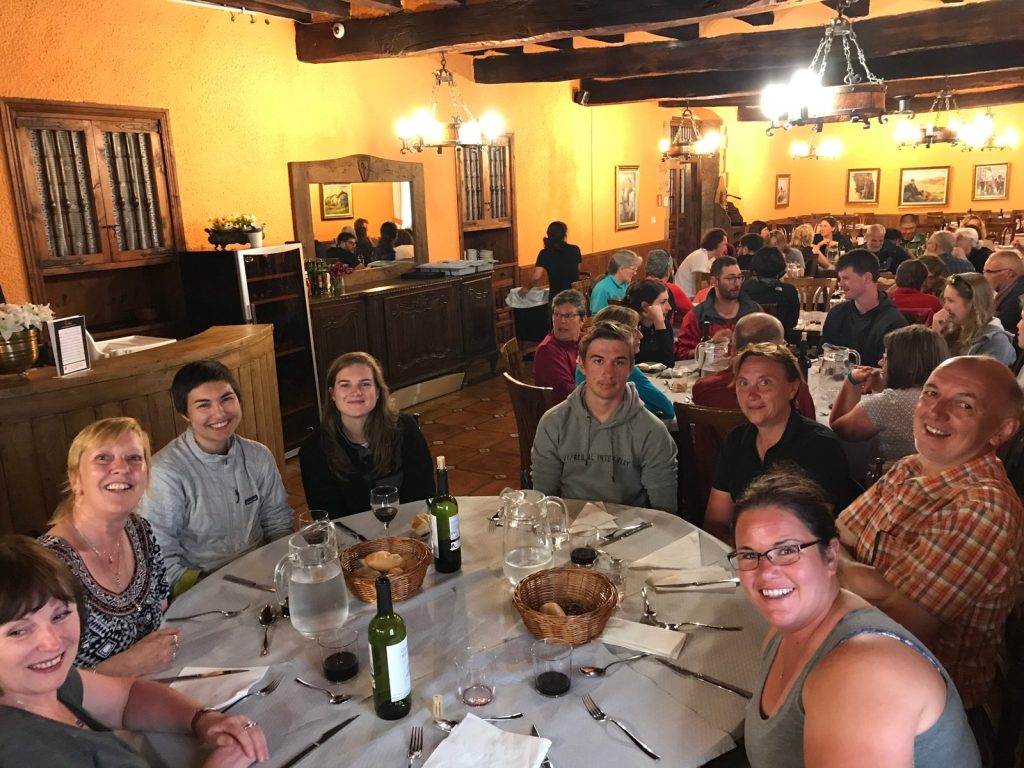
Never pass up an opportunity to eat a communal dinner, we met wonderful friends and had a great time, even when the food was only mediocre.

Communal dinner in Roncesvalles – the food wasn’t the best but the company was fantiastic

Finally, I can’t recommend enough to use common sense when eating in Spain, just as you would anywhere in the states. If an establishment looks dirty or seedy, don’t go in or leave. We never had any problems and NEVER felt unsafe while in Spain, but there were times we decided not to go into a bar or down a certain street because it didn’t look like our scene. Another thing to be wary of is looking for fresh food. We often didn’t go into places because they had a sign like this outside. All of the food pictured is premade, frozen food that is just reheated. Food is so inexpensive in Spain, why waste your time eating a frozen meal?

If you have additional questions about food or any other subjects on the Camino, let us know in the comments below. If you’ve been, what was your favorite meal?

Recipe of the Month – Mexican Chicken Soup

Yep, you read that correctly, the recipe of the week is becoming the recipe of the month so that we can focus on bringing you more content in other areas, such as Camino planning and recaps of some of our best previous adventures.

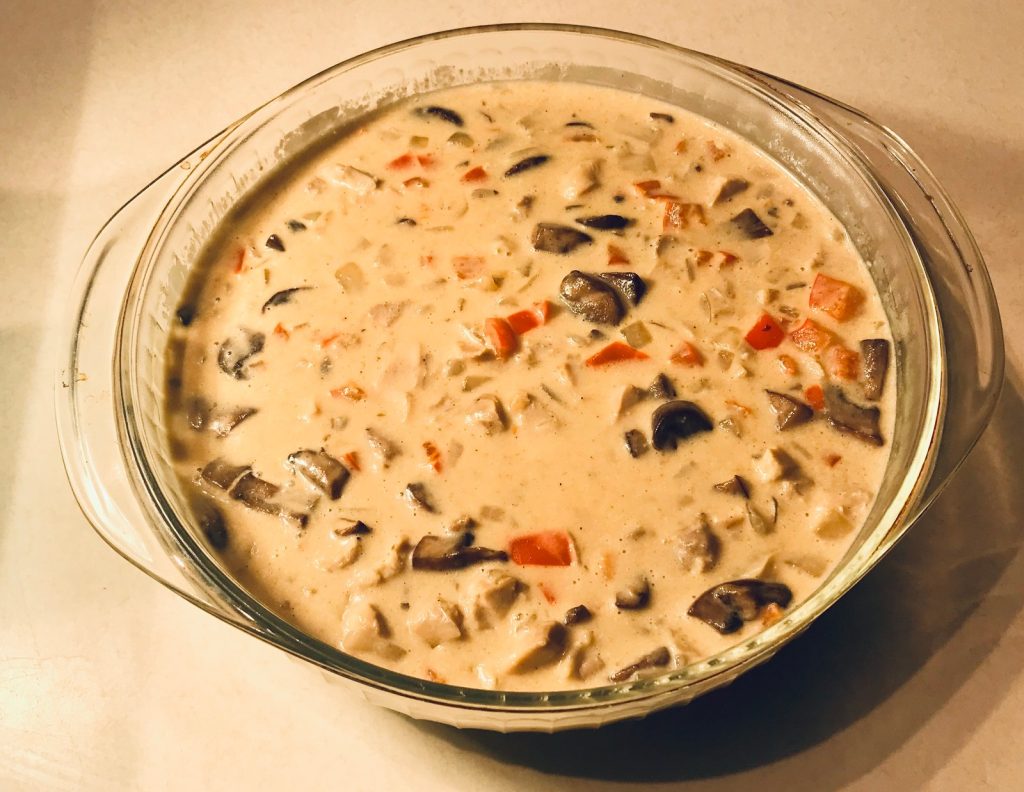
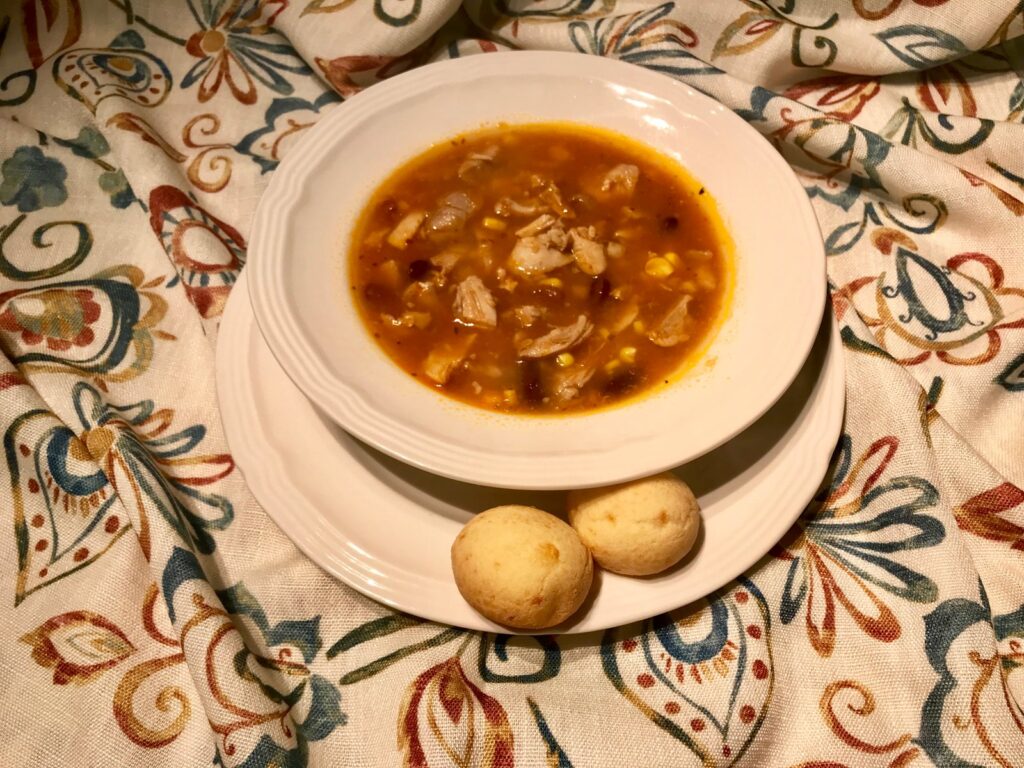
With all of the cold weather we have been having lately, I’ve been making lots of soup. It not only warms the stomach but also the house! I love this recipe but it’s not ours, we have to thank Laurie (one of Michelle’s colleagues) who found the recipe on Cooks Country. On a side note and a fun fact we learned that Laurie has diligently subscribed to Cooking Light magazine since its inception 40 years ago and was one of their first subscribers! The soup has just enough kick to warm you up on multiple fronts. Of course, you could adjust the spicy heat up or down depending on your preferences.

Begin by bringing six cups of chicken broth to a simmer in a large pot and add about a pound and a half of chicken thighs to poach for 15 minutes.

In a food processor, combine half of a large onion, a can of diced tomatoes (or Ro-tel tomatoes with you like things on the spicy side), half (or more) of a seeded jalapeno pepper, four cloves of garlic, one canned chipotle chili and a tablespoon of the adobo sauce it’s packed in, and a teaspoon each of salt, pepper, and cilantro. Pulse the whole thing until it is smooth and well pureed. If I had any tortilla chips in the house this is probably as far as I would have gone because it looked and tasted like a smooth salsa at this point.

Remove the chicken from the pot and set aside to cool. Pour the broth into a container to skim the fat off the top.

In the same pot, heat a tablespoon of oil and add the “salsa” to the pot. Let it simmer for five minutes or so to cook the “green-ness” out of it and allow the flavors to combine.

Skim the fat off the broth and add it back into the pot along with two cups of frozen corn and a can of rinsed and drained tri-blend beans (or kidney, pinto, or black beans). Allow the soup to come to a boil and then reduce the heat. Simmer for 15 minutes. Meanwhile, run a knife through the chicken to cut it into bite-sized pieces. Take the pot off the heat and add the chicken and two tablespoons of lime juice. Taste and adjust seasonings if needed (I added a little more salt).

Top the soup with diced avocado, slices of fresh or crispy tortilla, or a little cojita or queso fresco. We served it with pao de queijo, which are amazing gluten-free cheese rolls.

Mexican Cheese Soup

  • 6 c chicken broth
  • 1 1/2 pounds chicken thighs
  • 1/2 of a large onion
  • 1 t each salt, pepper, and cilantro
  • 1 can of diced tomatoes (get the kind with chilis or jalapeno if you like)
  • 1/2 jalapeno pepper, seeded
  • 4 cloves garlic
  • 1 canned chipotle pepper plus 1 T adobo sauce it’s packed in
  • 1 T oil
  • 2 c frozen corn
  • 1 can beans, any variety, drained and rinsed
  • 2 T lime juice
  • assorted toppings such as diced avocado, Mexican cheese, or tortilla strips

Bring chicken broth to a boil and add chicken. Simmer for 15 minutes until the chicken is done and there is no pink remaining.

In a food processor, combine onion, spices, tomatoes, garlic, and peppers and pulse until smooth.

Remove chicken from pot and set aside to cool. Pour broth into another container to skim fat once cooled. In the same pot, heat the oil and add the tomato mixture. Simmer for 15 minutes over medium heat to combine flavors.

After skimming fat from broth, add back to the pot along with the corn and beans. Bring to a simmer and cook for 15 minutes. Shred the chicken and add to the pot at the end of cooking along with the lime juice. Adjust seasonings if needed.

Let us know if you try this recipe or any other recipe we have posted! Tag us on Facebook or Instagram with the hashtag #cruisinwiththecolemans! We’d love to hear from you!

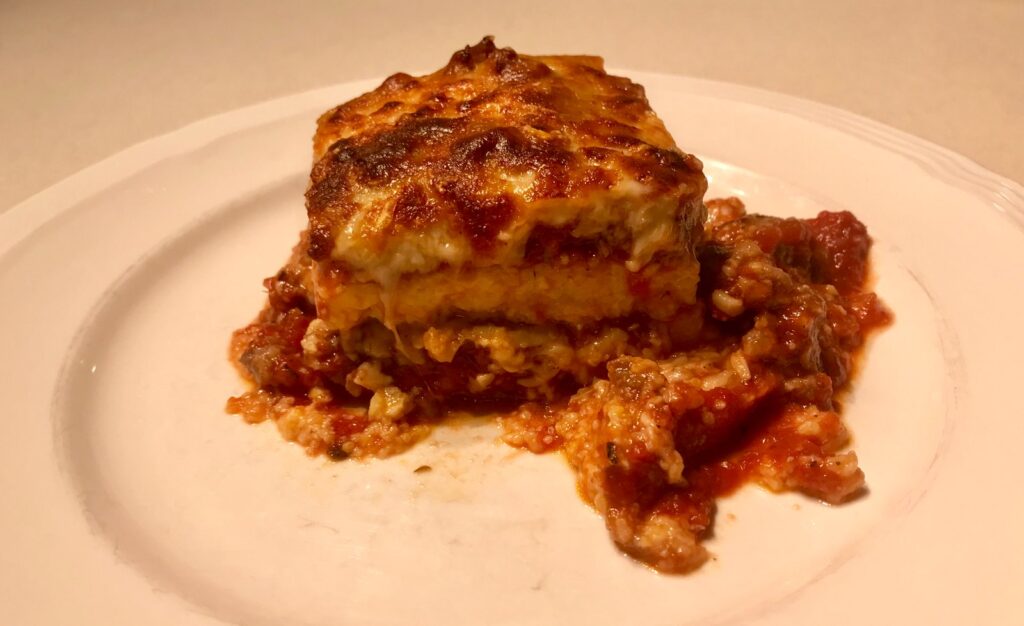
Recipe of the Week – Polenta Lasagna

When living a gluten-free lifestyle, whether by choice or necessity, there are many foods that you assume you may never be able to eat again. While restaurants have become more knowledgeable about gluten-free options over the last five years, it is still common to be offered a salad or a burger with no bun as the only option on a “gluten-friendly” menu. Most grocery stores have progressively stocked a variety of manufacturers but the choices are limited. You have to go to a specialty or high-end stores if you want choices.

Some foods are a real rarity in the gluten-free marketplace. Lasagne noodles are one of them. Gluten-free noodles range from “you can’t tell the difference” to “cardboard or sticks” and aside from penne, spaghetti, and elbows, there are virtually no other pasta shapes readily available so we adapt and improvise.

This polenta lasagne came out of one such improvisation. If you don’t know polenta, it is the Italian version of ground cornmeal, fancy grits, if you will. You can find it in several different spots in the store. There is often a fancy imported variety in the Italian aisle that runs about $10 a pound, but if you look in the aisle with breakfast grains like oatmeal you can find both grits and polenta for under $4 a pound. There two different types, a fine white corn or hominy meal often marketed as grits and coarser yellow corn meal which is more commonly marketed as polenta. There is a slight difference in flavor but they are basically interchangeable (as long as you’re not cooking for food snobs). When you chill cooked polenta (or grits) it turns into a solid cake-like mass that can be cut into slices and used in a variety of ways (try it on the grill with some olive oil, salt, pepper, and parmesan). We love Bob’s Red Mill brand.

For the lasagna, cook the grits at least an hour before you plan to assemble the lasagna but the night before is even better. In a saucepan, heat two and a half cups of half and half and two and a half cups of chicken broth to a simmer. Turn down the heat and add half a teaspoon of salt and slowly whisk in one and a quarter cups of polenta. The polenta is likely to lump together, so make sure that the liquid is moving when you add it and keep stirring with the whisk until it is fully incorporated. Cook on low for about fifteen minutes until the liquid is fully absorbed and the polenta is smooth and creamy. Stir frequently to keep it from sticking to the bottom and scorching. Remove from the heat, add half a cup of grated parmesan cheese, and stir well to incorporate. Let the polenta cool slightly while you prepare the pan.

Cut a piece of parchment paper about four inches longer than your 9×9 brownie pan. Fold the edges over so the paper will lay in the bottom of the pan and crease the corners to make a liner. Pour the still hot polenta into the pan and use a spatula to spread it evenly. Cover with plastic wrap pressed down onto the surface of the polenta, otherwise, it will get a rubbery skin on the top, and place in the refrigerator to cool for at least one hour, but overnight is better.

In a sauté pan, brown one pound of Italian sausage with the casings removed. While it is cooking remove the polenta from the pan. Using a long serrated knife, cut the polenta in half, making what are essentially two large lasagna noodles.

In the same pan the polenta cooled in, pour about half a cup of marinara and place one piece of polenta on top.

Add the rest of the marinara sauce to the sausage. Now layer just as you would a traditional lasagna. I don’t use a layer of ricotta because the polenta is already pretty creamy once reheated. Pour half of the meat mixture over polenta and top with a half cup of mozzarella cheese. Top with the second slice of polenta, the rest of the meat mixture and the remaining cup and a half of cheese.

Place the pan on a foil lined cookie sheet because it will bubble over, and place in a 350º oven for one hour. Cut into nine servings and serve with a healthy salad and some Chianti.

Polenta Lasagna

  • 2 1/2 cups half and half
  • 2 1/2 cups chicken broth
  • 1/2 t salt
  • 1 1/4 cup polenta
  • 1/2 c grated parmesan
  • 1 lb Italian sausage, casings removed
  • 1 jar of marinara sauce (or your favorite spaghetti sauce)
  • 2 cups shredded mozzarella cheese

Bring broth and half and half to a simmer. Add salt and whisk in polenta. Cook for 15 minutes, stirring frequently to keep from sticking or scorching. Remove from heat and stir in parmesan cheese.

Line a 9×9 pan with parchment paper and spread polenta all the way into the edges. Cover with plastic wrap and cool overnight or at least one hour in the refrigerator.

Once cooled and very firm, slice polenta into two sheets with a long serrated knife.

Remove casings from sausage and brown in a sauté pan. Pour 1/2 cup of marinara sauce into the same pan the polenta cooled in and add the remaining sauce to the sausage. In the pan, layer one slice of polenta, half the sausage mixture, and 1/2 cup of mozzarella cheese. Top with the second slice of polenta, remaining sauce, and remaining cheese.

Place the pan on a lined cookie sheet and bake at 350º for one hour. Makes 9 servings.

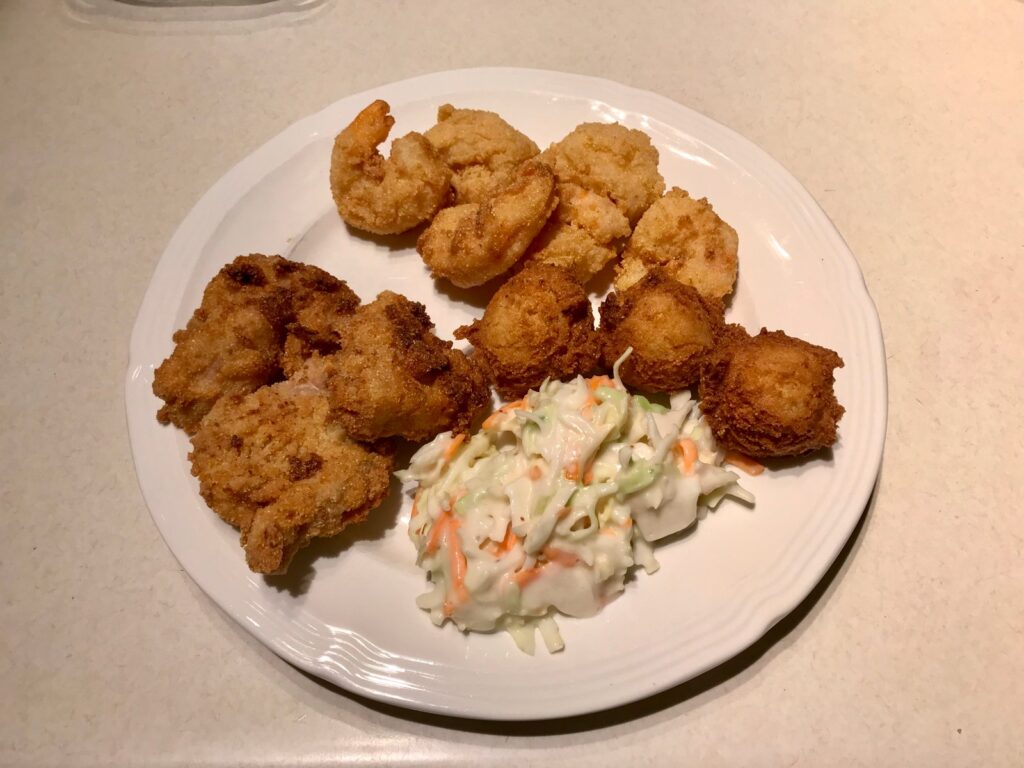
Recipe of the Week – Cruiser’s Platter (Gluten-Free Fried Fish and Shrimp)

One of our goals in the coming year as we travel is to find local specialties and convert them into both gluten-free and when possible, healthier meals. While on the Gulf Coast over Christmas, we got to eat quite a bit of seafood and it was delicious. Almost every restaurant we went to offered a sailor’s platter, captain’s platter, or even an admiral’s platter. The more expensive the restaurant, the higher the rank of the platter!

Unfortunately, finding gluten-free fried fish was not possible in the Fort Myer’s area. If you know of someplace, comment below because we’re going back next year and want to check it out.

After our last fishing misadventure, we decided to try again. Michelle’s requirement was that we spent some of our time fishing and some of our time searching for dolphin and manatee. Captain John at Conway Charters did not disappoint. After meeting him at a local marina, he took us out on his boat to search the canals and creeks for some manatee. With his knowledge, it didn’t take to long and our first goal was checked off with this 6-8 foot long male manatee.

Next goal our list: catch some fish. We didn’t have much luck on this day – the fish just weren’t biting. We did manage to bring in two sheepsheads, and as they say, any day on the water is a good day. We did complete our third goal also, seeing some dolphin on our return to the marina, but enough about that, let’s cook up some fish!

Luckily for me, Captain John filleted the fish we caught. If you’re not lucky enough to have fresh fish, look for a firm fish that has thicker fillets at the store. Cod works well, as would catfish. You will need about a quarter pound per person and about the same amount of peeled, deveined shrimp. You could also look for clams, scallops, or any other seafood that looks good at the store.

Begin by preparing you breading station. In a bowl, combine about one cup of half and half with two teaspoons apple cider vinegar and stir well. The vinegar will curdle the milk and create buttermilk after sitting for about ten minutes. In another bowl, you will need about two cups of cornbread mix such as Krusteaz Honey Cornbread. In the final bowl, combine 1 cup of gluten-free flour blend with 2 teaspoons of Tony Chachere’s Creole Seasoning. If you don’t like things too spicy you could use Old Bay instead. If you want some extra kick, add a little hot sauce to the buttermilk. Make sure that the seafood is mostly dry. I put it in the fridge uncovered for about thirty minutes while I was getting everything else ready to go.

Left to right: Cornmeal mix, buttermilk, seasoned flour, seafood

Pour about 3-4 inches of canola or peanut oil into a deep pot and heat over high heat until the oil reaches 265º. You want to keep the oil between 265º-300º while you are cooking. If the oil is too cool the breading will soak up too much oil and get soggy; too hot and things will burn before they cook through. Continuously monitor the oil temperature and adjust the heat accordingly.

Toss several pieces of fish into the flour mixture to coat and set on the edges of the bowl with your right hand (this is your “dry hand” and should only go into the two flour bowls). Using your left hand (the “wet hand” that should only go into the buttermilk bowl), drag the fish one piece at a time through the buttermilk and set them into the cornmeal bowl. Using your right hand, bury the pieces of fish under the cornmeal.

I know, I’m using the wrong hand in the buttermilk in the photo above. Trust me, you will make less of a mess if you keep one hand dry and the other wet, but it can be difficult in the heat of the moment! Carefully place pieces of fish into the hot oil by holding them just into the oil and releasing so that you don’t splash oil. The oil should bubble but not pot. If at any point the oil is smoking, it is too hot. If you get a lot of popping, the fish is too wet.

Once you have about 5-6 pieces of fish in the pot, begin the process again with the next batch. The fish should cook 5-6 minutes until it reaches your desired color. Remove the fish from the oil and place onto a cooling rack placed over a cookie sheet so the excess oil can drain off. Check your oil temperature and continue until you run out of seafood.

BONUS: take the remain cornmeal mixture and add the remaining milk to it along with 1/4 cup of finely diced onion. Stir together and add more half and half until you get a thick spoonable batter. Drop teaspoons of batter into the oil to make hushpuppies!

Once all of the seafood is cooked prepared, make your dipping sauces. For tartar sauce, combine 1 cup of mayo with 2 tablespoons of pickle relish and a 1/2 teaspoon of lemon juice. For the shrimp, I like a sweet chili sauce using 1/2 cup of sweet and sour sauce combined with a tablespoon of hot chili paste (from the Thai aisle at the store). For traditional cocktail sauce, use 1/2 cup of chili sauce (usually near the seafood) combined with 1-2 teaspoons of ground horseradish from the condiment aisle. Be careful with store bought cocktail sauces, some have soy sauce added and are not gluten-free!

We almost never eat fried food, but it is a nice treat from time to time and I was surprised at how little oil was actually absorbed into the food. I used a whole bottle of oil to cook and when I was done and poured the cooled oil back into the bottle to throw away (never reuse oil that you’ve cooked fish in) there was only about an inch missing from the bottle, and part of that was on the bottom of the cookie sheet that I had used as a drip pan.

We served our Cruiser’s Platter with coleslaw and a glass of Pine Island Breeze. What’s your favorite seafood treat or side dish? Leave us a comment below and let us know!

Cruiser’s Platter (Gluten-free Fried Shrimp and Fish) with Hushpuppies and dipping suaces

For the seafood:

  • 1/4 pound per person of assorted seafood such as cod, peeled shrimp, scallops, etc.
  • 1 c half and half
  • 2 t apple cider vinegar
  • 1 box of Krusteaz Gluten-free Honey Cornbread mix
  • 1 c Gluten-free Flour blend
  • 2 t Tony Chachere’s Creole seasoning (or similar)
  • canola or peanut oil
  • 1/4 c finely diced onion

For the dipping sauces

  • 1/2 c mayo
  • 2 T sweet pickle relish
  • 1/2 t lemon juice
  • 1/2 c sweet and sour sauce
  • 1 T hot chili paste
  • 1/2 c chili sauce
  • 1-2 t ground horseradish

Lay out the seafood on plates and refrigerate without covering so that it dries out a bit.

Begin by combining half and half with vinegar to let it curdle. Prepare the remaining breading stations by pouring cornmeal mix in one bowl and combining flour and seasoning in another. Meanwhile heat oil to 365º.

Dip pieces of seafood into flour, shake off, drag through buttermilk, and cover with cornmeal. Carefully lower each piece into the oil without splashing. Cook 5-6 pieces at a time for about 5 minutes or until the desired color has been reached.

Combine remaining cornmeal mix with onion and remaining buttermilk. Add more half and half if needed to create a spoonable batter. Drop by the teaspoonful into the oil to make hushpuppies.

For tartar sauce, combine 1 cup of mayo with 2 tablespoons of pickle relish and a 1/2 teaspoon of lemon juice. For the sweet chili sauce, combine sweet and sour sauce with hot chili paste. For traditional cocktail sauce, add ground horseradish to the chili sauce.

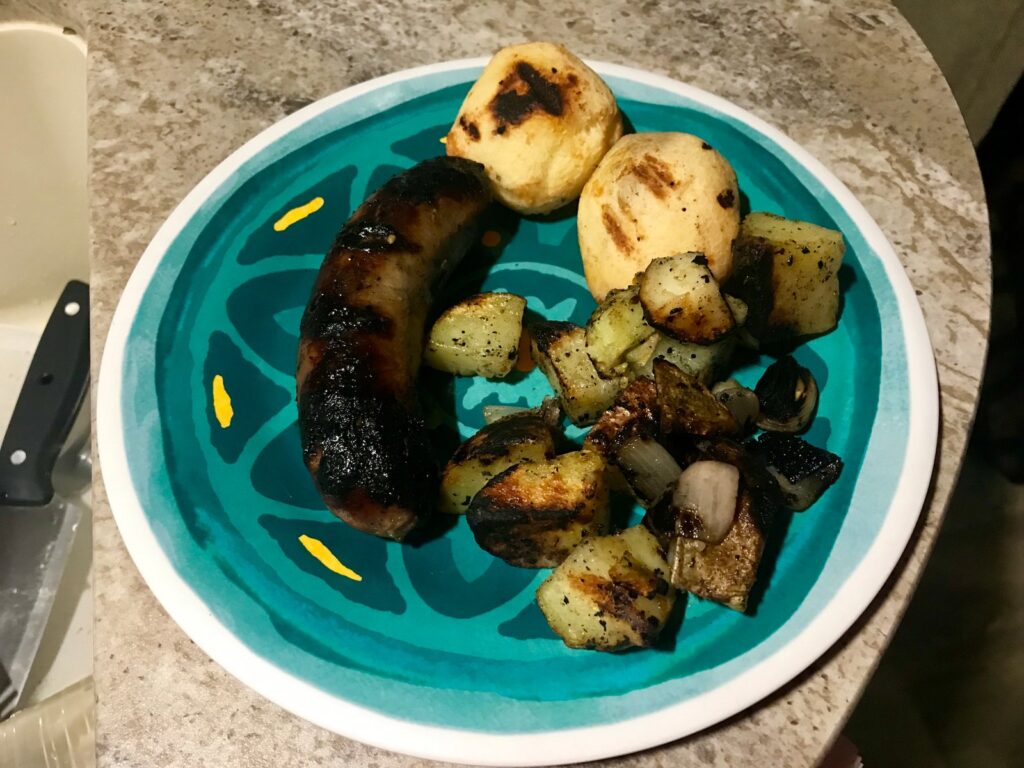
Recipe of the Week – Grilled Sausages with Potatoes, Shallot, and Spinach

Sometimes after a big day out exploring we just don’t feel like spending a lot of time cooking. That was the case after our day exploring Cape Coral. After visiting the fantastic Cape Coral Farmer’s Market, we did an eight-mile walk around town and found a great little Italian place for lunch that served gluten-free pizza. A visit to Wicked Dolphin Distillery and pool time back at the campground with some newly invented cocktails finished up our day.

By the time we got back to CC we were exhausted and starving. Here’s a quick dinner that you can throw together in no time at all with things that you might even have on hand.

Start out with a variety of potatoes: red, russet, and Yukon gold are my favorites. Dice them up into bite-sized pieces along with a couple of shallots and put into a microwave safe bowl.

Add about a tablespoon of olive oil and a good sprinkle of salt, garlic powder, and pepper. Cook in the microwave for five minutes or so until the potatoes are mostly cooked but still firm.

While the potatoes are cooking, get the grill heated up and add Italian sausages.

When the sausages almost done, add the potatoes and shallot mixture to the grill. BE CAREFUL to not pour the collected oil and water in the bottom of the bowl onto the grill or you will have some major flareup!

Cook the potatoes and sausage until they are nicely charred. Once they’re done, add a few handfuls of spinach and allow it to wilt for a second before removing everything from the grill and dividing between plates. Sprinkle with a little parmesan cheese.

I would highly recommend making sure that you have plenty light on the grill. We had to keep the lights off because of the no-see-ums and I might have burned things a bit! Also, you might notice that I didn’t use spinach… we couldn’t find any at the farmers market that morning so we just went without.

Grilled Sausages with Potatoes, Shallot, and Spinach

  • 1-2 Italian sausages per person
  • 1 lb of assorted potatoes, such as russet, red, and Yukon gold\
  • 2 shallots
  • 1 T olive oil
  • 1/2 t each salt, garlic powder, and pepper
  • 1 cup spinach leaves
  • 1-2 T parmesan cheese

Cut potatoes and shallots into bite-sized pieces and place into a microwave safe bowl. Top with oil and seasonings and stir to mix. Cook for 4-5 minutes in microwave until almost cooked.

Heat grill and add sausages. Cook for 6-8 minutes and turn. Add the potato-shallot mixture and continue to cook until charred to your liking, another 5-10 minutes, making sure that the sausages are cooked through. Add spinach on top and let wilt then remove to plates.

Sprinkle with parmesan cheese and enjoy!

No blog today… but we have cocktails!​

We have been so busy exploring Pine Island, Cape Coral, and Fort Meyers that there is no blog post for this week. but we have been working hard to find the best cocktail with a view! We’ve tried Rum Rummers, Goombay Smashes, Hurricanes, Mojitos, and more, but don’t worry, we’re always safe and never drive if we’ve had too many.

After extensive research, we decided to go straight to the source and visit the Wicked Dolphin Distillery in Cape Coral. Wicked Dolphin is the first distillery in Florida since Prohibition and they make rum in small batches from local ingredients. If you are in the Fort Myers area, you should definitely go check them out. The tours are free, as are the tastings. We picked up two bottles (but wanted more) and have created a couple of cocktails that we thought that you, our dear readers, might enjoy (we certainly have)! In all of the recipes below, we are using Wicked Dolphin Rum, but you could use your favorite as a substitute. We bought everything we used and they didn’t give us anything for free… but hey Wicked Dolphin, give us a call and we’ll pick up anything you’re willing to donate for the mention!


If you are not familiar with cocktail mixing, you should know that a jigger is the standard measure. The hourglass-shaped bar mixing tool holds 1 1/2 ounces on the large side, which is a shot; and 3/4 of an ounce on the small side, which is half a shot. There are variations and not all jiggers are created equal so you should do a “reality check” with your jigger to know its volume. Most home bartenders are not too worried about it and when making our drinks, I rarely measure, which can be dangerous!

Our first creation we decided to call the Pine Island KOA Breeze. In a pint glass, combine 1-1/2 ounces of coconut rum, 3 ounces of orange juice, and ice. Shake to combine and top with Cranberry Sprite (you could also use 3/4 ounce of cranberry juice and top off with Sprite). Garnish with orange slices and a sugared cranberry if you have them (we didn’t).

Next up is the Pine Island Storm. We made this one out of necessity since we ran out of Cranberry Sprite (it’s only available during the holidays). Begin by chopping up a fresh pineapple and covering it with coconut rum and let it marinate in the fridge for at least 24 hours. In a shaker, combine 1-1/2 ounces each of the pineapple infused coconut rum and black rum with ice and 3 ounces of orange juice. Shake until frothy. Pour over ice and top with Sprite and pieces of the drunken pineapple (and some maraschino cherries, if you have them). Give the glass a float of more dark rum to make it happy! The picture below is actually a double because we were doing laundry and were not very close to the RV.

The last cocktail we created we called the RumSlide. Combine equal parts black rum and Bailey’s Irish Cream with ice. Shake until frothy and pour over ice. If you want to take it to the next level, swirl some chocolate syrup into the glass first!

We hope you enjoy the fruits of our labors here on Pine Island and if you have other favorite rum cocktails, let us know in the comments. You don’;t have to be on the beach to enjoy a few moments of island life!

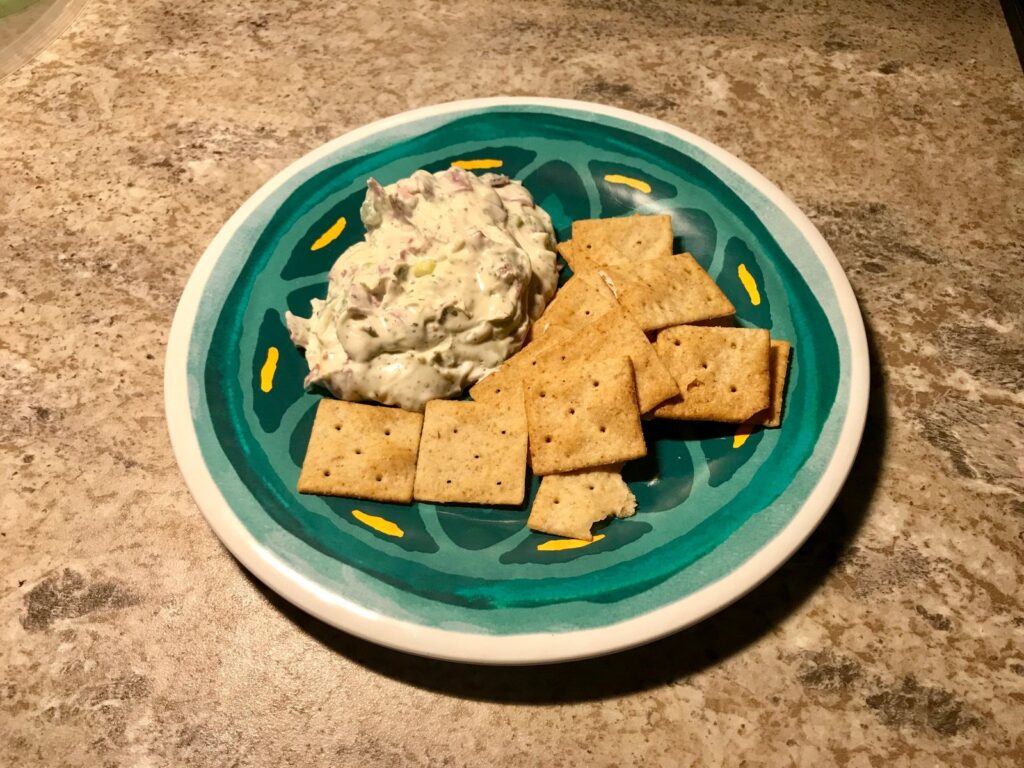
Recipe of the Week – Hot Beef Dip Appetizer

When we’re home for New Year’s Eve, which isn’t often, we love to serve a buffet of appetizers. Gluten-free crab rangoon, chicken wings, a good charcuterie board like this one from Self Proclaimed Foodie, and shrimp coctail will make any occasion a special event. One of our favorites is an old microwave classic, hot beef dip. The quantities below are a doubled version of the recipe so there is plenty for a crowd. The recipe at the bottom is the regular version.

Begin with a large bottle of dried beef. Dice the meat into small pieces about a quarter inch square and place it into a microwave safe bowl. Cover with water and microwave for about two minutes and let it sit until ready to use.

In another microwave safe bowl, combine a half cup each of diced green onion, greek yogurt (or sour cream), and mayonaise. Add one cup of parmesan cheese, two tablespoons of diced parsley, and two 8-ounce blocks of cream cheese (we always use the reduced fat Neufchatel). Mix everything together until well combined and cook in the microwave for about two minutes.

While the cheese mixture is heating, drain the water off of the beef and squeeze off any excess water. Mix the beef into the cheese mixture and cook another one to two minutes until everything is heated through and bubbly. Serve with gluten free crackers.

What are your favorite appetizers to serve for a party or gathering of friends (or maybe just a special treat dinner night)? Leave us a comment below to let us know. Don’t forget to hit subscribe to get notifications sop that you don’t miss a single post!

Recipe of the Week – Gluten-free Holiday Dressing

If you’re following us in Instagram (@cruisinwiththecolemans) you probably already know the we are in Florida right now celebrating Christmas with my parents at Lake Lochloosa. We’re thrilled to get to spend some time with them but we’re even more excited to be heading to the beach later this week.

Before we head out to do some kayaking with (hopefully) manatee and not alligators, I wanted to share one more special holiday recipe – dressing. In the Coleman house, we never stuff the turkey. It’s always roasted with plenty of butter, onion, herbs, and spices, but our dressing is served on the side where the edges can get crispy and I know there is no risk of undercooking. Anyone who is gluten free knows that you can’t run into the grocery store and buy a box of gluten-free dressing mix, so this treat has to be a little more labor intensive than usual, but it’s always made with a secret ingredient, LOVE!

Preheat the oven to 250º. Start out with fourteen slices of bread. We use Kinnikinnick gluten-free bread and for this batch we used half white and half multigrain. Stack the bread up and using a serrated bread knife, cut the pieces into quarter inch cubes and toss them into a large bowl.

Melt a stick of butter and add two teaspoons of poultry seasoning, two teaspoons of parsley, and one teaspoon of garlic powder. Pour the butter mixture over the bread and mix thoroughly to get every piece of bread covered in butter and spices.

Spread the mixture on two cookie sheets so that the bread cubes are not crowded and put them in in the oven. The next step is going to take a while, so I hope you’re not in a hurry. Bake the cubes for one hour, stirring them every 10 to 15 minutes. You want the cubes to dry out but not brown or burn. Think of how Stove-Top looks coming out of the box, and that is your goal. Depending on how fresh the bread is, it may even take an hour and a half.

By the way, at this point , these make excellent croutons for a salad!

Dice two stalks of celery, a medium onion, and two cloves of garlic.

Sauté half of a pound of celery in a skillet and add the vegetables. Cook until the celery and onions are soft.

Add the mixture to the bread cubes in a large bowl. Add two cups of chicken or turkey broth and stir until it is mostly absorbed by the bread. Taste the mixrture to adjust seasoning. Add salt is needed. Stir in two eggs and if the mixture is dry, a little more broth.

Pour the entire mixture into a greased casserole dish and bake at 350º for an hour.

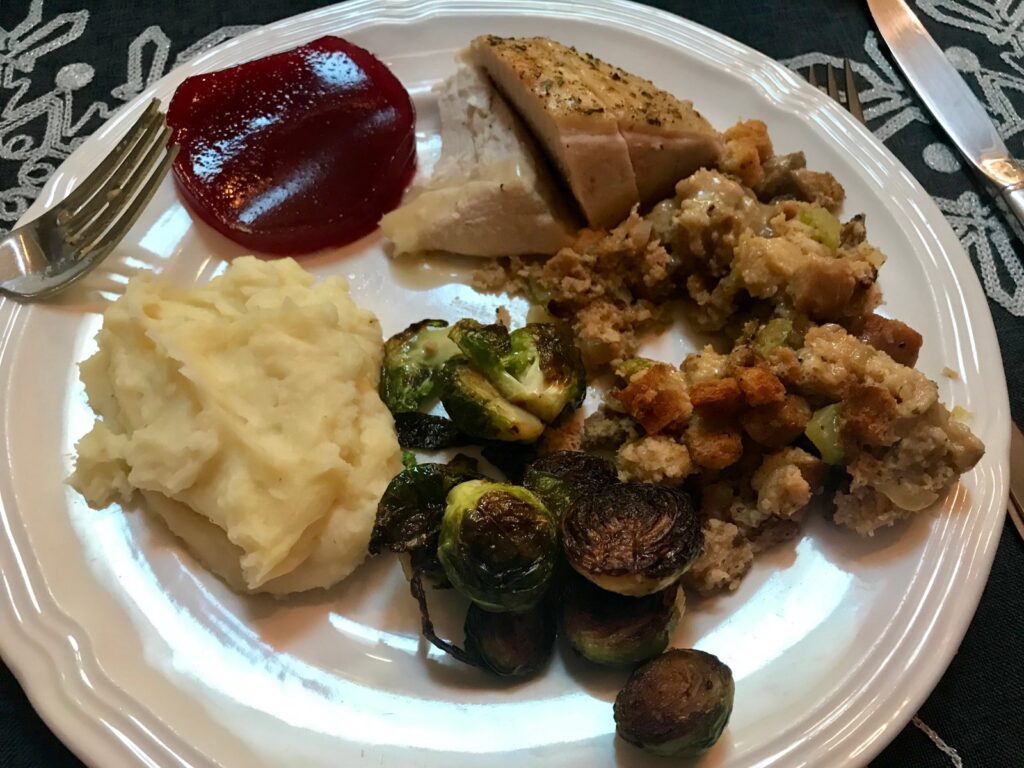
Our Thanksgiving menu included Roasted Turkey, Holiday Mashed Potatoes, Brussel’s Sprouts, Dressing, and of course canned cranberry sauce. For dessert, everyone enjoyed Gluten Free Praline Pumpkin Pie.


Holiday Dressing

  • 14 slices of gluten free bread
  • 1/2 c (1 stick) melted butter
  • 2 t poultry seasing
  • 2 t dried parsley
  • 1 t garlic powder
  • 2 stalks celery
  • 1 medium onion
  • 2 cloves of garlic
  • 1/2 pound breakfast sausage
  • 2-3 cups of turkey or chicken broth
  • 2 eggs

Preheat the oven to 250º. Using a serrated knife, cut the bread into 1/4 inch cubes. Melt the butter and add the poultry seasoning, parsley, and garlic powder. Stir the seasoned butter into the bread cubes and make sure they are well coated. Spread onto 2 cookie sheets and bake for an hour, stirring every 10-15 minutes until the cubes are dry but not browned.

Dice the celery, onion and garlic. Sauté the sausage in a pan and add the vegetables. Cook until soft.

Mix the sausage mixture into the bread crumbs. Add the broth and taste to adjust seasonings. Add salt if needed. Stir in the eggs and add more broth if the mixture seems too dry. Pour into a greased casserole dish and bake at 350º for an hour.

Recipe of the Week – Gluten Free Praline Pumpkin Pie

Welcome to the new and improved Cruisin’ with the Colemans website. Here’s a huge shout out to our web designer Elizabeth Kimmel for a fantastic job! Make sure that you click around and explore everything that we have to offer and stay tuned for new features that will be coming soon, including an Etsy store selling prints of some of our favorite travel photos.

As promised before our hiatus, here is my recipe for Gluten Free Praline Pumpkin Pie! When Michelle had to go gluten-free six years ago due to a diagnosis of lifelong heath issues we were concerned many favorite special treats would have to disappear from her diet. Surely we both had to make major adjustments to our cooking, but over the years we have found and developed our own recipes to include most of our favorite menu items into a gluten-free diet. Pie crust is one of those items. I have found two different pie crusts that work well with non-wheat based flour, a pat-in-the-pan crust that involves no rolling and the one that I have here. I have used them both for sweet and savory pies with great success, but this roll out dough is my favorite because it turns out both crispy and flaky. At Thanksgiving dinner this year with some of our neighbors, the ladies asked how I got the crust so flaky and were shocked to discover it was wheat free! With more than a hundred years of pie making experience at the table, I took it as a great compliment!

Let’s start with the crust. Cut a stick of butter into eight slices and put in the freezer while you gather the rest of the ingredients. You’ll need all purpose gluten free flour (such as Pamela’s Artisan Blend), salt, white and dark brown sugar, pecans, more butter, pumpkin puree, evaporated milk, an egg, and almost every spice in your rack. Finally get a measuring cup of water and add several ice cubes.

Preheat the oven to 450º. In the bowl of a food processor (I love my Ninja) place one and a quarter cups of all purpose gluten free flour blend, a teaspoon of salt, and two tablespoons of sugar (we always use Whey Low sugar substitute) and give it a quick pulse to mix the ingredients. Add the butter directly from the freezer and pulse eight to ten more times to combine into a crumbly texture with pea-sized pieces of butter remaining.

Add four tablespoons of ice cold water to the processor and mix together. The dough should mostly clump together and but still appear dry. If the humidity is dry, you may need one to two more tablespoons of water. Be careful not to end up with a sticky mess or you will not be able to roll it out.

Pour the mixture onto a large piece of parchment paper and press together into a mound. Using as little additional flour as possible and a rolling pin, roll into a thin round circle about an inch bigger than the top of your pie pan.

Don’t worry if the edges crack like mine, you’ll be able to press them back together once you line the pan. If the dough is a little too wet, a second piece of parchment on top may be helpful. Carefully transfer the dough to a 9-inch pie pan. If things totally fall apart here, don’t panic. I’ve always found that the worse the crust looks, the easier time you will have convincing everyone that it’s totally home-made. Break off any pieces that are overhanging the edge of the pan and use them to fill in any gaps or cracks that you have. Tuck the edges down and crimp around the pan to create as decorative and edge as you wish.

In a small bowl soften two tablespoons of butter and add a third of a cup of brown sugar (such as Whey Low Gold) and about half a cup of chopped pecan pieces.

Mix together with your fingers to create a chunky paste and crumble it into the bottom of the pie pan. Bake for ten minutes until the sugar is bubbly and the crust is set.

You do not want the crust to brown at this point. If the crust gets air bubbles, prick it with a fork. If it begins to slide down into the pan, press it back up with the back of a fork. Once the crust is prebaked, set it aside while you make the filling. Lower the oven to 400º.

Melt one tablespoon of butter in a saute pan and add a 15-oz can of pumpkin puree. This will not only give a toasty flavor to the pie but remove excess liquid from the pumpkin. Let it cook for about ten minutes, stirring occasionally.

Meanwhile, in a large bowl combine a quarter cup of sugar (or Whey Low sugar substitute) a quarter cup of brown sugar (again, Whey Low Gold), two teaspoons of gluten-free all purpose flour blend, one teaspoon of cinnamon, half a teaspoon of ginger, a quarter teaspoon each of salt, nutmeg, and clove, and a dash of allspice. Mix together well to ensure that all of the spices are well combined.

Add one egg and the entire can of evaporated milk and mix thoroughly then stir in the pumpkin. The mixture will be very wet.

Unfortunately this is were things begin to fall apart for me. Because I was cooking several other items at the same time (it was Thanksgiving dinner after all, I forgot to continue taking pictures so you will just have to use your imagination!

Pour the filling into the pie crust. There may be more than you can use, if so, pour the extra into lined muffin cups. Bake the pie for one hour and check that it is set. If the crust is beginning to brown too much, cover the edges with foil to prevent burning. The pie is done when the center is set and no longer jiggles. Don’t worry if the filling cracks in places, you’re going to cover that up with whipped cream anyway, right?

By the way, the secret to the flaky crust? It’s the praline! The caramel layer in the bottom of the crust keeps the pie filling from getting the crust soggy. We hope you enjoy our favorite pumpkin pie, leave a comment below to tell us about your favorite Thankgiving dessert.


Gluten Free Praline Pumpkin Pie

For the crust

  • 1/2 cup butter (1 stick)
  • 1 1/4 cup all ourpose gluten free flour blend
  • 1 t salt
  • 2 T sugar (may omit if making a savory pie)
  • 4 T (or more) ice cold water

For the praline

  • 2 T butter, softened
  • 1/3 c brown sugar
  • 1/2 c chopped pecan pieces

For the filling

  • 1 T butter
  • 1 15-oz can pumpkin puree
  • 1/4 sugar
  • 1/4 brown sugar
  • 2 t gluten free flour blend
  • 1 t cinnamon
  • 1/2 t ginger
  • 1/4 t salt
  • 1/4 t nutmeg
  • 1/4 t clove
  • dash allspice
  • 1 egg
  • 1 12-oz can evaporated milk

Begin by cutting the butter into 1 T size pieces and and freeze while you gather the remaining ingredients. Pre-heat the oven to 450º.

Combine flour, salt, and sugar in a food processor bowl. Pulse to mix. Add butter and pulse 8-10 times until the butter is mixed but some pea sized pieces remain. Add 4 T ice cold water and pulse again until the dough begins to hold together. You may need to add additional water but be careful that it doesn’t gett too sticky.

Turn the dough out onto a large piece of parchment paper and press together into a flat disk. Useing as little extra flour as possible, roll out the dough with a rolling pin into a circle about 1 inch parger than your pie pan.

Carefully, transfer the crust to a 9-inch pie pan. Press cracks together and pinch the edges to make a decorative crust. Prick the sides of the crust with a fork to keep it from bubbling up. Put the dough in the refridgerator until you are ready to add the praline and bake.

To make the praline, soften the butter and add the brown sugar and pecans. Mix together with your fingers and crumble into the bottom of the pie crust. Bake at 450º for about 10 minutes. Do not the the sides brown and use the back of a fork to press them back up if they start to slouch. When the praline is bubbly, it’s done. Lower the oven to 400º to bake the pie.

Melt another tablespoon of butter in a sauté pan and add the pumpkin. Stir together and simmer over medium heat for 10 minutes.

In a large bowl, combine sugar, flour, and spices and mix thoroughly. Add the egg and evaporated milk and whisk until smooth. Stir in the pumpkin. The mixture will be runny. Pour into the pie crust. If there is extra, pour it into lined muffin tins. Bake the pie for approximately 1 hour until the center is set. If the crust begins to get too brown, cover the edges with foil.

Recipe of the Week – Potato Fennel Hash

While we were in Michigan this summer we took a fishing charter on Lake Superior and came home with a mess of fish. You’ll hear about our fishing adventure on Wednesday’s post but today you will see the fruits of our labor. We love to serve fish with Potato Fennel Hash but it actually goes well with any meat.
Fennel, also sometimes called Anise (ah-nees), is a bulb vegetable similar to celery but with a mild licorice flavor. The fronds have a stronger flavor can be dried or used fresh anywhere you would use dill. The stalks can be diced and added to salad for a spicy crunch. The bulb adds a nice flavor to potatoes and bulks the dish up with half the calories and carbs.
Begin by heating the oven to 450º. Place a heavy pan in the oven with a little oil to preheat with the oven. Trim the stalks and fronds and save for another use. Slice the bulb in half and remove the core. Slice the bulb finely to match size of the shredded potatoes. The slicing side of a box grater works well.

Slice a sweet onion into thin slices also.

Add about a pound of grated potatoes and mix all together so that they are well combined. The onions and fennel should be roughly the same texture as the potatoes. We often use bagged grated potatoes for convenience.

Heat a large skillet over medium high heat and add about one tablespoon of canola oil. Add about half of the potato mixture to the pan and sprinkle with salt and pepper. Don’t overcrowd the pan, you want the moisture to evaporate away while the potatoes get brown and crunchy.

After a couple of minutes, stir the mixture to allow the potatoes to cook evenly.

Once they are mostly cooked through, put the mixture into the pan from the oven. The hash should sizzle when it hits the pan. Place the pan back in the oven and repeat the process with the rest of the potato mixture.

Once all of the potatoes are in the oven, allow to brown and continue cooking while you prepare the meat, stirring occasionally.

I pan-fried our fish this night. It’s lake trout in a buttermilk cornmeal breading with cajun seasoning. The tartar sauce is homemade too! What do you love to serve with your fish fry? Post ideas in the comments below!

Potato Fennel Hash

  • 1 large fennel bulb, trimmed, cored, and thinly sliced
  • 1 large sweet onion, thinly sliced
  • 2 medium-sized russet potatoes, grated, with or without the peels
  • 2 1/2 T canola oil, divided
  • salt and pepper to taste

Pre-heat the oven to 450º with a heavy pan with 1/2 T oil in the oven.
Thinly slice the fennel and onion and mix with the grated potatoes. All three ingredients should be roughly the same sized shred.
Heat a heavy skillet over medium high heat. Add 1 T of oil and once hot, add half of potato mixture. Sprinkle with salt and pepper. Cook, stirring occasionally until most of the moisture has evaporated and the fennel and onion are cooked through.
Transfer the hash to the hot pan in the oven and repeat the process with the remaining potato mixture.
Allow the hash to brown in the oven, stirring occasionally, while you prepare the rest of dinner.

★ 25 years guiding ★ 48 U.S. states ★ 10 countries ★ 3,000+ Camino miles